place

Uzkoye

Buildings and structures in MoscowCultural heritage monuments of regional significance in MoscowGeography of Moscow
Казанская церковь в Узком

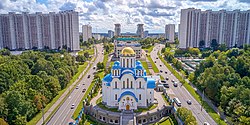
Uzkoe (Russian: Узкое) is a historic estate in the southwestern part of Moscow. Before 1629, the area belonged to Prince Gagarin, then it passed to Maksim Streshnev, a cousin of Tsarina Eudoxia Streshneva. Upon the death of Maksim's grandson in 1692, the ownership passed sideways to a cousin, Tikhon Streshnev. It was he who commissioned a singular five-domed church to be built there in 1698-1704. Its four-petaled plan was of Ukrainian Baroque inspiration; but all five towers are equal in height and crowned by typical Russian onion domes. This five-towered church, dedicated to the Theotokos of Kazan, is quite extraordinary in Russian architecture. Its design is attributed to Osip Startsev, who was responsible for some of the major Baroque cathedrals of Kyiv but also worked in Moscow. Tikhon's granddaughter Sophie was the last of her race; she married Prince Galitzine, whose son Alexis built a Baroque residence flanked by two wings. Alexis also built a regular park on the grounds and laid out a series of ponds. His daughter Marie was wife of Count Pyotr Aleksandrovich Tolstoy, who received Uzkoe as a dowry and had a larch alley planted there. In the mid-19th century the estate passed through marriage to the Troubetzkoys who had the old country house swept away and replaced with a Neoclassical mansion, which borrowed many details from its predecessor. It was there that the Russian philosopher Vladimir Solovyov died in 1900. After the Russian Revolution of 1917, the Troubetzkoys were expelled from Uzkoe and their estate was given over to the Soviet Academy of Sciences, which has used it as a rest home for its members. Ski treks of Uzkoe were popular with Lev Landau, while Andrei Kolmogorov liked swimming in the local ponds. The church had been stripped of its 17th-century icon screen (its whereabouts are still unknown) and until 1995 it housed libraries which were looted in Nazi Germany by the Red Army. In 1995 it reverted to the Russian Orthodox Church.

Excerpt from the Wikipedia article Uzkoye (License: CC BY-SA 3.0, Authors, Images).

Uzkoye
Тютчевская аллея, Moscow Yasenevo District

Geographical coordinates (GPS) Address Nearby Places
placeShow on map

Wikipedia: UzkoyeContinue reading on Wikipedia

Geographical coordinates (GPS)

Latitude Longitude
N 55.623333333333 ° E 37.539 °
placeShow on map

Address

Тютчевская аллея

Тютчевская аллея
117321 Moscow, Yasenevo District
Moscow, Russia
mapOpen on Google Maps

Казанская церковь в Узком
Share experience

Nearby Places

Bulldozer Exhibition

The Bulldozer Exhibition (Russian: Бульдозерная выставка) was an unofficial art exhibition on a vacant lot in the Belyayevo urban forest (Bitsa Park) by Moscow and Leningrad avant-garde artists on 15 September 1974. The exhibition was forcefully broken-up by a large police force that included bulldozers and water cannons, hence the name. Since the 1930s in the Soviet Union Socialist realism had been the only art style largely supported by the state. All other forms of art were forced underground and sometimes prosecuted. One of the attempts to break out of the underground to more public view was the Belyayevo exhibition. It was organised by three underground artists, Oscar Rabin (artist), Youri Jarkikh (Jarki) and Alexander Gleser. Among the artists taking part in the exhibition were Evgeny Rukhin, Valentin Vorobyov (b. 1938), Vladimir Nemukhin, Lidiya Masterkova, Borukh Steinberg, Nadegda Elskaja, Alexander Rabin, Vasilij Sitnikov, Vera Sell-Ryazanoff, Vitaly Komar, Alexander Melamid, and Igor Sinyavin. It was held on a vacant lot, officially part of an urban forest in Belyayevo. Attendance consisted of approximately twenty artists and a group of spectators that included relatives, friends of the artists, friends of the friends and some Western journalists. The paintings were installed on makeshift stands made out of dump wood. The organizer Oscar Rabin told in an interview in London in 2010: "The exhibition was prepared as a political act against the oppressive regime, rather than an artistic event. I knew that we'd be in trouble, that we could be arrested, beaten. There could be public trials. The last two days before the event were very scary, we were anxious about our fate. Knowing that virtually anything can happen to you is frightening." Rabin was arrested and punished with expulsion from Russia, but was allowed to leave with his family to Paris.Despite the minor size of the event it was considered by the authorities as very serious. They marshalled a large group of attackers that included three bulldozers, water cannons, dump trucks and hundreds of off-duty policemen. Officially, the group was supposed to be "gardeners" expanding the urban forest, who reacted in spontaneous outrage to the offense against their proletarian sensibilities. It was never denied, though, that they got their orders from the KGB. The attackers destroyed the paintings, beat and arrested the artists, spectators and journalists. One of the most dramatic scenes was Oscar Rabin who went through the exhibition hanging to the blade of the bulldozer. One of the attackers, militsia lieutenant Avdeenko, memorably shouted at the artists: "You should be shot! Only you are not worth the ammunition ..." ("Стрелять вас надо! Только патронов жалко..."). Rabin later recounted the horror of seeing art crushed and artists arrested: "It was very frightening … The bulldozer was a symbol of an authoritarian regime just like the Soviet tanks in Prague." Two of his own paintings – a landscape and a still life – were among those flattened by bulldozers or burned by the invading KGB.After the event was widely publicized in the Western media, embarrassed authorities were forced to allow a similar open air exhibition in the Izmailovo urban forest two weeks later on 29 September 1974. The new exhibition of works of 40 artists was held for four hours and was visited by thousands of people (the numbers cited differ from one and a half thousand [1] to twenty-five thousand [2]). A participant in the exhibitions, Boris Zhutkov, has said that the quality of the Izmaylovo paintings was much lower than the paintings in Belyayevo, since in the original exhibition the artists showed the best paintings they had only to have most of them destroyed. The four hours in the forest of the Izmailovo exhibition has often been remembered as "The Half-day of Freedom." The Izmailovo exhibition in turn gave way to other exhibitions of nonconformist art which were very important in the history of modern Russian art.