place

Novoyasenevskaya (Moscow Metro)

Kaluzhsko-Rizhskaya LineMoscow Metro stationsRailway stations in Russia opened in 1990Railway stations located underground in Russia
Bitsevsky mm
Bitsevsky mm

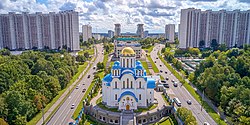
Novoyasenevskaya (Russian: Новоя́сеневская), formerly Bittsevsky Park (Russian: Би́тцевский парк) is a Moscow Metro station in the Yasenevo District, South-Western Administrative Okrug, Moscow. It is on the Kaluzhsko-Rizhskaya Line, serving as its southern terminus.

Excerpt from the Wikipedia article Novoyasenevskaya (Moscow Metro) (License: CC BY-SA 3.0, Authors, Images).

Novoyasenevskaya (Moscow Metro)
Новоясеневский проспект, Moscow Yasenevo District

Geographical coordinates (GPS) Address Nearby Places
placeShow on map

Wikipedia: Novoyasenevskaya (Moscow Metro)Continue reading on Wikipedia

Geographical coordinates (GPS)

Latitude Longitude
N 55.601 ° E 37.5541 °
placeShow on map

Address

Новоясеневский проспект

Новоясеневский проспект
117593 Moscow, Yasenevo District
Moscow, Russia
mapOpen on Google Maps

Bitsevsky mm
Bitsevsky mm
Share experience

Nearby Places

Uzkoye
Uzkoye

Uzkoe (Russian: Узкое) is a historic estate in the southwestern part of Moscow. Before 1629, the area belonged to Prince Gagarin, then it passed to Maksim Streshnev, a cousin of Tsarina Eudoxia Streshneva. Upon the death of Maksim's grandson in 1692, the ownership passed sideways to a cousin, Tikhon Streshnev. It was he who commissioned a singular five-domed church to be built there in 1698-1704. Its four-petaled plan was of Ukrainian Baroque inspiration; but all five towers are equal in height and crowned by typical Russian onion domes. This five-towered church, dedicated to the Theotokos of Kazan, is quite extraordinary in Russian architecture. Its design is attributed to Osip Startsev, who was responsible for some of the major Baroque cathedrals of Kyiv but also worked in Moscow. Tikhon's granddaughter Sophie was the last of her race; she married Prince Galitzine, whose son Alexis built a Baroque residence flanked by two wings. Alexis also built a regular park on the grounds and laid out a series of ponds. His daughter Marie was wife of Count Pyotr Aleksandrovich Tolstoy, who received Uzkoe as a dowry and had a larch alley planted there. In the mid-19th century the estate passed through marriage to the Troubetzkoys who had the old country house swept away and replaced with a Neoclassical mansion, which borrowed many details from its predecessor. It was there that the Russian philosopher Vladimir Solovyov died in 1900. After the Russian Revolution of 1917, the Troubetzkoys were expelled from Uzkoe and their estate was given over to the Soviet Academy of Sciences, which has used it as a rest home for its members. Ski treks of Uzkoe were popular with Lev Landau, while Andrei Kolmogorov liked swimming in the local ponds. The church had been stripped of its 17th-century icon screen (its whereabouts are still unknown) and until 1995 it housed libraries which were looted in Nazi Germany by the Red Army. In 1995 it reverted to the Russian Orthodox Church.

Foreign Intelligence Service (Russia)

The Foreign Intelligence Service of the Russian Federation (Russian: Служба внешней разведки Российской Федерации, tr. Sluzhba vneshney razvedki Rossiyskoy Federatsii, IPA: [ˈsluʐbə ˈvnʲɛʂnʲɪj rɐˈzvʲɛtkʲɪ]) or SVR RF (Russian: СВР РФ) is Russia's external intelligence agency, focusing mainly on civilian affairs. The SVR RF succeeded the First Chief Directorate (PGU) of the KGB in December 1991. The SVR has its headquarters in the Yasenevo District of Moscow. Unlike the Russian Federal Security Service (FSB), the SVR is tasked with intelligence and espionage activities outside the Russian Federation. It works together with the Russian Main Intelligence Directorate (Russian: Главное разведывательное управление, tr. Glavnoye razvedyvatel'noye upravleniye, IPA: [ˈglavnəjə rɐzˈvʲɛdɨvətʲɪlʲnəjə ʊprɐˈvlʲenʲɪjə], GRU), its military-joint affairs espionage counterpart, which reportedly deployed six times as many spies in foreign countries as the SVR in 1997. The SVR is also authorized to negotiate anti-terrorist cooperation and intelligence-sharing arrangements with foreign intelligence agencies, and provides analysis and dissemination of intelligence to the Russian president.Any information pertaining to specific identities of staff employees (officers) of the SVR is legally classified as a state secret; since September 2018, the same applies to non-staff personnel, i.e. informers and recruited agents.