place

Yehuda Halevi Synagogue

1942 architecture1942 establishments in MexicoBuildings and structures completed in 1942Jews and Judaism in Mexico CityMexican building and structure stubs
Religious buildings and structures in Mexico CitySephardi Jewish culture in MexicoSephardi synagoguesSynagogues in Mexico

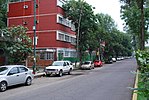
Yehuda HaLevi Synagogue (Spanish: Sinagoga Rabí Yehuda Halevi) is a Jewish synagogue located in the Colonia Roma neighborhood of Mexico City. Built between 1941 and 1942, the synagogue was named after Yehudah Halevi, Jewish philosopher, physician and poet from medieval Spain.

Excerpt from the Wikipedia article Yehuda Halevi Synagogue (License: CC BY-SA 3.0, Authors).

Yehuda Halevi Synagogue
Avenida Monterrey, Mexico City Cuauhtémoc

Geographical coordinates (GPS) Address Nearby Places
placeShow on map

Wikipedia: Yehuda Halevi SynagogueContinue reading on Wikipedia

Geographical coordinates (GPS)

Latitude Longitude
N 19.404722222222 ° E -99.161111111111 °
placeShow on map

Address

Avenida Monterrey
06760 Mexico City, Cuauhtémoc
Mexico
mapOpen on Google Maps

Share experience

Nearby Places

Instituto Nacional de Antropología e Historia

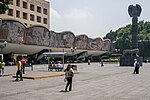
The Instituto Nacional de Antropología e Historia (INAH, National Institute of Anthropology and History) is a Mexican federal government bureau established in 1939 to guarantee the research, preservation, protection, and promotion of the prehistoric, archaeological, anthropological, historical, and paleontological heritage of Mexico. Its creation has played a key role in preserving the Mexican cultural heritage. Its current national headquarters are housed in the Palace of the Marqués del Apartado. INAH and the Instituto Nacional de Bellas Artes y Literatura are tasked with cataloging and protecting monuments and buildings regarded as cultural patrimony. INAH is entrusted with 'archaeological' (pre-Hispanic and paleontological) and 'historical' (post-Conquest 16th to 19th centuries) structures, zones and remnants, while INBAL is entrusted with 'artistic' buildings and monuments (properties that are of significant aesthetic value as deemed by a commission). Worthy edifices are catalogued in the Registro Público de Monumentos y Zonas Arqueológicos e Históricos (Public Register of Archeological and Historic Monuments and Zones).Currently, the INAH carries out its work through a Technical Secretariat which supervises the performance of its main duties and whose tasks are distributed among its seven National Coordination Offices and 31 Regional Centers throughout the states of the Mexico. This bureau is responsible for the over 110,000 historical monuments, built between the 16th and 19th centuries, and for 29,000 of Mexico's estimated 200,000 pre-Columbian archeological zones found throughout the country. One hundred and fifty of the archeological sites are open to the public. The INAH also supervises over a hundred museums. These are found across the country and are categorized according to the extension and quality of their collections, geographical locations, and number of visitors. Over 500 Teotihuacan murals are in storage at the INAH.