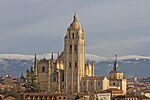
The Alcázar of Segovia is a medieval castle located in the city of Segovia, in Castile and León, Spain. It has existed since at least the 12th century, and is one of the most renowned medieval castles globally and one of the most visited landmarks in Spain. It has been the backdrop for significant historical events and has been home to twenty-two kings, along with notable historical figures.
The fortress stands on a rocky crag at the western end of Segovia's Old City, which was declared a UNESCO World Heritage Site in 1985, above the confluence of the rivers Eresma and Clamores. Today, it is used as a museum and a military archives building since its declaration as a National Archive by a Royal Decree in 1998. It has also worked at times as a state prison, a Royal Artillery College, and a military academy.
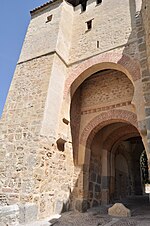
The Alcázar served both as a royal palace and a fortress for the Castilian monarchs, and its architecture reflects the grandeur and is a notable example of "power architecture": the impenetrable walls, the deep moat, its impressive towers like the Homage or John II's, and the strategic location symbolise power and authority. Furthermore, the luxury and opulence of its interior, with lavishly decorated rooms and coffered ceilings, were designed to awe and subdue visitors, reinforcing the authority of the kings of Castile. Similarly, the legends and rumours surrounding the Alcázar of Segovia have played a significant role in its history.
Despite its stern and fortified appearance, the Alcázar of Segovia has also been a place of daily life. Many princes, nobles, and infants have grown up within its halls, and their presence has helped soften the palace's appearance, making the castle a home for many.
Its history begins in the 12th or early 13th century when the royal family of Castile had quarters in the Alcázar, known as the "major palace". In the Homage tower, the treasure of the Crown of Castile was stored, from which funds were secured to finance Christopher Columbus's first voyage. In 1437, the books of the royal administration were moved to the Alcázar, establishing one of the first royal archives of Castile and laying one of the foundations for the current General Archive of Simancas. Additionally, the Alcázar housed the royal armory, which served as the basis for the one now exhibited in the Royal Armoury of Madrid.
The Alcázar has been the stage for crucial events in Spain's history, such as meetings of the Cortes of Castile, held there on multiple occasions; the signing of the Concord of Segovia, which laid the groundwork for the formation of the Spanish nation, took place there; Isabel the Catholic, one of the most significant and influential women in history, left the Alcázar to proclaim herself queen of Castile. It was also the site of the last meeting between Christopher Columbus and King Ferdinand the Catholic before the explorer's death. The marriage of Philip II to Anna of Austria strengthened the alliance between the House of Habsburg and the Hispanic Monarchy. As the headquarters of the royal college of artillery, in the 18th century, the first military flight for military purposes was carried out, marking the beginning of military aviation, and the chemist Joseph Proust, a professor at the Royal College, formulated the Law of Definite Proportions, a fundamental advance in modern chemistry.
The Alcázar of Segovia has made its mark on cinema and popular culture. It was used by Orson Welles in the film "Chimes at Midnight" and served as inspiration for Cinderella Castle in the Walt Disney movie.

 Continue reading on Wikipedia