place

Clock Tower (Central University of Venezuela)

1954 establishments in VenezuelaBuildings and structures completed in 1954Buildings and structures in CaracasCiudad Universitaria de CaracasClock towers
Historic sites in Venezuela
Torre del reloj de tres apoyos en la Plaza del Rectorado, Ciudad Universitaria de Caracas (cropped)

The UCV Clock Tower, also known by its Spanish name Torre del Reloj de la UCV, or Reloj de la UCV, is a monument made of prestressed concrete. It is by the Rectory Plaza of the Central University of Venezuela in the University City of Caracas, and was built between 1953 and 1954.The tower was proposed by architect Carlos Raúl Villanueva as a joint piece built by the engineer Juan Otaola Paván, with both contributing to the design. Its twisted columns were designed with new structural engineering principles.

Excerpt from the Wikipedia article Clock Tower (Central University of Venezuela) (License: CC BY-SA 3.0, Authors, Images).

Clock Tower (Central University of Venezuela)
Avenida Cabriales, Caracas Bello Monte

Geographical coordinates (GPS) Address Website Nearby Places
placeShow on map

Wikipedia: Clock Tower (Central University of Venezuela)Continue reading on Wikipedia

Geographical coordinates (GPS)

Latitude Longitude
N 10.4925 ° E -66.890361111111 °
placeShow on map

Address

Universidad Central de Venezuela (Ciudad Universitaria de Caracas)

Avenida Cabriales
1080 Caracas, Bello Monte
Capital District, Venezuela
mapOpen on Google Maps

Website
ucv.ve

linkVisit website

Torre del reloj de tres apoyos en la Plaza del Rectorado, Ciudad Universitaria de Caracas (cropped)
Share experience

Nearby Places

Aula Magna (Central University of Venezuela)

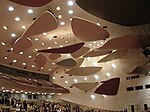
The Aula Magna is an auditorium at the Central University of Venezuela. It is located within the University City of Caracas, next to the University's main library building. The hall was designed by the Venezuelan architect Carlos Raúl Villanueva in the 1940s and built by the Danish company Christiani & Nielsen from 1952–53. It was declared a UNESCO World Heritage Site in November 2000 for being artistically and architecturally significant. The most notable feature of the hall is its acoustic 'clouds', which serve both aesthetic and practical functions. They are an element of the hall's design which contributed to the science of interior space acoustics, though the building exterior is also architecturally significant. The Aula Magna has been named the "most important auditorium" at the university. This is in part because of practicality: it is the largest capacity auditorium, being able to hold approximately 2,700 people with removable seats. However, it is also significant because of the academic, artistic, and political events which have taken place within it. Some of these events have been of great importance for the country and some have been part of historical movements. In present-day Caracas, the hall has been a site of political controversy, as well as suffering from a lack of maintenance funds. The current director of the hall is Trina Medina, with the assistant director Rosario Silva Prieto.

University City of Caracas

The University City of Caracas (Spanish: Ciudad Universitaria de Caracas), also known by the acronym CUC, is the main campus of the Central University of Venezuela (UCV), located in central Caracas, the capital of Venezuela. It was designed by the Venezuelan architect Carlos Raúl Villanueva and was declared a World Heritage Site by UNESCO in 2000. The Ciudad Universitaria de Caracas is considered a "masterpiece" of architecture and urban planning, and greatly influenced Venezuelan architecture.Villanueva oversaw design from the end of the Second World War, and oversaw the campus construction for 20 years. He gave his skills and also vision of design principles to it, and it remains the only university campus designed by a single architect in the 20th century that has received cultural heritage recognition by UNESCO. The campus comprises a variety of different environments; its northern half is a Botanical Garden, with extensive sports facilities at its east, west and south. There are many different areas of the campus separated by Faculty and School, including Sciences, Architecture, Humanities, and Medicine. These converge in the center of the campus at the Tierra de nadie — green space and woodland pertaining to no discipline — and the Plaza Cubierta complex of shared buildings and the titular museum of permanent modern art features. Though elements of the campus face both natural and deliberate deterioration, it remains a landmark of Venezuela, and maintains its excellence in design and planning. It has been included on the 2010 and 2014 lists of the World Monuments Fund for special preservation efforts.