place

Radiocentro CMQ Building

1949 architecture20th-century architecture in CubaArchitecture in HavanaBuildings and structures completed in 1949Buildings and structures in Havana
CineramaCommercial buildings completed in 1949Office buildings completed in 1949
Radiocentro CMQ Building. Havana, Cuba

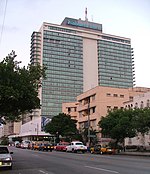
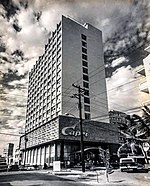
The Radiocentro CMQ Building complex is a former radio and television production facility and office building at the intersection of Calle L and La Rampa in El Vedado, Cuba. It was modeled after Raymond Hood's 1933 Rockefeller Center in New York City. With 1,650 seats, the theater first opened on December 23, 1947, under the name Teatro Warner Radiocentro, it was owned by brothers Goar and Abel Mestre. Today the building serves as the headquarters of the Cuban Institute of Radio and Television (ICRT).

Excerpt from the Wikipedia article Radiocentro CMQ Building (License: CC BY-SA 3.0, Authors, Images).

Radiocentro CMQ Building
Calle L,

Geographical coordinates (GPS) Address Phone number Website Nearby Places
placeShow on map

Wikipedia: Radiocentro CMQ BuildingContinue reading on Wikipedia

Geographical coordinates (GPS)

Latitude Longitude
N 23.14 ° E -82.383333333333 °
placeShow on map

Address

Cine Yara

Calle L 363
10308 (Rampa)
Havana, Cuba
mapOpen on Google Maps

Phone number

call+5378329430

Website
conocecuba.com

linkVisit website

Radiocentro CMQ Building. Havana, Cuba
Share experience

Nearby Places

Edificio del Seguro Médico, Havana

The Edificio del Seguro Médico is a commercial building in El Vedado, Havana. [1] Built between 1955 and 1958, it was designed as a mixed use building for apartments and offices for the headquarters of the National Medical Insurance Company by Antonio Quintana Simonetti. In regards to Edificio del Seguro Médico an architect from the Universidad de Oriente, Santiago de Cuba, Carlos Alberto Odio Soto made the following observation: "Within the modern heritage architecture of the 50s, there is the Medical Insurance Building, work designed by the architect Antonio Quintana in 1955. This work was praised even before its inauguration by the prestigious Professor Pedro Martínez Inclán on the occasion of the delivery of the First Prize to the Project where he proposed that Quintana, when he managed to carry out his project, could blazon of having endowed Havana, according to the famous sentence of Paul Valery, "of a building that speaks." At the national level, Quintana received the recognition of the main specialized publications that circulated in the country at that time: Architecture, Space, Cuba Album, etc .; at the same time is diffused internationally through the book Latin American Architecture since 1945, published by the Museum of Modern Art in New York, and the Exhibition of Modern Cuban Architecture held in the city itself by the Architectural League of New York. Almost at the end of the 50s, he receives two distinctions: in 1959 the Gold Medal Award of the National College of Architects and the condition of best commercial work of this period." Today the building houses the Cuban Ministry of Public Health and the Prensa Latina Agency. The only complete package of information about the building is the slides that were presented for the architectural contest, collected in the magazine 'Arquitectura', nº 269, of 1955 published by the College of Architects of Havana.

Battle of the Hotel Nacional of Cuba

The Battle of the Hotel Nacional de Cuba took place from October 2–3, 1933. After the Sergeants' Revolt on September 4, 1933 and the proclamation of sergeant Fulgencio Batista as the new Army Chief of Staff, replacing Julio Sanguily Echarte, the higher ranking army officials (such as captains, colonels, and generals) refused to recognize this proclamation. Suffering from a hemorrhaging ulcer in his stomach at the time, Sanguily would rest at the Hotel Nacional de Cuba. In addition to Sanguily, the United States ambassador, Sumner Welles was also staying at the Hotel Nacional de Cuba. Given the importance of Sanguily, who in the eyes of the higher ranking army officials, was the legitimate Army Chief of Staff and on the other hand the fact that the U.S. ambassador himself was staying at Hotel Nacional, it followed that the Hotel Nacional was the perfect place for the army officials to regroup and put Ramon Grau's government in a deadlock. On September 8, 1933, United States Ambassador to Cuba at the time, Sumner Welles telegraphed the following to the United States Secretary of State, The Hotel Nacional in Habana, where many of the American colony are living at the present moment and to which I myself have moved since the lease on my house expired, has been decided upon today by the Cuban Army officers as headquarters. Approximately 500 officers fully armed are in the hotel. Some of them have received information that their houses have been sacked by the soldiers this morning and many of them are in fear of their lives. They refuse to leave the hotels since they state that it is the only place open to them in Habana, which can be readily defended. The battle of the Hotel Nacional de Cuba finally began on October 2. It is said by most scholars that the fighting began on the side of the soldiers surrounding the Hotel Nacional. The army officials had approximately 400 men, whereas the soldiers were 2,000 strong. Despite these differences in number, the officials had some key advantages, namely the positioning of the Hotel Nacional relative to the soldiers surrounding the Hotel. It was quite clear that the numerous windows of the Hotel provided the army officials better positioning than the soldiers who would be clearly visible from any of the Hotel's windows. Secondly, many among the officials were expert shooters; many had fought during the Cuban War of Independence of the late 19th century. These advantages were reflected in the battle, that after 11 hours of fighting conservative casualties place the number of soldiers dead at least 30, whereas only 2 army officials were killed in the brawl. The next day two units of the Navy bombarded the Hotel Nacional de Cuba. With low munitions and the impossibility of resistance, the army officials capitulated. After the surrender, probably due to high casualties suffered by the soldiers, approximately a dozen of the high-ranking officials were murdered in cold-blood by the soldiers.

Napoleon Museum (Havana)

The Napoleon Museum in Havana, Cuba houses one of the most important collections from the 18th and 19th centuries preserved in the Western hemisphere. The museum is on San Miguel Street, between Ronda and Mazón, on one side of the University of Havana. The museum was founded in 1961, with the collection of Julio Lobo, occupying a 1929 Florentine Renaissance style mansion "La Dolce Dimora", the home of an Italian-Cuban politician, Orestes Ferrara. The architects were Evelio Govantes and Félix Cabarrocas, whose also designed El Capitolio and the Casa de la Amistad on Paseo. The museum reopened in March 2011 after a three-year restoration by the City Historian’s Office. Napoleon Princess Alix de Foresta, widow of Luis Marie Bonaparte, a descendant of Bonaparte’s younger brother Jérôme Bonaparte, was especially invited to the island for the reopening.The museum displays almost 8,000 items, most of them related to the period from the French Revolution through the Second Empire. The collection includes a specialized library, suits, weapons, military equipment, furniture, coins, historic and decorative objects. Artwork is displayed from Louis Tocqué, Jean-Marc Nattier, Nicolas de Largillière, Jean Baptiste Regnault; François Flameng, Andrea Appiani and Robert Léfèvre. The museum displays Napoleon’s death mask, brought by Dr. Francesco Antommarchi, the last doctor to treat Napoleon on Saint Helena, who died in Santiago de Cuba; and Napoleon's telescope.