place

Charilaou

Populated places in Thessaloniki (regional unit)
Charilaou
Charilaou

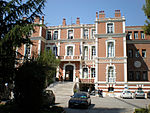
Charilaou (Greek: Χαριλάου) is a district in eastern Thessaloniki, Greece. The district was named after the banker and entrepreneur Epameinontas Charilaos, the landowner in the area, who had origins from the Ainos of Thrace. There is also the Ainou square named after this town. It is densely built-up and located above the Dépôt area and near Toumba and Pylaia. Its main street is Papanastasiou Street where is also located Kleanthis Vikelidis Stadium.

Excerpt from the Wikipedia article Charilaou (License: CC BY-SA 3.0, Authors, Images).

Charilaou
Ξυγγόπουλου, Thessaloniki Municipal Unit Χαριλάου (5th District of Thessaloniki)

Geographical coordinates (GPS) Address Nearby Places
placeShow on map

Wikipedia: CharilaouContinue reading on Wikipedia

Geographical coordinates (GPS)

Latitude Longitude
N 40.6 ° E 22.966666666667 °
placeShow on map

Address

Ξυγγόπουλου 1
542 49 Thessaloniki Municipal Unit, Χαριλάου (5th District of Thessaloniki)
Macedonia and Thrace, Greece
mapOpen on Google Maps

Charilaou
Charilaou
Share experience

Nearby Places

Municipal Art Gallery (Thessaloniki)

The Municipal Art Gallery of the Municipality of Thessaloniki in Central Macedonia, Greece was founded in 1966 as an offshoot of the Municipal Library. Since 1986 it has been housed in the Villa Mordoch on Vassilissis Olgas Avenue, a mansion designed by the architect Xenophon Paionidis in the eclectic style in 1905 and owned by the Municipality of Thessaloniki. Since 2013 it is housed in Villa Bianca, also on Vassilissis Olgas Avenue. It also uses the Makridis Room near the Posidonio sports centre on the sea front and the old Archaeological Museum (Yeni Cami) as permanent exhibition spaces. The gallery has more than 1,000 works in its collection, and these are divided into the Thessalonian Artists Collection (3 generations: 1898–1922, 1923–40, 1941–67), the Modern Greek Engraving Collection, the Collection of Byzantine and Postbyzantine Icons, which covers a period of six centuries, the Modern Greek Art Collection, and the Sculpture Collection. The gallery organises regular (mainly retrospective) exhibitions of Greek artists, produces numerous publications, has a specialised library-cum-reading-room, and offers guided tours for the public (booked in advance). Since 1986 it has held 55 exhibitions of Greek and foreign artists. One of its aims is to jointly organise exhibitions with major visual arts institutions in Greece and abroad. Thus it has presented such artists as Max Ernst and Nikos Engonopoulos (in 1997), Theofilos Hatzimichail (in 1998), and, for the first time in Greece, the works of Nikolaos Gyzis owned by his family (in late 1999). The latter include drawings and oil paintings from Gyzis’’s travels in Greece, Asia Minor, and Germany, family portraits and scenes, allegorical subjects, genre paintings, and still lives. The immediate aims of the Municipal Gallery include converting the second and third floors of the Villa Bianca into permanent exhibition spaces for works by Thessalonian artists and its collection of Byzantine icons.