place

Port-au-Prince

1749 establishments in the French colonial empireCapitals in North AmericaCapitals in the CaribbeanCommunes of HaitiGulf of Gonâve
Pages including recorded pronunciationsPages with French IPAPages with Haitian Creole IPAPopulated coastal places in HaitiPopulated places established in 1749Populated places in Ouest (department)Port-au-PrincePort cities in the CaribbeanSource attribution
Port au Prince Montage

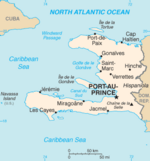
Port-au-Prince ( PORT oh PRINSS; French: [pɔʁ o pʁɛ̃s] ; Haitian Creole: Pòtoprens, [pɔtopɣɛ̃s]) is the capital and most populous city of Haiti. The city's population was estimated at 1,200,000 in 2022 with the metropolitan area estimated at a population of 2,618,894. The metropolitan area is defined by the IHSI as including the communes of Port-au-Prince, Delmas, Cité Soleil, Tabarre, Carrefour, and Pétion-Ville. The city of Port-au-Prince is on the Gulf of Gonâve: the bay on which the city lies, which acts as a natural harbor, has sustained economic activity since the civilizations of the Taíno. It was first incorporated under French colonial rule in 1749. The city's layout is similar to that of an amphitheater; commercial districts are near the water, while residential neighborhoods are located on the hills above. Its population is difficult to ascertain due to the rapid growth of slums in the hillsides above the city; however, recent estimates place the metropolitan area's population at around 3.7 million, nearly a third of the country's national population. The city was catastrophically affected by a massive earthquake in 2010, with large numbers of structures damaged or destroyed. Haiti's government estimated the death toll to be 230,000. Gang violence is extensive, and kidnappings, massacres and gang rapes are common occurrences, often with the complicity of police officers and politicians.

Excerpt from the Wikipedia article Port-au-Prince (License: CC BY-SA 3.0, Authors, Images).

Port-au-Prince
Paris Paris 8e Arrondissement (Paris)

Geographical coordinates (GPS) Address Nearby Places
placeShow on map

Wikipedia: Port-au-PrinceContinue reading on Wikipedia

Geographical coordinates (GPS)

Latitude Longitude
N 18.533333333333 ° E -72.333333333333 °
placeShow on map

Address


75008 Paris, Paris 8e Arrondissement (Paris)
Île-de-France, France
mapOpen on Google Maps

Port au Prince Montage
Share experience

Nearby Places

Battle of Port-au-Prince (1920)

The Battle of Port-au-Prince, or "la débâcle", took place on January 15, 1920 when Haitian rebels, known as Cacos, attacked the capital of Haiti during the Second Caco War and the American occupation of Haiti. At 4:00 a.m., "more than 300" Caco rebels, many wearing stolen uniforms of the Haitian gendarmes, commanded by Benoît Batraville, attacked the city. The Cacos moved into Port-au-Prince in columns, "with flags and conch horns blowing", only to be gunned down by Browning Automatic Rifle (BAR) and Lewis gun fire. It turns out that the city's garrison of US Marines and Haitian gendarmes were ready for the assault, since a citizen who heard the Cacos coming informed the former. The Cacos were forced to break ranks and seek shelter in buildings, where they proceeded to snipe from windows and from around corners. One Caco group attacked the city's slums and set a block on fire, which lit up "the entire surrounding countryside". One of the defenders' patrols, a detachment of ten US Marines led by Lieutenant Gerald Thomas, met a Caco force on the waterfront that was headed for the National Bank. Near the Iron Market, "a large number" of rebels was spotted coming down the street. Thomas loaded his detachment of marines into a truck to engage the incoming force of Caco insurgents. The truck carrying the Marines moved past the arcades and iron-grilled buildings of the city's central marketplace. After seeing the flashes of rifles up the street, Thomas ordered his Marines off the truck and into the arcade on the right side of the street. The Marine patrol jogged by bounds from pillar to pillar. Thomas spotted the head of a column of Cacos emerge from a side street and ordered his Marines who were hidden by the darkness of the arcade into a hasty ambush. When the Haitian Caco rebels closed to fifty yards or less, Thomas and his fellow marines executed their ambush and opened fire with eight Springfield rifles and two BARs decimating the column of Caco rebels and conflicting heavy casualties. The surviving Cacos broke off the action within ten minutes and fled the city. However, Thomas saw that seven of his fellow Marines in return were hit, two seriously wounded. Thomas sent the two seriously wounded back to headquarters in the truck and led the remaining seven Marines to a sugar company compound. One of the seriously wounded who later died of his injuries was Private Lencil Combs. "Fully a fifth" of the Caco attackers were killed, according to one estimate. Another source puts the number of rebel dead at 66, plus "many more" wounded and captured. One of the dead was Solomon Janvier, a Port-au-Prince resident and one of the leaders of the attack. The surviving Cacos would remember the battle as "la débâcle". With the arrival of daylight, "patrols moved east and north of the city", killing "more than fifty" additional rebels.

State University of Haiti

The State University of Haiti (French: Université d'État d'Haïti (UEH), Haitian Creole: Inivèsite Leta Ayiti) is one of Haiti's most prestigious institutions of higher education. It is located in Port-au-Prince. Its origins date to the 1820s, when colleges of medicine and law were established. In 1942, the various faculties merged into the University of Haiti. After a student strike in 1960, François Duvalier's government brought the university under firm government control and renamed it the State University of Haiti. In 1983, the university became an independent institution according to the Haitian constitution. The university's independent status was confirmed in the Haitian constitution of 1987. In 1981, there were 4,099 students at the University of Haiti, of whom 26% were enrolled in the School of Law and Economics, 25% in the School of Medicine and Pharmacy, 17% in the School of Administration and Management, and 11% in the School of Science and Topography. Despite the important role played by agriculture in the Haitian economy, only 5% of the university's students were enrolled in the School of Agronomy and Veterinary Medicine. In 1981, the University of Haiti had 559 professors, compared to 207 in 1967. Most professors worked part-time, were paid on an hourly basis, and had little time for contact with students. UEH also suffered severe shortages of books and other materials. As of 2010, tuition was US$15 a year. However, while this made it more affordable for many Haitians than other forms of tertiary education in the country, competition for places was fierce. The university accepted only 15% of applicants for undergraduate places, while its dentistry school had just 20 places for about 800 applicants yearly. Among its past rectors, the university includes the writer Jean Price Mars. The university's buildings were largely destroyed during the earthquake of January 12, 2010. A consortium of historically black colleges in the United States was formed to help rebuild part of the campus. After the earthquake, the government of the Dominican Republic paid for the construction of a new university campus near the town of Limonade in northern Haiti, called the Université d'État d'Haïti, Campus Henri Christophe de Limonade.