place

Redwoods Forest, Whakarewarewa

All pages needing cleanupCoast redwood grovesForests of New ZealandTourist attractions in RotoruaWikipedia pages needing cleanup from November 2022
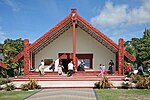
Lit sculptures above entrance tower portrait

Redwoods Forest or Redwood Memorial Grove is a forest of naturalised coastal redwood on the outskirts of Rotorua, New Zealand, adjacent to the Whakarewarewa thermal area. The 6 hectares (15 acres) stand of Californian redwoods is part of the larger Whakarewarewa State Forest Park, which is in turn part of the Kaingaroa Forest area.

Excerpt from the Wikipedia article Redwoods Forest, Whakarewarewa (License: CC BY-SA 3.0, Authors, Images).

Redwoods Forest, Whakarewarewa
Mokopuna Trail, Rotorua Lynmore

Geographical coordinates (GPS) Address Nearby Places
placeShow on map

Wikipedia: Redwoods Forest, WhakarewarewaContinue reading on Wikipedia

Geographical coordinates (GPS)

Latitude Longitude
N -38.158333333333 ° E 176.275 °
placeShow on map

Address

Mokopuna Trail
3010 Rotorua, Lynmore
Bay of Plenty, New Zealand
mapOpen on Google Maps

Lit sculptures above entrance tower portrait
Share experience

Nearby Places

Whakarewarewa
Whakarewarewa

Whakarewarewa (reduced version of Te Whakarewarewatanga O Te Ope Taua A Wahiao, meaning The gathering place for the war parties of Wahiao, often abbreviated to Whaka by locals) is a Rotorua semi-rural geothermal area in the Taupo Volcanic Zone of New Zealand. This was the site of the Māori fortress of Te Puia, first occupied around 1325, and known as an impenetrable stronghold never taken in battle. Māori have lived here ever since, taking full advantage of the geothermal activity in the valley for heating and cooking. Whakarewarewa has some 500 pools, most of which are alkaline chloride hot springs, and at least 65 geyser vents, each with their own name. Seven geysers are currently active. Pohutu Geyser, meaning big splash or explosion, erupts approximately hourly to heights of up to 30 m (98 ft).Many of the thermal features at Whakarewarewa have been adversely affected by Rotorua residents taking advantage of the underlying geothermal fluids of the city by drawing shallow wells (20–200 m [66–656 ft] deep) to extract hot water for both domestic and commercial heating. A bore closure programme in 1987–1988 resulted in 106 wells within 1.5 km (0.93 mi) of Pohutu Geyser being cemented shut, with another 120 wells outside the radius being shut due to a punitive royalty charging regime. There has subsequently been a pronounced recovery in the geysers and hot springs at Whakarewarewa.The area features Te Pākira Marae and Wahiao meeting house, a meeting place of the Tūhourangi hapū of Ngāti Puta, Ngāti Uruhina, Ngāti Wāhiao, Tūhourangi and Ngāti Taoi.

Polynesian Spa

Polynesian Spa is a developed geothermal spa facility in Rotorua, North Island, New Zealand. Local Māori acclaimed the therapeutic benefits of the water and bathed for centuries in the acidic pool 'Te Pupunitanga', now called Priest’s Bath. European thermal bathing history at Polynesian Spa began in 1878 when a Catholic Priest named Father Mahoney bathed regularly in the thermal spring water of hand dug pools where Polynesian Spa is now located on the shores of Lake Rotorua. Over several months his arthritis was greatly alleviated, initiating an international reputation for the therapeutic properties of the hot mineral spring water.The first bath house on site, the Pavilion Bath House opened in 1882, followed by the Ward Baths in 1931. Early bath houses on the site were government-run, the Pavilion Bath, the Duchess Bath, named for the Duchess of Cornwall and York who visited in 1901 and the Ward Baths, named for an early New Zealand Prime Minister, Sir Joseph Ward, who had a passion for thermal waters. In 1902 Mary MacKillop or Saint Mary of the Cross came to Rotorua to seek treatment in the therapeutic waters of the Duchess Bath. On 16 March Mother Mary MacKillop wrote "I feel the baths are doing me good. The rheumatism in my knees is becoming less and I can walk easily now... This is such a nice private house. We have had a priest resident here most of the time..." In 1972, the government of the day leased the Ward Baths to Polynesian Pools Limited and the spa is now known as the Polynesian Spa.