place

Pōhutu Geyser

Bay of Plenty Region geography stubsGeysers of New ZealandLandforms of the Bay of Plenty RegionRotorua Lakes DistrictTaupō Volcanic Zone
WhakarewarewaPohutuGeyserSign

Pōhutu Geyser is a geyser in the Whakarewarewa Thermal Valley, Rotorua, in the North Island of New Zealand. The geyser is the largest in the southern hemisphere and among the most active in the area, erupting up to twenty times per day at heights of up to 30 m (98 ft). The name Pōhatu is derived from te reo Māori, although it has an unclear etymology – being translated as either 'big splash', 'explosion' or 'constant splashing'.The use of geothermal bores for heating by nearby Rotorua has impacted on the activity of Pōhutu Geyser and other nearby geothermal features. After a decline in geothermal activity at Whakarewarewa, a programme in the late 1980s saw bores within 1.5 km (0.93 mi) of the geyser being shut, leading to a pronounced increase in activity. This activity increase has concerned some scientists who have been involved with the field, who claim that the increased regularity of Pōhutu Geyser's eruptions may result in the system dying in the future. Its crater is 50 centimetres in diameter.

Excerpt from the Wikipedia article Pōhutu Geyser (License: CC BY-SA 3.0, Authors, Images).

Pōhutu Geyser
Hemo Road, Rotorua Whakarewarewa

Geographical coordinates (GPS) Address Phone number Website Nearby Places
placeShow on map

Wikipedia: Pōhutu GeyserContinue reading on Wikipedia

Geographical coordinates (GPS)

Latitude Longitude
N -38.163511111111 ° E 176.25408055556 °
placeShow on map

Address

Te Puia Thermal Park

Hemo Road 334
3010 Rotorua, Whakarewarewa
Bay of Plenty, New Zealand
mapOpen on Google Maps

Phone number

call+6473489047

Website
tepuia.com

linkVisit website

WhakarewarewaPohutuGeyserSign
Share experience

Nearby Places

Whakarewarewa
Whakarewarewa

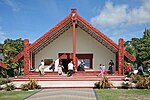
Whakarewarewa (reduced version of Te Whakarewarewatanga O Te Ope Taua A Wahiao, meaning The gathering place for the war parties of Wahiao, often abbreviated to Whaka by locals) is a Rotorua semi-rural geothermal area in the Taupo Volcanic Zone of New Zealand. This was the site of the Māori fortress of Te Puia, first occupied around 1325, and known as an impenetrable stronghold never taken in battle. Māori have lived here ever since, taking full advantage of the geothermal activity in the valley for heating and cooking. Whakarewarewa has some 500 pools, most of which are alkaline chloride hot springs, and at least 65 geyser vents, each with their own name. Seven geysers are currently active. Pohutu Geyser, meaning big splash or explosion, erupts approximately hourly to heights of up to 30 m (98 ft).Many of the thermal features at Whakarewarewa have been adversely affected by Rotorua residents taking advantage of the underlying geothermal fluids of the city by drawing shallow wells (20–200 m [66–656 ft] deep) to extract hot water for both domestic and commercial heating. A bore closure programme in 1987–1988 resulted in 106 wells within 1.5 km (0.93 mi) of Pohutu Geyser being cemented shut, with another 120 wells outside the radius being shut due to a punitive royalty charging regime. There has subsequently been a pronounced recovery in the geysers and hot springs at Whakarewarewa.The area features Te Pākira Marae and Wahiao meeting house, a meeting place of the Tūhourangi hapū of Ngāti Puta, Ngāti Uruhina, Ngāti Wāhiao, Tūhourangi and Ngāti Taoi.