Moscow Manege

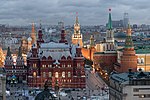
The Moscow Manege (Russian: Мане́ж, IPA: [mɐˈnʲeʂ] (listen)) is an oblong building along the west side of Manege Square, which was cleared in the 1930s and lies adjacent to Red Square. It is the site of Moscow Design Museum since 2012. Designed by Spanish engineer Agustín de Betancourt with a roof without internal support for 45 metres (148 ft) (the building's width), it was erected from 1817 to 1825 by the Russian architect Joseph Bové, who clothed it in its Neoclassical exterior, an order of Roman Doric columns enclosing bays of arch-headed windows in a blind arcade, painted white and cream yellow. The roof, with its internal rafters and beams exposed, rests on external columns of the Manege. The structure was used first as a traditional manège, an indoor riding academy, to house parades of horsemen and a training school for officers. The 180 m long Manege was large enough to hold an entire infantry regiment—over two thousand soldiers— as well as an invited audience. Since 1831 it has been an exhibition place. In 1867, Hector Berlioz and Nikolai Rubinstein performed at the Manege before a crowd of 12,000. During the Soviet years, the building was used as an art gallery. It was there that Nikita Khrushchev chided avant-garde artists for promoting degenerate art, an episode known as the Manege Affair.
Excerpt from the Wikipedia article Moscow Manege (License: CC BY-SA 3.0, Authors, Images).Moscow Manege
Mokhovaya Street, Moscow Tverskoy District
Geographical coordinates (GPS) Address External links Nearby Places Show on map
 Continue reading on Wikipedia
 Geographical coordinates (GPS)
| Latitude | Longitude |
|---|---|
| N 55.753333333333 ° | E 37.612222222222 ° |
Address
Манеж
Mokhovaya Street 1
103009 Moscow, Tverskoy District
Moscow, Russia
Open on Google Maps
External links