place

Alexander Garden

Cultural heritage monuments of federal significance in MoscowParks and gardens in MoscowUrban public parks
Alexander Garden Gates

Alexander Gardens (Russian: Александровский сад) was one of the first urban public parks in Moscow, Russia. The park comprises three separate gardens, which stretch along all the length of the western Kremlin wall for 865 metres (2,838 ft) between the building of the Moscow Manege and the Kremlin.

Excerpt from the Wikipedia article Alexander Garden (License: CC BY-SA 3.0, Authors, Images).

Alexander Garden
Trinity Gate, Moscow Tverskoy District

Geographical coordinates (GPS) Address Nearby Places
placeShow on map

Wikipedia: Alexander GardenContinue reading on Wikipedia

Geographical coordinates (GPS)

Latitude Longitude
N 55.7525 ° E 37.613888888889 °
placeShow on map

Address

Троицкий мост

Trinity Gate
103009 Moscow, Tverskoy District
Moscow, Russia
mapOpen on Google Maps

Alexander Garden Gates
Share experience

Nearby Places

Robespierre Monument

The Robespierre Monument (Russian: Памятник Робеспьеру) was one of the first monuments erected in the Russian Soviet Federative Socialist Republic (later part of the Soviet Union), raised in Moscow on 3 November 1918 – just ahead of the first anniversary of the October Revolution, which had brought the Bolsheviks to power. It depicted Maximilien de Robespierre, a prominent figure of the French Revolution. Located in Alexander Garden, it had been designed by the sculptor Beatrice Yuryevna Sandomierz (Russian: Беатриса Юрьевна Сандомирская). Created as part of the "monumental propaganda" plan, the monument was commissioned by Vladimir Lenin, who in an edict referred to Robespierre as a "Bolshevik avant la lettre". It was only one of several planned statues depicting French revolutionaries – others were to be made of Georges Danton, François-Noël Babeuf and Jean-Paul Marat, although only the one of Danton was never completed.Created in the context of the ongoing Russian Civil War and with the country in a state of war communism, there were few materials available to make the statue. Lacking bronze or marble, the monument was instead constructed using concrete, with hollow pipes running through it. This design proved frail, lasting only a few days. On the morning of 7 November only a pile of rubble remained. Over the following days different newspapers supplied varying versions as to why it collapsed, with Znamya Trudovoi Kommuny and others saying it was the work of "criminal" (counter-revolutionary) hands, and Izvestia stating the statue's demise was caused by improper construction.

Armorial Gate
Armorial Gate

The Armorial Gate (Russian: Гербовые ворота, romanized: Gerbovye vorota) was a unique monumental erection of traditional Russian architecture. Situated in the Moscow Kremlin, the structure was symbolic of the centralized Russian state. Its name references polychrome tiles of the second floor, which displayed heraldic (armorial) emblems of formerly independent Russian principalities. When constructing a palace for Ivan III in the late 15th century, the Italian architect Aloisio built an interior brick wall inside the Kremlin to defend the royal palace from south and west. The western wall was pierced by two arches, the smaller for pedestrians and the larger for vehicles. The larger gate was called Kolymazhnye, either from the old Russian word for vehicles or from the Kolymazhny Chamber situated nearby. After the Romanov family ascended the throne in 1613, they rebuilt Ivan's residence into the Terem Palace. At about the same time, in the 1630s, they commissioned a tower to crown the Kolymazhnye Gate leading to the royal court. The tower was square in plan, with the first floor pierced by a wide arch for vehicles. The second floor had twin double-arched windows with decorative elaborations of white stone. The third floor was pierced by a row of machicolations and a row of murder-holes. Above that was a gallery ringed by a perforated parapet. The structure was crowned by a tiled tent, decorated with two levels of dormers and surmounted by a heraldic double-headed eagle. By the 19th century, the wall had lost its defensive purpose and was dismantled. After that, the detached tower appeared redundant and was pulled down at the urging of the Kremlin's castellan in 1807.

Terem Palace
Terem Palace

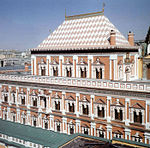
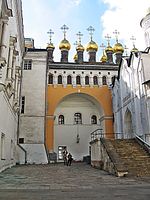
Terem Palace or Teremnoy Palace (Russian: Теремной дворец) is a historical building in the Moscow Kremlin, Russia, which used to be the main residence of the Russian czars in the 17th century. Its name is derived from the Greek word τερεμνον (i.e., "dwelling"). Currently, the structure is not accessible to the public, as it belongs to the official residence of the President of Russia. In the 16th century Aloisio da Milano constructed the first royal palace on the spot. Only the ground floor from that structure survives, as the first Romanov tsar, Mikhail Feodorovich, had the palace completely rebuilt in 1635–36. The new structure was surrounded by numerous annexes and outbuildings, including the Boyar Platform, Golden Staircase, Golden Porch, and several turrets. On Mikhail's behest, the adjoining Golden Tsaritsa's Chamber constructed back in the 1560s for Ivan IV's wife, was surmounted with 11 golden domes of the Upper Saviour Cathedral. The complex of the palace also incorporates several churches of earlier construction, including the Church of the Virgin's Nativity from the 1360s. The palace consists of five stories. The third story was occupied by the czarina and her children; the fourth one contained the private apartments of the czar. The upper story is a tent-like structure where the Boyar Duma convened. The exterior, exuberantly decorated with brick tracery and colored tiles, is brilliantly painted in red, yellow, and orange. The interior used to be painted as well, but the original murals were destroyed by successive fires, particularly the great fire of 1812. In 1837, the interiors were renovated in accordance with old drawings in the Russian Revival style.