place

Soviet Russia (Exhibition, 1967)

1967 in the Soviet UnionArt exhibitions in RussiaSocialist realism
Catalog Soviet Russia 67 bw

Third National Art Exhibition "Soviet Russia" (Moscow, 1967) (Russian: Третья Республиканская художественная выставка "Советская Россия" 1967 года) became a main national art event of 1967, as well as one of the largest Soviet art exhibitions of the 1960s. The exhibition took place in Manezh Exhibition Hall.

Excerpt from the Wikipedia article Soviet Russia (Exhibition, 1967) (License: CC BY-SA 3.0, Authors, Images).

Soviet Russia (Exhibition, 1967)
Mokhovaya Street, Moscow Tverskoy District

Geographical coordinates (GPS) Address Nearby Places
placeShow on map

Wikipedia: Soviet Russia (Exhibition, 1967)Continue reading on Wikipedia

Geographical coordinates (GPS)

Latitude Longitude
N 55.7535 ° E 37.6122 °
placeShow on map

Address

Манеж

Mokhovaya Street 1
103009 Moscow, Tverskoy District
Moscow, Russia
mapOpen on Google Maps

Catalog Soviet Russia 67 bw
Share experience

Nearby Places

Robespierre Monument

The Robespierre Monument (Russian: Памятник Робеспьеру) was one of the first monuments erected in the Russian Soviet Federative Socialist Republic (later part of the Soviet Union), raised in Moscow on 3 November 1918 – just ahead of the first anniversary of the October Revolution, which had brought the Bolsheviks to power. It depicted Maximilien de Robespierre, a prominent figure of the French Revolution. Located in Alexander Garden, it had been designed by the sculptor Beatrice Yuryevna Sandomierz (Russian: Беатриса Юрьевна Сандомирская). Created as part of the "monumental propaganda" plan, the monument was commissioned by Vladimir Lenin, who in an edict referred to Robespierre as a "Bolshevik avant la lettre". It was only one of several planned statues depicting French revolutionaries – others were to be made of Georges Danton, François-Noël Babeuf and Jean-Paul Marat, although only the one of Danton was never completed.Created in the context of the ongoing Russian Civil War and with the country in a state of war communism, there were few materials available to make the statue. Lacking bronze or marble, the monument was instead constructed using concrete, with hollow pipes running through it. This design proved frail, lasting only a few days. On the morning of 7 November only a pile of rubble remained. Over the following days different newspapers supplied varying versions as to why it collapsed, with Znamya Trudovoi Kommuny and others saying it was the work of "criminal" (counter-revolutionary) hands, and Izvestia stating the statue's demise was caused by improper construction.

Biblioteka Imeni Lenina

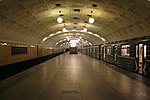
Biblioteka Imeni Lenina (Russian: Библиоте́ка и́мени Ле́нина, English: Lenin Library) is a station on the Sokolnicheskaya Line of the Moscow Metro. The station was opened on 15 May 1935 as a part of the first stage of the Metro. It is situated in the very centre of the city under Mokhovaya Street, and is named for the nearby Russian State Library (named the Lenin Library from 1925 until 1992). Its architects were A. I. Gontskevich and S. Sulin. To prevent the disruption of traffic, Biblioteka Imeni Lenina was built using underground excavation rather than cut and cover even though the station ceiling is just two metres (6.5 ft) below ground level. Soil conditions and the narrowness of the space in which the station was to be built necessitated a single-vault design, the only one on the first Metro line. The entire excavation was only 19.8 metres (65 ft) wide and 11.7 metres (38 ft) high. The main station vault was built from rubble stone set in concrete and reinforced with an iron framework. This was lined with an "umbrella" of bitumen-coated paper to prevent groundwater from seeping into the station. The station was finished with plaster, yellow ceramic tile, and marble. The station originally had two entrance vestibules, one at either end. The southern vestibule, located between the old and new buildings of the State Library, is shared with Borovitskaya. The temporary northern vestibule, which served Biblioteka Imeni Lenina and Aleksandrovsky Sad, was removed in the 1940s.