place

Casino Lisboa (Macau)

1970 establishments in MacauCasino hotelsCasinos completed in 1970Casinos in MacauHotel buildings completed in 1970
Hotel buildings completed in 1991Hotel buildings completed in 2006Hotels in MacauMacau PeninsulaSkyscraper hotels in MacauSkyscrapers in Macau
Casino Lisboa (5234400075)

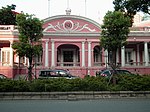
Casino Lisboa (lit. 'Lisbon Casino', Chinese: 葡京娛樂場) is a hotel casino in Sé, Macau, owned by the Sociedade de Turismo e Diversões de Macau (STDM). This three-storey complex was built in late 1960s.The original casino and the 12-storey round hotel tower were built in 1970 by Stanley Ho, Teddy Yip, Yip Hon and Henry Fok. A 270-room extension was added in 1991 for a total of 927 rooms. In 2006, another extension, the Grand Lisboa, was built next to the current complex. Therefore, a total of 2,362 rooms are in place in Hotel Lisboa as of 2010. This expansion was partly done in competition with the newly opened Wynn Macau, located right next to the original Casino Lisboa.

Excerpt from the Wikipedia article Casino Lisboa (Macau) (License: CC BY-SA 3.0, Authors, Images).

Casino Lisboa (Macau)
亞馬喇前地 Praça de Ferreira do Amaral,

Geographical coordinates (GPS) Address External links Nearby Places
placeShow on map

Wikipedia: Casino Lisboa (Macau)Continue reading on Wikipedia

Geographical coordinates (GPS)

Latitude Longitude
N 22.18959 ° E 113.544039 °
placeShow on map

Address

葡京酒店 Hotel Lisboa

亞馬喇前地 Praça de Ferreira do Amaral 1-5
519020 , Grand Beach
Macau, China
mapOpen on Google Maps

linkWikiData (Q1047611)
linkOpenStreetMap (13857747)

Casino Lisboa (5234400075)
Share experience

Nearby Places

Academia de Musica de S. Pio X

Academia de Música S. Pio X is a multi-lingual music school founded by the priest Áureo Castro in 1962, under the suggestion of the director of the Lisbon National Conservatory. Its original name was "Escola das Missões Católicas" (lit. "School of the Catholic Missions"), and the school opened its doors on 2 October with 48 enrolled students. Its initial staff was composed by Cesare Brianza (piano), Maria de Lurdes Ruas Freire Garcia (piano), António Freire Garcia (violin), Marcos Lau and two other unidentified teachers, known as Liang e Chao. In 1975, bishop Macau, D. Arquimínio da Costa authorized an expansion of the school using funds from the government. Governor António Lopes dos Santos also started conceding a mensal allowance for it, alleging it was "a private institution of cultural value, considered to be of utility to the province" (in Portuguese: "Uma instituição particular de carácter cultural, considerada de utilidade para a Província"). According to the words of Áureo Castro, "the academy was founded with the purpose of giving young men from Macau, Portuguese and Chinese, a gradually progressive musical institution. So there was the need of using a bilingual educational system, using Portuguese and Chinese; and later also English. Of the many students that were taught by the academy, at least three dozen proceeded with their musical studies, graduating in diverse music colleges. Several also now live in Canada, United States, Hong Kong and Australia." (adapted, see footnotes for lit.).

Macau
Macau

Macau or Macao (English: ; Portuguese: [mɐˈkaw]; Chinese: 澳門, Cantonese: [ōu.mǔːn]), officially the Macao Special Administrative Region of the People's Republic of China (MSAR), is a city and special administrative region of China in the western Pearl River Delta by the South China Sea. With a population of about 680,000 and an area of 32.9 km2 (12.7 sq mi), it is the most densely populated region in the world. Formerly a Portuguese colony, the territory of Portuguese Macau was first leased by the Ming dynasty to Portugal as a trading post in 1557. Portugal paid an annual rent and administered the territory under Chinese sovereignty until 1887. Portugal later gained perpetual colonial rights in the Sino-Portuguese Treaty of Peking. The colony remained under Portuguese rule until 1999, when it was transferred to China. Macau is a special administrative region of China, which maintains separate governing and economic systems from those of mainland China under the principle of "one country, two systems". The unique blend of Portuguese and Chinese architecture in the city's historic centre has resulted in its inscription on the UNESCO World Heritage List in 2005.Originally a sparsely populated collection of coastal islands, Macau, often referred to as the "Las Vegas of the East", since the late 20th century has become a major resort city and a top destination for gambling tourism. Its gambling industry is seven times larger than that of Las Vegas. The city has one of the highest per capita incomes in the world, US$43,770 in 2021, and its GDP per capita by purchasing power parity is one of the highest in the world.It has a very high Human Development Index, as calculated by the Macau government, and the fourth-highest life expectancy in the world. The territory is highly urbanised; two-thirds of the total land area is built on land reclaimed from the sea.