place

Octagonal Pavilion Library

Libraries established in 1927Libraries in MacauLibrary and information science stubs
Pavilionlibrary
Pavilionlibrary

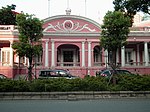
The Octagonal Pavilion Library (simplified Chinese: 八角亭图书馆; traditional Chinese: 八角亭圖書館), or Bajiaoting Library, formally named as the Reading and Newspaper Room attached to the Macau Chinese Chamber of Commerce, simply known as Octagonal Pavilion, is a library located on the periphery of the S. Francisco Garden of Macau. The library is named after its octagonal pavilion shape.

Excerpt from the Wikipedia article Octagonal Pavilion Library (License: CC BY-SA 3.0, Authors, Images).

Octagonal Pavilion Library
水坑尾街 Rua do Campo,

Geographical coordinates (GPS) Address External links Nearby Places
placeShow on map

Wikipedia: Octagonal Pavilion LibraryContinue reading on Wikipedia

Geographical coordinates (GPS)

Latitude Longitude
N 22.19282 ° E 113.54372 °
placeShow on map

Address

澳門中華總商會附設閱書報室 (八角亭) Biblioteca Publica da Associaçao Comercial de Macau

水坑尾街 Rua do Campo
519020 , 雀仔園 Horta da Mitra
Macau, China
mapOpen on Google Maps

linkWikiData (Q10397483)
linkOpenStreetMap (405411408)

Pavilionlibrary
Pavilionlibrary
Share experience

Nearby Places

Academia de Musica de S. Pio X

Academia de Música S. Pio X is a multi-lingual music school founded by the priest Áureo Castro in 1962, under the suggestion of the director of the Lisbon National Conservatory. Its original name was "Escola das Missões Católicas" (lit. "School of the Catholic Missions"), and the school opened its doors on 2 October with 48 enrolled students. Its initial staff was composed by Cesare Brianza (piano), Maria de Lurdes Ruas Freire Garcia (piano), António Freire Garcia (violin), Marcos Lau and two other unidentified teachers, known as Liang e Chao. In 1975, bishop Macau, D. Arquimínio da Costa authorized an expansion of the school using funds from the government. Governor António Lopes dos Santos also started conceding a mensal allowance for it, alleging it was "a private institution of cultural value, considered to be of utility to the province" (in Portuguese: "Uma instituição particular de carácter cultural, considerada de utilidade para a Província"). According to the words of Áureo Castro, "the academy was founded with the purpose of giving young men from Macau, Portuguese and Chinese, a gradually progressive musical institution. So there was the need of using a bilingual educational system, using Portuguese and Chinese; and later also English. Of the many students that were taught by the academy, at least three dozen proceeded with their musical studies, graduating in diverse music colleges. Several also now live in Canada, United States, Hong Kong and Australia." (adapted, see footnotes for lit.).