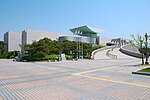
Institute for Basic Science

The Institute for Basic Science (IBS; Korean: 기초과학연구원) is a Korean government-funded research institute that conducts basic science research and relevant pure basic research. IBS was established in November 2011 by the Lee Myung-bak administration as a research institute, later be a core of the International Science and Business Belt (ISBB) upon relocation of their headquarters from a rented property to their own campus in January 2018 using land reclaimed from the Taejŏn Expo '93 in Expo Science Park. Comprising 30 research centers with 68 research groups across the nation and a headquarters in Daejeon, IBS has approximately 1,800 researchers and doctoral course students. Around 30% of the researchers are from countries outside of South Korea. The organization is under the Ministry of Science and ICT. In 2011, the Korean government announced an investment of more than 2 trillion KRW (roughly US$2 billion) to build a heavy ion accelerator facility, named RAON, in northern Daejeon by 2021 before getting pushed back to 2025. The facility is expected to be the world's first device using both the isotope separator on-line (ISOL) and in-flight (IF) methods.From December 2018, the IBS Center for Climate Physics, headed by Axel Timmermann, began to utilize a 1.43-petaflop Cray XC50 supercomputer, named Aleph, for climate physics research. In that same year it was noted that the largest share of Clarivate Highly Cited Researchers in Korea are affiliated with IBS.
Excerpt from the Wikipedia article Institute for Basic Science (License: CC BY-SA 3.0, Authors, Images).Institute for Basic Science
Expo-ro, Daejeon Sinseong-dong
Geographical coordinates (GPS) Address Nearby Places Show on map
 Continue reading on Wikipedia
 Geographical coordinates (GPS)
| Latitude | Longitude |
|---|---|
| N 36.375959 ° | E 127.385751 ° |
Address
Expo-ro
34126 Daejeon, Sinseong-dong
South Korea
Open on Google Maps