place

Military Manpower Administration

Conscription by countryGovernment agencies of South KoreaMinistry of National Defense (South Korea)Organizations based in DaejeonPages with non-numeric formatnum arguments
South Korea stubs
Emblem of the Military Manpower Administration (English)

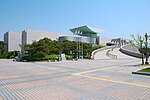
The Military Manpower Administration (MMA, Korean: 병무청; Hanja: 兵務廳) is a government agency in South Korea under the Ministry of National Defense. Its headquarters is in Seo District, Daejeon. It has a Physical Reexamination Center in Daegu and a call center in Daejeon.It gathers and manages information about 8.01 million South Koreans (16.8% of the total population), in order to facilitate conscription and wartime mobilization. It also handles the issuing of overseas travel permits for conscription candidates.

Excerpt from the Wikipedia article Military Manpower Administration (License: CC BY-SA 3.0, Authors, Images).

Military Manpower Administration
Cheongsa-ro, Daejeon Dunsan 1(il)-dong

Geographical coordinates (GPS) Address Nearby Places
placeShow on map

Wikipedia: Military Manpower AdministrationContinue reading on Wikipedia

Geographical coordinates (GPS)

Latitude Longitude
N 36.3622267 ° E 127.3849235 °
placeShow on map

Address

정부대전청사

Cheongsa-ro 189
35208 Daejeon, Dunsan 1(il)-dong
South Korea
mapOpen on Google Maps

Emblem of the Military Manpower Administration (English)
Share experience

Nearby Places

Daejeon
Daejeon

Daejeon (Korean: [tɛdzʌn] ) is South Korea's fifth-largest metropolis, with a population of 1.5 million as of 2019. Located in a central lowland valley alongside forested hills and the Geum River, the city is known for its technology and research institutions, and for celebrating its natural environment, with most mountains, hot springs, and rivers freely open for public use. Daejeon serves as a hub of transportation for major rail and road routes, and is approximately 50 minutes from the capital, Seoul, by KTX or SRT high speed rail.Daejeon (along with Seoul, Gwacheon and Sejong City) is one of South Korea's administration hubs. The city is home to 23 universities and colleges, including Korea Advanced Institute of Science and Technology (KAIST) and Chungnam National University, as well as government research institutes, and research and development centers for global companies such as Samsung, LG, mostly located in the city's Daedeok Science Town.Occupied by humans since the Stone Age, Daejeon was historically a collection of small riverside villages. Though the area had varying degrees of strategic importance depending on the period in history, it was largely undeveloped until its use as a rail hub from the early 1900s, during the period of Japanese occupation. From the 1980s, multiple national administrative functions were moved from Seoul to Daejeon, most of which are now located in the Daejeon Government Complex, resulting in another population increase. The city hosted the 1986 Asian Games, the Taejon Expo '93, the International Mathematical Olympiads in 2000, and was elevated to the status of Metropolitan City in 2005.Daejeon is situated in a lowland valley with three major rivers, all of them eventually flowing into the Yellow Sea by way of the Geum river. The city is surrounded by several small mountains, and is located approximately 170 km (105.6 mi) south of Seoul and 290 km (180 mi) north of Busan, and 70 km (43 mi) east of the Yellow Sea. Daejeon experiences a monsoon-influenced, four-season climate with wet, hot summers and drier, cold winters.

Institute for Basic Science

The Institute for Basic Science (IBS; Korean: 기초과학연구원) is a Korean government-funded research institute that conducts basic science research and relevant pure basic research. IBS was established in November 2011 by the Lee Myung-bak administration as a research institute, later be a core of the International Science and Business Belt (ISBB) upon relocation of their headquarters from a rented property to their own campus in January 2018 using land reclaimed from the Taejŏn Expo '93 in Expo Science Park. Comprising 30 research centers with 68 research groups across the nation and a headquarters in Daejeon, IBS has approximately 1,800 researchers and doctoral course students. Around 30% of the researchers are from countries outside of South Korea. The organization is under the Ministry of Science and ICT. In 2011, the Korean government announced an investment of more than 2 trillion KRW (roughly US$2 billion) to build a heavy ion accelerator facility, named RAON, in northern Daejeon by 2021 before getting pushed back to 2025. The facility is expected to be the world's first device using both the isotope separator on-line (ISOL) and in-flight (IF) methods.From December 2018, the IBS Center for Climate Physics, headed by Axel Timmermann, began to utilize a 1.43-petaflop Cray XC50 supercomputer, named Aleph, for climate physics research. In that same year it was noted that the largest share of Clarivate Highly Cited Researchers in Korea are affiliated with IBS.