place

Daejeon Science High School for the Gifted

1984 establishments in South KoreaEducational institutions established in 1984Schools in DaejeonScience high schools in South Korea
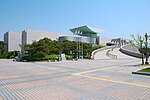
대전과학고등학교 탐의관 전경 (Daejeon Science Highschool Tamui building)

Daejeon Science High School for the Gifted (DSHS, Korean: 대전과학고등학교) is located in Daejeon, South Korea. It was founded in 1984. The school is for gifted students with talents in mathematics and sciences. The graduates of the school usually go to science or engineering schools in Seoul National University, KAIST and other prestigious universities in Korea and in the world, and also medical schools in Korea.

Excerpt from the Wikipedia article Daejeon Science High School for the Gifted (License: CC BY-SA 3.0, Authors, Images).

Daejeon Science High School for the Gifted
Gwahak-ro, Daejeon Sinseong-dong

Geographical coordinates (GPS) Address Website External links Nearby Places
placeShow on map

Wikipedia: Daejeon Science High School for the GiftedContinue reading on Wikipedia

Geographical coordinates (GPS)

Latitude Longitude
N 36.373611111111 ° E 127.37083333333 °
placeShow on map

Address

대전과학고등학교

Gwahak-ro 46
34142 Daejeon, Sinseong-dong
South Korea
mapOpen on Google Maps

Website
djshs.djsch.kr

linkVisit website

linkWikiData (Q5208226)
linkOpenStreetMap (78059218)

대전과학고등학교 탐의관 전경 (Daejeon Science Highschool Tamui building)
Share experience

Nearby Places

Korea Research Institute of Bioscience and Biotechnology

Korea Research Institute of Bioscience and Biotechnology (KRIBB) is a government research institute in Daejeon, South Korea. It is dedicated to biotechnology research across a broad span of expertise, from basic studies for the fundamental understanding of life phenomena to applied studies such as drug discovery, novel biomaterials, integrated biotechnology and bioinformation. KRIBB was established in 1985. Its accomplishments include the advancement of welfare and medical technology, an increase in food production, a cleaner environment and new bio-materials and energy sources. It has identified reasons for the failure of animal cloning, conducted a comparative study of chimpanzee genes and successfully analyzed the structure of the reactive oxygen species switch protein, which became the first study by Korean scholars to be published in Cell, an international scientific journal. The institute was ranked first in the discovery of new microorganisms, including the indigenous microorganisms of the Dokdo Islets, for four consecutive years. Its recent accomplishments include the development of a genome capable of controlling cancer cell proliferation and the identification of a neuropeptide Y-based growth control mechanism, with possibilities for new treatments for cancer, diabetes, obesity and ageing. Nano–bio sensor research led to the development of the world's smallest surface plasmon resonance biochip.

Institute for Basic Science

The Institute for Basic Science (IBS; Korean: 기초과학연구원) is a Korean government-funded research institute that conducts basic science research and relevant pure basic research. IBS was established in November 2011 by the Lee Myung-bak administration as a research institute, later be a core of the International Science and Business Belt (ISBB) upon relocation of their headquarters from a rented property to their own campus in January 2018 using land reclaimed from the Taejŏn Expo '93 in Expo Science Park. Comprising 30 research centers with 68 research groups across the nation and a headquarters in Daejeon, IBS has approximately 1,800 researchers and doctoral course students. Around 30% of the researchers are from countries outside of South Korea. The organization is under the Ministry of Science and ICT. In 2011, the Korean government announced an investment of more than 2 trillion KRW (roughly US$2 billion) to build a heavy ion accelerator facility, named RAON, in northern Daejeon by 2021 before getting pushed back to 2025. The facility is expected to be the world's first device using both the isotope separator on-line (ISOL) and in-flight (IF) methods.From December 2018, the IBS Center for Climate Physics, headed by Axel Timmermann, began to utilize a 1.43-petaflop Cray XC50 supercomputer, named Aleph, for climate physics research. In that same year it was noted that the largest share of Clarivate Highly Cited Researchers in Korea are affiliated with IBS.