place

Kukeldash Madrasah (Tashkent)

Buildings and structures in TashkentReligious buildings and structures in Uzbekistan
Kukeldash Madrasah inner yard

Kukeldash Madrasah is a medieval madrasa in Tashkent, located close to Chorsu Bazaar and Chorsu Metro station. It was built around 1570 by the Shaybanid ruler Dervish Sultan. The madrasah is built of yellow brick, and has a traditional square shape with a big portal and an inner yard. The walls around the inner yard contain cells inhabited by the students. The portal is 20 metres (66 ft) high and contains two towers at its sides.In 1830-1831 the first floor of the madrasah was demolished, and the bricks were used to build the nearby Beklarbegi Madrasah. It was later restored. The madrasah was damaged by the earthquake in 1868 and subsequently reconstructed in 1902–1903. It was reconstructed again in the 1950s and became one of only several religious buildings which survived the 1966 Tashkent earthquake.The madrasah was converted into a caravanserai in the 18th century, then it served as a fortress. In the 20th century it was a museum, first of atheism, and later of folk music. In the 1990s, the building became a madrasah again.

Excerpt from the Wikipedia article Kukeldash Madrasah (Tashkent) (License: CC BY-SA 3.0, Authors, Images).

Kukeldash Madrasah (Tashkent)
Beruniy Street, Tashkent

Geographical coordinates (GPS) Address Nearby Places
placeShow on map

Wikipedia: Kukeldash Madrasah (Tashkent)Continue reading on Wikipedia

Geographical coordinates (GPS)

Latitude Longitude
N 41.323055555556 ° E 69.235833333333 °
placeShow on map

Address

Beruniy shoh ko'chasi

Beruniy Street
100000 Tashkent
Uzbekistan
mapOpen on Google Maps

Kukeldash Madrasah inner yard
Share experience

Nearby Places

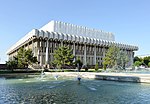
Peoples' Friendship Palace

The Peoples' Friendship Palace (Uzbek: Xalqlar doʻstligi saroyi, Russian: Дворец Дружбы народов) is the concert and cinema hall in Tashkent, capital city of Uzbekistan. The building was designed by architect Yevgeny Rozanov from the Moscow Architectural Institute who one decade prior to that worked on the city's Lenin Museum, modern day State Museum of History of Uzbekistan. The building was completed in 1981. As the largest cinema and concert hall in the country the palace provides seating for up to 6,000 people. The palace is named in the memory of solidarity and friendship of volunteers who came to the city after the devastating 1966 Tashkent earthquake. Up until 2020 the palace is represented on the 100 Uzbekistani sum banknote. Initial plans for the new palace were developed already in 1971. The interior of the building was decorated with ceiling lights, chandeliers, large plaster panels and with three monumental florentine mosaics, named "Peoples' Friendship", "Holiday" and "Land of Flowers", on the banquet hall walls. The building's façade and decorations draw inspiration from national ornamental patterns, reminiscent of muqarnas elements found in local architecture. Local marble, as well as Nurota and G'ozg'on marbles, were used in the construction. Today, the palace is used for various events such as congresses, conferences, festivals, and concerts. Official ceremonies for foreign state representatives are also held in the concert hall. The treaty leading to the establishment of the post-Soviet regional Collective Security Treaty Organization was signed at the palace in 1992 while in 2004 the palace hosted the summit of the Shanghai Cooperation Organisation. In April of 2008 the body known as the Republican Commission on the Standardization of Toponyms issued the decision No. 07-5-16 after which the palace was renamed to the "Palace of Arts Istiklol". The decision was nevertheless reversed in when on 26 April 2018 President of Uzbekistan Shavkat Mirziyoyev suggested reintroduction of the previous name followed by the formal decision by the Tashkent City Council of People's Deputies on May 3, 2018.