place

Tashkent City

Buildings and structures in Tashkent
Tashkent City name statue

Tashkent City (International Business Center “Tashkent City”, Uzbek: “Tashkent City” xalqaro biznes markazi, “Tashkent City” IBC) is a business center under construction in Tashkent. Located in the Shayxontoxur district, between Alisher Navoi Avenue, Olmazor, Furkat streets and Islam Karimov Avenue. Within the framework of the Tashkent City IBC, a business activity zone is being created that will unite business, residential apartments and leisure. The managing company of the Tashkent City IBC project is the Tashkent City Directorate.Construction is being carried out on the site of the demolished mahallas (neighborhoods) of Olmazor and Ukchi, on a territory with a total area of 80 hectares. This is the largest construction project in Uzbekistan. The construction of the project is carried out with financial investments from private investors.The commercial concept of the project was developed by the American company Cushman & Wakefield.Of the 8 projects for the future business center, the concept proposed by the Turkish architectural company Tabanlıoğlu Architects was chosen.

Excerpt from the Wikipedia article Tashkent City (License: CC BY-SA 3.0, Authors, Images).

Tashkent City
Zargar street, Tashkent

Geographical coordinates (GPS) Address Nearby Places
placeShow on map

Wikipedia: Tashkent CityContinue reading on Wikipedia

Geographical coordinates (GPS)

Latitude Longitude
N 41.316621731819 ° E 69.248502649837 °
placeShow on map

Address

Zargar street
100000 Tashkent
Uzbekistan
mapOpen on Google Maps

Tashkent City name statue
Share experience

Nearby Places

Tashkent State University of Economics

The Tashkent State University of Economics (Uzbek: Toshkent Davlat Iqtisodiyot Universiteti , Тошкент Давлат Иқтисодиёт Университети) is one of the largest higher education establishments in the sphere of economics in Uzbekistan and in Central Asia. It is the former Tashkent Institute of Economics. The university includes: 5 faculties Master's Degree Department 28 academic departments Second Degree DepartmentThe Tashkent State University of Economics has roughly 10,000 students and is one of the largest economic universities in Central Asia. It is divided into functional institutes that strive to provide education regarding the economics of Uzbekistan. TSEU was the first international American-style business school in Uzbekistan and has gained notoriety by building relationships with notable universities in the US, Great Britain, and Germany. It maintains the largest university library in Central Asia. There are the Institute of Economics, Business, and Professional development and Retraining of personnel, Specialized higher business school, Republican economic lyceum, Economic gymnasium, various scientific-research institutes, consulting and training centers at the University. All these structures ensure the continual economic education. TSUE serves as the base university for economic education in the Republic of Uzbekistan. The university employs over 600 faculty staff, including 3 academicians of Academy of Sciences of Uzbekistan, one academician of Academy of Humanities of the Russian Federation, one academician of Academy of Natural Sciences of the Republic of Kazakhstan, 2 academicians and 3 corresponding members of International Academy of Work and Employment, over 50 Doctors of Science, roughly 300 Doctors of Phylosophy.

Peoples' Friendship Palace

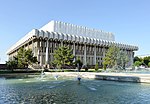
The Peoples' Friendship Palace (Uzbek: Xalqlar doʻstligi saroyi, Russian: Дворец Дружбы народов) is the concert and cinema hall in Tashkent, capital city of Uzbekistan. The building was designed by architect Yevgeny Rozanov from the Moscow Architectural Institute who one decade prior to that worked on the city's Lenin Museum, modern day State Museum of History of Uzbekistan. The building was completed in 1981. As the largest cinema and concert hall in the country the palace provides seating for up to 6,000 people. The palace is named in the memory of solidarity and friendship of volunteers who came to the city after the devastating 1966 Tashkent earthquake. Up until 2020 the palace is represented on the 100 Uzbekistani sum banknote. Initial plans for the new palace were developed already in 1971. The interior of the building was decorated with ceiling lights, chandeliers, large plaster panels and with three monumental florentine mosaics, named "Peoples' Friendship", "Holiday" and "Land of Flowers", on the banquet hall walls. The building's façade and decorations draw inspiration from national ornamental patterns, reminiscent of muqarnas elements found in local architecture. Local marble, as well as Nurota and G'ozg'on marbles, were used in the construction. Today, the palace is used for various events such as congresses, conferences, festivals, and concerts. Official ceremonies for foreign state representatives are also held in the concert hall. The treaty leading to the establishment of the post-Soviet regional Collective Security Treaty Organization was signed at the palace in 1992 while in 2004 the palace hosted the summit of the Shanghai Cooperation Organisation. In April of 2008 the body known as the Republican Commission on the Standardization of Toponyms issued the decision No. 07-5-16 after which the palace was renamed to the "Palace of Arts Istiklol". The decision was nevertheless reversed in when on 26 April 2018 President of Uzbekistan Shavkat Mirziyoyev suggested reintroduction of the previous name followed by the formal decision by the Tashkent City Council of People's Deputies on May 3, 2018.