place

Prince Alexander of Battenberg Square

Bulgaria stubsSquares in Sofia
Royal Palace Sofia
Royal Palace Sofia

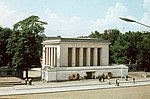
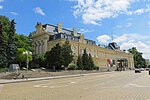
Prince Alexander I Square (Bulgarian: площад Княз Александър I, Ploshtad Knyaz Aleksandar I), often called simply Battenberg Square (площад Батенберг) is the largest square of Sofia, the capital of Bulgaria. It is named after Alexander Joseph of Battenberg (Alexander I of Bulgaria), the first prince of modern Bulgaria. During the Communist rule of Bulgaria, the square was named September 9th Square, after a coup on September 9, 1944, made the country a Communist state. Before 1944, the square was known as Tsar's Square because the former royal palace, now the National Art Gallery was located there. It was the site of the Georgi Dimitrov Mausoleum from 1949 until 1999. It is arguably the most suitable place in Sofia for major open-air concerts such as the concert series "Opera on the Square", demonstrations, parades (including the military parade on St George's Day) and other large-scale events.

Excerpt from the Wikipedia article Prince Alexander of Battenberg Square (License: CC BY-SA 3.0, Authors, Images).

Prince Alexander of Battenberg Square
pl. Knyaz Aleksandar I, Sofia Centre (Sredec)

Geographical coordinates (GPS) Address Nearby Places
placeShow on map

Wikipedia: Prince Alexander of Battenberg SquareContinue reading on Wikipedia

Geographical coordinates (GPS)

Latitude Longitude
N 42.696111111111 ° E 23.326388888889 °
placeShow on map

Address

Един човек

pl. Knyaz Aleksandar I
1000 Sofia, Centre (Sredec)
Bulgaria
mapOpen on Google Maps

Royal Palace Sofia
Royal Palace Sofia
Share experience

Nearby Places

City Garden (Sofia)
City Garden (Sofia)

The City Garden (Bulgarian: Градска градина, Gradska gradina) is Sofia, the capital of Bulgaria's oldest and most central public garden, in existence since 1872. It is located between Tsar Osvoboditel Boulevard to the north, Knyaz Alexander Battenberg Street to the west and Joseph Vladimirovich Gourko Street to the south, in the historical centre of the city. Originally arranged in the last years of the Ottoman rule of Bulgaria, it was radically transformed immediately after the Liberation of Bulgaria in 1878 and the choice of Sofia as the capital the following year under the city architect Antonín Kolář on the initiative of the temporary governor Pyotr Alabin. The alley network was reorganized, new plants were added, as well as a low wooden fence, a coffeehouse and a kiosk for musicians. The garden was initially named the Alexander II Garden in honour of Russian tsar Alexander II, who initiated the Russo-Turkish War of 1877-78, which led to the Liberation of Bulgaria. Until the end of the 19th century the City Garden was repeatedly reorganized and further developed. Among the noted gardeners that worked on it were Karl Betz, Daniel Neff and Iliya Todorov, who shaped the garden's appearance that it would retain until the Second World War. The construction of the now-demolished Georgi Dimitrov Mausoleum soon after the beginning of Communist rule of Bulgaria after the war was followed by multiple fundamental reorganizations, such as in 1951 and 1959 by Sugarev and R. Robev, 1976 and 1978 by A. Agura. These led to the orientation of the garden not towards the former royal palace as previously, but towards the Ivan Vazov National Theatre. The new composition was often in conflict with the initial planning and the City Garden lost territory and key architectural elements in the period. Today the City Garden is not only a popular retreat for the residents of the capital, but also a favoured place for amateur chess players, who can be regularly seen in the small garden in front of the National Theatre. It was also the place where a group of around 300 people gathered on 27 August 1895 to climb Cherni vrah in Vitosha led by the writer Aleko Konstantinov on what is regarded as the birth date of tourism in Bulgaria.

Ivan Vazov National Theatre

The Ivan Vazov National Theatre (Bulgarian: Народен театър „Иван Вазов“, Naroden teatar „Ivan Vazov“) is Bulgaria's national theatre, as well as the oldest and most authoritative theatre in the country and one of the important landmarks of Sofia, the capital of Bulgaria. It is located in the centre of the city, with the facade facing the City Garden.Founded in 1904 by the artists from the Salza i Smyah company, it was initially called simply the National Theatre, but before being named after the prominent writer Ivan Vazov it also bore the name of Krastyu Sarafov between 1952 and 1962. Vazov's play The Outcasts was the first to be performed at the theatre when it opened. The theatre's Neoclassical building, designed by famous Viennese theatre architects Hermann Helmer and Ferdinand Fellner, was finished in 1906 and opened on 3 January 1907. The building was extensively damaged by a fire in 1923 during an anniversary celebration, but was reconstructed in 1929 by German architect Martin Dülfer. A theatrical school was established as part of the National Theatre in 1925. The bombing of Sofia in World War II caused considerable damage to the building, but it was reconstructed in 1945. Another reconstruction followed in 1971–1975, and a €100,000 restoration project was implemented in 2006.The Ivan Vazov National Theatre has a well-equipped main stage with 750 seats, a smaller 120-seat stage and an additional 70-seat one on the fourth floor. The building's facade is depicted on the obverse of the Bulgarian 50 levs banknote, issued in 1999 and 2006.The theatre has been host to productions from notable theatre directors such as Alexander Morfov who has been the Chief director since 1993.