place

Russian Church, Sofia

20th-century Eastern Orthodox church buildings20th-century churches in BulgariaChurches completed in 1914Churches in SofiaEastern Orthodox church buildings in Bulgaria
Russian Orthodox church buildingsRussian Revival architecture
Russian Church Sofia Bulgaria Morning

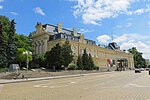
The Russian Church (Bulgarian: Руска църква, romanized: Ruska tsarkva), officially known as the Church of St Nicholas the Miracle-Maker (Bulgarian: църква „Св. Николай Чудотворец“, romanized: tsarkva "Sv. Nikolay Chudotvorets"), is a Russian Orthodox church in central Sofia, Bulgaria situated on Tsar Osvoboditel Boulevard.

Excerpt from the Wikipedia article Russian Church, Sofia (License: CC BY-SA 3.0, Authors, Images).

Russian Church, Sofia
bul. Tsar Osvoboditel, Sofia Centre (Sredec)

Geographical coordinates (GPS) Address External links Nearby Places
placeShow on map

Wikipedia: Russian Church, SofiaContinue reading on Wikipedia

Geographical coordinates (GPS)

Latitude Longitude
N 42.6957 ° E 23.3291 °
placeShow on map

Address

Св. Николай Чудотворец (Руска църква)

bul. Tsar Osvoboditel 3
1000 Sofia, Centre (Sredec)
Bulgaria
mapOpen on Google Maps

linkWikiData (Q873892)
linkOpenStreetMap (162791009)

Russian Church Sofia Bulgaria Morning
Share experience

Nearby Places

Central Military Club

The Central Military Club (Bulgarian: Централен военен клуб, Tsentralen voenen klub) is a multi-purpose monument of culture building in the centre of Sofia, the capital of Bulgaria, located on Tsar Osvoboditel Boulevard and Georgi Rakovski Street. It serves the Bulgarian Army and is administered by the Executive Agency of Military Clubs and Information. The 2010 world chess championship match between Viswanathan Anand of India and Vaselin Topalov of Bulgaria was held in this building that was won by Viswanathan Anand. The foundation stone of the edifice was laid in 1895. The Military Club was designed by Czech architect Antonín Kolář in the Neo-Renaissance style and finished by Bulgarian architect Nikola Lazarov in 1907. The lot and the funding was provided by the Sofia Officers' Assembly. A stone from the battlefield at Slivnitsa from the Serbo-Bulgarian War (1885-1886) was laid in the foundations. The building has three stories and features a coffeehouse, an art gallery, a number of refined halls varying in size, as well as an imposing concert hall with 450 seats. Due to all this, the Central Military Club has always been an important cultural centre of the capital, once exhibiting works by Ivan Mrkvička, Vladimir Dimitrov, Jaroslav Věšín and providing these noted artists with studios. The concert hall has also seen performances by actors and opera singers like Krastyu Sarafov, Nicolai Ghiaurov, Feodor Chaliapin, Boris Christoff, and bands like Ladytron etc.

National Opera and Ballet of Bulgaria

The National Opera and Ballet (Bulgarian: Национална опера и балет) is a national cultural institution in Bulgaria that covers opera and ballet. It is based in an imposing building in Sofia, the capital of Bulgaria. The first opera company in Bulgaria was founded in 1890 as part of the Capital Opera and Drama Company. The two sections split in 1891 to form the Salza i Smyah theatrical company and the Capital Bulgarian Opera. It was, however, disbanded the next year due to lack of government funding and financial difficulties. The Bulgarian Opera Society was established in 1908 and staged its first test performance. The first full opera was performed in 1909 — Pagliacci by Leoncavallo. The first Bulgarian opera works were also presented in the period, including Siromahkinya by Emanuil Manolov, Kamen i Tsena by Ivan Ivanov and Václav Kaucký, Borislav by Georgi Atanasov and Tahir Begovitsa by Dimitar Hadzhigeorgiev. As the company evolved under the ensemble system and style, the permanent troupe of soloists, choir, orchestra, ballet, technical and production teams produced up to 10 opera and ballet premieres a year, in addition to concert programs. Gradually, the basic repertory of world opera classics was established at the same time as the theatre began to attract Bulgarian composers who created new national works. 20th Century performers such as Nicolai Ghiaurov, Nicola Ghiuselev, and Ghena Dimitrova began their careers within the structure of the National Opera, as did later singers such as Irena Petkova and Kiril Manolov. The institution became a national one in 1922 and changed its name to National Opera. A ballet company was established and gave its first performance in 1928. The opera ceased its activity for a while after the 1944 bombing of Sofia, but was restored shortly afterward with a significant increase of government funding. The National Opera and Ballet's building was designed in 1921 and built for the most part between 1947 and its opening in 1953. In 2000, the company co-organized the Boris Christoff Twelfth International Competition for Young Opera Singers with the idea of attracting a younger audience and supporting young and upcoming singers. The repertoire historically tended to favour the Italian and French repertoire with little Wagnerian tradition, although since 2010, the artistic director of the opera company Plamen Kartaloff began a Ring Cycle with entirely Bulgarian casts. Following the entry of Parsifal and Tristan und Isolde into the repertoire, the complete cycle was performed both in Moscow and Sofia during 2018.

Monument to the Unknown Soldier, Sofia

The Monument to the Unknown Soldier (Bulgarian: Паметник на Незнайния воин, Pametnik na Neznayniya voin) is a monument in the centre of Sofia, the capital of Bulgaria, located just next to the 6th-century Church of St Sophia, on 2 Paris Street. The monument commemorates the hundreds of thousands of Bulgarian soldiers who died in wars defending their homeland. Ceremonies involving the President of Bulgaria and foreign state leaders are often performed here.The monument was designed by architect Nikola Nikolov and opened on September 22, 1981, the 1300th anniversary of establishment of the Bulgarian state.The Monument to the Unknown Soldier features an eternal flame, turf from Stara Zagora and Shipka Pass, sites of two of the most important battles of the Russo-Turkish War of Liberation (the Battle of Stara Zagora and the Battle of Shipka Pass), a sculpture of a lion (a national symbol of Bulgaria) by the noted sculptor Andrey Nikolov, as well as a stone inscription of a stanza (part of The New Graveyard Above Slivnitsa 1885 poem) by the national writer Ivan Vazov: БЪЛГАРИЙО, ЗА ТЕБЕ ТЕ УМРЯХА,ЕДНА БЕ ТИ ДОСТОЙНА ЗАРАД ТЯХ И ТЕ ЗА ТЕБ ДОСТОЙНИ, МАЙКО, БЯХА! O BULGARIA, FOR YOU THEY DIED,ONLY ONE WERE YOU WORTHY OF THEM AND THEY OF YOU WORTHY, O MOTHER, WERE! After the end of the First World War, a group of Bulgarians proposed building the monument. However, strong opposition to the building of this monument arose. Some Bulgarian intellectuals argued that a monument of an unknown soldier is unacceptable since it would imply that the names of the soldiers have been forgotten. "Not a single soldier shall be forgotten who gave his life in this war and in all other wars for the freedom of Bulgaria!".The monument was designed but was not displayed because of the above-mentioned arguments. The lion itself was considered an abuse for a long time because it was sitting. The pose was considered a metaphor of surrender to the national ideas.