place

Stolichna Municipality

Geography of Sofia City Province

The Stolichna Municipality (Bulgarian: Столична община, romanized: Stolichna obshtina (also transcribed as Stolična obština), lit. 'Capital Municipality') is an obshtina (municipality) in Sofia City Province, Western Bulgaria. It is named after its administrative centre - the city of Sofia, which is also the capital of Sofia City Province and Sofia Province and the capital of Bulgaria as well. The municipality is located mainly in the Sofia Valley, and also in the foots and lower parts of the mountains of Stara planina and Vitosha, Plana, Lozen, Rila. It is home to 1,500,927 inhabitants from which 1.400 million live in Sofia (as of 2016).

Excerpt from the Wikipedia article Stolichna Municipality (License: CC BY-SA 3.0, Authors).

Stolichna Municipality
Ларгото, Sofia

Geographical coordinates (GPS) Address Nearby Places
placeShow on map

Wikipedia: Stolichna MunicipalityContinue reading on Wikipedia

Geographical coordinates (GPS)

Latitude Longitude
N 42.6976 ° E 23.3236 °
placeShow on map

Address

ЦУМ

Ларгото
1000 Sofia (Oborishte)
Bulgaria
mapOpen on Google Maps

Share experience

Nearby Places

Church of St Petka of the Saddlers

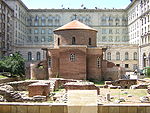
The Church of St Petka of the Saddlers (Bulgarian: Църква „Света Петка Самарджийска“) is a medieval Bulgarian Orthodox church in Sofia, the capital of Bulgaria. It is a small one-naved building partially dug into the ground located in the very centre of both the modern and the antique city, in the TZUM underpass. The church features a semi-cylindrical vault, a hemispherical apse, and a crypt discovered during excavations after the Second World War. The walls are 1 m thick and made from brick and stone. The church was first mentioned in the 16th century and was constructed at the place of a former Roman religious building. It is today a monument of culture known for its mural paintings from the 14th, 15th, 17th and 19th century depicting biblical scenes. The church is dedicated to St Petka, an 11th-century Bulgarian saint. The Church of Saint Petka acquired its present name due to it being a patron of the saddlers in the Middle Ages, who performed their rituals in the church. The adjective samardzhiyski ("of the saddlers") was derived from the Ottoman Turkish word semerci, meaning "saddlemaker". According to one theory, Bulgarian national hero Vasil Levski is buried in the church. Press reports from 1937 retelling the stories of those who carried out a reburial, which might have been for Levski and reports from the 1956 excavation speculating that bones found might have been those indicated by the 1937 press, led to the skeleton labeled "No. 95", being sent for professional examination. When Magdalina Stancheva museologist and head of the Archaeology Department at the Sofia Regional Historical Museum received the bones, she sent them to the laboratory run by Petîr Boev at the Archaeological Institute for examination. The bones were either destroyed by mice or lost. Nikolai Khaitov, a popular writer, accused Stancheva; archaeologists Georgi Dzhingov and Stamen Mikhailov; Krîstiu Miiatev, director of the Archaeological Institute; and Todor Pavlov, president of the National Academy of Bulgaria of participating in a conspiracy to prevent investigation into Levski's burial site and publicly accused Stancheva of mishandling the remains. Two commissions met over the controversy in the 1980s, and confirmed that there was no proof which could substantiate that the bones were Levski's, as the bones were missing.

Sofia Central Mineral Baths

The Central Mineral Baths (Централна минерална баня, Tsentralna mineralna banya) is a landmark in the city center of Sofia, the capital of Bulgaria, a city known for the mineral springs in the area. It was built in the early 20th century near the former Turkish bath (then destroyed) and was used as the city's public baths until 1986. Public baths have existed in Sofia since at least the 16th century. During the visit of Bohemian traveler Hans Dernschwam to Sofia in 1553–1555, Derschwam noted the presence of 1 large bath and 2 smaller baths on either side of the city. Dernschwam described the baths as follows: The baths are located on the square; there is a big quadrangular building in front by the entrance, with a round Greek-style dome on top, like the Pantheon in Rome. It is richly covered in white marble … The big water conduits that lead the water into the baths are made of potter's clay. Each tube is approximately one Viennese cubit long and the separate tubes go through each other. They are plastered up like I have seen in Siebenbürgen (Transylvania) too, in old buildings in Thorenburg (Turda). The current Central Mineral Baths building was designed in the Vienna Secession style, but integrating typically Bulgarian, Byzantine and Eastern Orthodox ornamental elements, by the architects Petko Momchilov and Friedrich Grünanger in 1904–1905 and approved on 30 January 1906, as projects by an Austrian (in 1889) and a French architect (in 1901) were declined. The raw construction was finished in 1908 and a Bulgarian company constructed the complex roof and the mineral water conduit. The baths opened on 13 May 1913, but the building was completely finished after 2 more years and a garden was arranged in front of the baths. Artists Haralampi Tachev and St. Dimitrov designed the building's ceramic majolica decoration.The north wing was damaged during the bombing of Sofia in World War II, but was restored several years later. The baths continued to work as public baths until 1986, when the building was closed due to its bad condition and the possible collapse of the roof. It was subsequently partially reconstructed and thoroughly cleaned and accommodates the Sofia Regional Historical Museum since September 2015.