place

National Museum of Natural History, Bulgaria

Bulgarian building and structure stubsEuropean museum stubsFossil museumsGeology museums in BulgariaMuseums established in 1889
Museums in SofiaNational museums of BulgariaNatural history museums in BulgariaScience museums in Bulgaria
Natural history sofia ifb

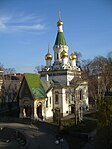
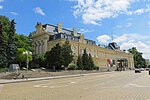
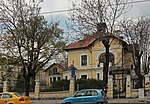
The National Museum of Natural History (Bulgarian: Национален природонаучен музей, Natsionalen prirodonauchen muzey; abbreviated НПМ, NMNHS) of Bulgaria is a natural history museum located in Sofia, the capital of Bulgaria, on Tsar Osvoboditel Boulevard, next to the Russian church. Founded in 1889, it is affiliated with the Bulgarian Academy of Sciences, and is the first and largest museum of this kind in the Balkans. The Museum's collection includes over 400 stuffed mammals, over 1,200 species of birds, hundreds of thousands of insects and other invertebrates, as well as samples of about one quarter of the world's mineral species. The National Museum of Natural History was founded in 1889 as the Natural History Museum of Knyaz Ferdinand of Bulgaria, with various foreign and Bulgarian specialists (e.g. Ivan Buresh, director from 1913 to 1947) serving as its directors until 1947, when the museum became part of the Bulgarian Academy of Sciences' Zoological Institute. The Museum became autonomous as a separate institute within the system of BAS in 1974. In 1992, the Asenovgrad Palaeontology Museum, an NMNH branch in Asenovgrad, was formed. Currently the museum publishes Historia naturalis bulgarica journal.

Excerpt from the Wikipedia article National Museum of Natural History, Bulgaria (License: CC BY-SA 3.0, Authors, Images).

National Museum of Natural History, Bulgaria
bul. Tsar Osvoboditel, Sofia Centre (Sredec)

Geographical coordinates (GPS) Address Website External links Nearby Places
placeShow on map

Wikipedia: National Museum of Natural History, BulgariaContinue reading on Wikipedia

Geographical coordinates (GPS)

Latitude Longitude
N 42.695683333333 ° E 23.328463888889 °
placeShow on map

Address

Национален природонаучен музей при БАН

bul. Tsar Osvoboditel 1
1000 Sofia, Centre (Sredec)
Bulgaria
mapOpen on Google Maps

Website
nmnhs.com

linkVisit website

linkWikiData (Q6974486)
linkOpenStreetMap (2109132)

Natural history sofia ifb
Share experience

Nearby Places

Central Military Club

The Central Military Club (Bulgarian: Централен военен клуб, Tsentralen voenen klub) is a multi-purpose monument of culture building in the centre of Sofia, the capital of Bulgaria, located on Tsar Osvoboditel Boulevard and Georgi Rakovski Street. It serves the Bulgarian Army and is administered by the Executive Agency of Military Clubs and Information. The 2010 world chess championship match between Viswanathan Anand of India and Vaselin Topalov of Bulgaria was held in this building that was won by Viswanathan Anand. The foundation stone of the edifice was laid in 1895. The Military Club was designed by Czech architect Antonín Kolář in the Neo-Renaissance style and finished by Bulgarian architect Nikola Lazarov in 1907. The lot and the funding was provided by the Sofia Officers' Assembly. A stone from the battlefield at Slivnitsa from the Serbo-Bulgarian War (1885-1886) was laid in the foundations. The building has three stories and features a coffeehouse, an art gallery, a number of refined halls varying in size, as well as an imposing concert hall with 450 seats. Due to all this, the Central Military Club has always been an important cultural centre of the capital, once exhibiting works by Ivan Mrkvička, Vladimir Dimitrov, Jaroslav Věšín and providing these noted artists with studios. The concert hall has also seen performances by actors and opera singers like Krastyu Sarafov, Nicolai Ghiaurov, Feodor Chaliapin, Boris Christoff, and bands like Ladytron etc.

Ivan Vazov National Theatre

The Ivan Vazov National Theatre (Bulgarian: Народен театър „Иван Вазов“, Naroden teatar „Ivan Vazov“) is Bulgaria's national theatre, as well as the oldest and most authoritative theatre in the country and one of the important landmarks of Sofia, the capital of Bulgaria. It is located in the centre of the city, with the facade facing the City Garden.Founded in 1904 by the artists from the Salza i Smyah company, it was initially called simply the National Theatre, but before being named after the prominent writer Ivan Vazov it also bore the name of Krastyu Sarafov between 1952 and 1962. Vazov's play The Outcasts was the first to be performed at the theatre when it opened. The theatre's Neoclassical building, designed by famous Viennese theatre architects Hermann Helmer and Ferdinand Fellner, was finished in 1906 and opened on 3 January 1907. The building was extensively damaged by a fire in 1923 during an anniversary celebration, but was reconstructed in 1929 by German architect Martin Dülfer. A theatrical school was established as part of the National Theatre in 1925. The bombing of Sofia in World War II caused considerable damage to the building, but it was reconstructed in 1945. Another reconstruction followed in 1971–1975, and a €100,000 restoration project was implemented in 2006.The Ivan Vazov National Theatre has a well-equipped main stage with 750 seats, a smaller 120-seat stage and an additional 70-seat one on the fourth floor. The building's facade is depicted on the obverse of the Bulgarian 50 levs banknote, issued in 1999 and 2006.The theatre has been host to productions from notable theatre directors such as Alexander Morfov who has been the Chief director since 1993.

National Opera and Ballet of Bulgaria

The National Opera and Ballet (Bulgarian: Национална опера и балет) is a national cultural institution in Bulgaria that covers opera and ballet. It is based in an imposing building in Sofia, the capital of Bulgaria. The first opera company in Bulgaria was founded in 1890 as part of the Capital Opera and Drama Company. The two sections split in 1891 to form the Salza i Smyah theatrical company and the Capital Bulgarian Opera. It was, however, disbanded the next year due to lack of government funding and financial difficulties. The Bulgarian Opera Society was established in 1908 and staged its first test performance. The first full opera was performed in 1909 — Pagliacci by Leoncavallo. The first Bulgarian opera works were also presented in the period, including Siromahkinya by Emanuil Manolov, Kamen i Tsena by Ivan Ivanov and Václav Kaucký, Borislav by Georgi Atanasov and Tahir Begovitsa by Dimitar Hadzhigeorgiev. As the company evolved under the ensemble system and style, the permanent troupe of soloists, choir, orchestra, ballet, technical and production teams produced up to 10 opera and ballet premieres a year, in addition to concert programs. Gradually, the basic repertory of world opera classics was established at the same time as the theatre began to attract Bulgarian composers who created new national works. 20th Century performers such as Nicolai Ghiaurov, Nicola Ghiuselev, and Ghena Dimitrova began their careers within the structure of the National Opera, as did later singers such as Irena Petkova and Kiril Manolov. The institution became a national one in 1922 and changed its name to National Opera. A ballet company was established and gave its first performance in 1928. The opera ceased its activity for a while after the 1944 bombing of Sofia, but was restored shortly afterward with a significant increase of government funding. The National Opera and Ballet's building was designed in 1921 and built for the most part between 1947 and its opening in 1953. In 2000, the company co-organized the Boris Christoff Twelfth International Competition for Young Opera Singers with the idea of attracting a younger audience and supporting young and upcoming singers. The repertoire historically tended to favour the Italian and French repertoire with little Wagnerian tradition, although since 2010, the artistic director of the opera company Plamen Kartaloff began a Ring Cycle with entirely Bulgarian casts. Following the entry of Parsifal and Tristan und Isolde into the repertoire, the complete cycle was performed both in Moscow and Sofia during 2018.