place

Temnac P-38G Lightning

1940s United States fighter aircraft1942 establishments in AlaskaAircraft on the National Register of Historic PlacesAlaska Registered Historic Place stubsIndividual aircraft of World War II
Lockheed aircraftNational Register of Historic Places in Anchorage, AlaskaTransportation on the National Register of Historic Places in AlaskaUse mdy dates from August 2023World War II on the National Register of Historic Places in Alaska
P 38 at JBER 2
P 38 at JBER 2

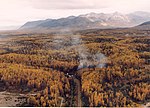
The Temnac P-38G Lightning is a historic military aircraft, now on display at Joint Base Elmendorf–Richardson. It is a Lockheed P-38 Lightning, military serial number 42-13400, which entered service in the United States Army Air Forces at what was then known as Elmendorf Field in 1942, during World War II, and was assigned to the 54th Fighter Squadron. In January 1945 it was taken out on a training mission over the western Aleutian Islands by 2d Lt. Robert Nesmith. While flying low over the Temnac River valley on Attu Island, Nesmith experienced fluctuations in one of the engines, and was forced to put the aircraft down. He crash-landed the aircraft in the valley without injury to himself.The aircraft was abandoned at the crash site, the Air Force stripping it of salvageable materials. The hulk remained in situ for many years, and was listed on the National Register of Historic Places in 1979. The hulk was recovered in 1999 by Air Force veterans and brought to Elmendorf AFB, where it underwent restoration to correct the ravages of weather and damage done by the original salvage operation. It was placed on display at Elmendorf in 2000.

Excerpt from the Wikipedia article Temnac P-38G Lightning (License: CC BY-SA 3.0, Authors, Images).

Temnac P-38G Lightning
Sijan Avenue, Anchorage

Geographical coordinates (GPS) Address Website Nearby Places
placeShow on map

Wikipedia: Temnac P-38G LightningContinue reading on Wikipedia

Geographical coordinates (GPS)

Latitude Longitude
N 61.248333333333 ° E -149.80194444444 °
placeShow on map

Address

McCloud Memorial

Sijan Avenue
99506 Anchorage
Alaska, United States
mapOpen on Google Maps

Website
af.mil
linkVisit website

P 38 at JBER 2
P 38 at JBER 2
Share experience

Nearby Places

Joint Task Force-Alaska

The Joint Task Force Alaska (JTF-AK), headquartered at Joint Base Elmendorf-Richardson in Alaska is a multi-service command composed of approximately 80 soldiers, sailors, airmen, coast guardsmen and civilian specialists. The task force is a homeland defense component of U.S. Northern Command that coordinates the land defense of Alaska and also coordinates military assistance to civil authorities. The JTF-AK's goals are stated as "detect, deter, prevent and defeat terrorist threats within the Alaskan joint area of operations". The task force also states that is conducts civil support as directed. JTF-AK plans and integrates the full spectrum of DoD support to homeland defense and civil support to lead federal agencies, such as the Federal Emergency Management Agency (FEMA). Prevention, crisis response and consequence management are capabilities included within the spectrum of support. In coordination with other federal, state and local agencies, JTF-AK constantly evaluates events and locations throughout Alaska for their potential vulnerability as targets for aggression, such as terrorism. JTF-AK provides situational awareness to military commands and civilian agencies throughout the state of Alaska and the continental U.S. to aid in homeland security awareness and planning. JTF-AK's civil support mission includes domestic disaster relief operations that occur during fires, hurricanes, floods and earthquakes. Support also includes managing the consequences of a terrorist event employing a weapon of mass destruction. The task force provides assistance to a lead federal agency when tasked by the DoD. Per the Posse Comitatus Act, military forces can provide civil support in order to save lives, prevent injuries and provide temporary critical life support, but cannot become directly involved in law enforcement. The U.S. military has a long history of providing assistance to civil authorities during emergencies and other instances of national concern. An emergency must exceed the management capabilities of local, state and federal agencies before JTF-AK becomes involved. In most cases, support will be limited, localized and specific. When the scope if the disaster is reduced to the point that the lead federal agency can again assume full control and management without military assistance, JTF-AK will exit, leaving the on-scene experts to finish the job. On February 11, 2002, the Chairman of the Joint Chiefs of Staff directed USNORTHCOM to establish and USPACOM to source JTF-AK.