place

1995 Alaska Boeing E-3 Sentry accident

1995 in AlaskaAccidents and incidents involving United States Air Force aircraftAccidents and incidents involving the Boeing 707Airliner accidents and incidents caused by bird strikesAviation accidents and incidents in 1995
Aviation accidents and incidents in AlaskaSeptember 1995 events in the United States
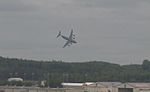
E 3B Sentry AWACS Crash 22 Sep 95

The Alaska Boeing E-3 Sentry accident was the September 22, 1995 crash of a United States Air Force Boeing E-3 Sentry airborne early warning aircraft with the loss of all 24 crewmembers on board. The aircraft, serial number 77-0354 with callsign Yukla 27, hit birds on departure from Elmendorf Air Force Base in Alaska, United States. With the loss of thrust from both of the left engines the aircraft crashed into a wooded area less than a mile from the end of the runway.

Excerpt from the Wikipedia article 1995 Alaska Boeing E-3 Sentry accident (License: CC BY-SA 3.0, Authors, Images).

1995 Alaska Boeing E-3 Sentry accident
Ladue Road, Anchorage

Geographical coordinates (GPS) Address Nearby Places
placeShow on map

Wikipedia: 1995 Alaska Boeing E-3 Sentry accidentContinue reading on Wikipedia

Geographical coordinates (GPS)

Latitude Longitude
N 61.265833333333 ° E -149.76083333333 °
placeShow on map

Address

Ladue Road

Ladue Road
99506 Anchorage
Alaska, United States
mapOpen on Google Maps

E 3B Sentry AWACS Crash 22 Sep 95
Share experience

Nearby Places

Joint Task Force-Alaska

The Joint Task Force Alaska (JTF-AK), headquartered at Joint Base Elmendorf-Richardson in Alaska is a multi-service command composed of approximately 80 soldiers, sailors, airmen, coast guardsmen and civilian specialists. The task force is a homeland defense component of U.S. Northern Command that coordinates the land defense of Alaska and also coordinates military assistance to civil authorities. The JTF-AK's goals are stated as "detect, deter, prevent and defeat terrorist threats within the Alaskan joint area of operations". The task force also states that is conducts civil support as directed. JTF-AK plans and integrates the full spectrum of DoD support to homeland defense and civil support to lead federal agencies, such as the Federal Emergency Management Agency (FEMA). Prevention, crisis response and consequence management are capabilities included within the spectrum of support. In coordination with other federal, state and local agencies, JTF-AK constantly evaluates events and locations throughout Alaska for their potential vulnerability as targets for aggression, such as terrorism. JTF-AK provides situational awareness to military commands and civilian agencies throughout the state of Alaska and the continental U.S. to aid in homeland security awareness and planning. JTF-AK's civil support mission includes domestic disaster relief operations that occur during fires, hurricanes, floods and earthquakes. Support also includes managing the consequences of a terrorist event employing a weapon of mass destruction. The task force provides assistance to a lead federal agency when tasked by the DoD. Per the Posse Comitatus Act, military forces can provide civil support in order to save lives, prevent injuries and provide temporary critical life support, but cannot become directly involved in law enforcement. The U.S. military has a long history of providing assistance to civil authorities during emergencies and other instances of national concern. An emergency must exceed the management capabilities of local, state and federal agencies before JTF-AK becomes involved. In most cases, support will be limited, localized and specific. When the scope if the disaster is reduced to the point that the lead federal agency can again assume full control and management without military assistance, JTF-AK will exit, leaving the on-scene experts to finish the job. On February 11, 2002, the Chairman of the Joint Chiefs of Staff directed USNORTHCOM to establish and USPACOM to source JTF-AK.

Alaska Native Heritage Center

The Alaska Native Heritage Center is an educational and cultural institution for all Alaskans, located in Anchorage, Alaska. The center opened in 1999. The Alaska Native Heritage Center shares the heritage of Alaska's 11 major cultural groups. These 11 groups are the Athabaskan people, Eyak people, Tlingit people, Haida people, Tsimshian people, Unangax people (Aleut), Alutiiq people, Yup'ik, Cup'ik, Siberian Yupik, and Inupiaq.The Heritage Center, located ten miles from downtown Anchorage, is situated on 26 wooded acres. The Gathering Place provides visitors an opportunity to experience demonstrations of Alaska Native dancing, Native Games, and traditional storytelling. The Hall of Cultures provides rotating exhibits, craft activities for the family, and craft and artwork created by Alaska Native artists. The theatre features rotating films, including a documentary produced by the Heritage Center, titled "Stories Given, Stories Shared." Outside, visitors can tour the village sites, consisting of six life-sized Native dwellings surrounding Lake Tiulana. The six dwellings represent the unique ways of living practiced by the Athabascan, Inupiaq/St. Lawrence Island Yupik, Yup’ik/Cup’ik, Aleut, Alutiiq, and the Eyak, Tlingit, Haida and Tsimshian peoples. Youth interns lead many tours of the village sites, which also include artifacts for use in daily life.The Alaska Native Heritage Center is the only statewide organization which represents all Alaska Native cultures. The nonprofit is operated by Alaska Natives and is one of the few tribally unaffiliated arts organizations that is run by Indigenous people.