place

Gapcheon station

Daejeon Metro stationsRailway stations in South Korea opened in the 2000sRailway stations opened in 2007Seo District, DaejeonSouth Korea rapid transit stubs
South Korean railway station stubs
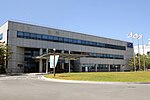
Gapcheon sta. nameplate

Gapcheon Station (Korean: 갑천역; Hanja: 甲川驛) is a station of the Daejeon Metro Line 1 in Wolpyeong-dong, Seo District, Daejeon, South Korea. It has two functional platforms. It was opened on April 17, 2007. It is located on the river side and on the Gapcheondosi Expressway.

Excerpt from the Wikipedia article Gapcheon station (License: CC BY-SA 3.0, Authors, Images).

Gapcheon station
Wolpyeongsaetteum-ro 20beon-gil, Daejeon Wolpyeong 1(il)-dong

Geographical coordinates (GPS) Address Nearby Places
placeShow on map

Wikipedia: Gapcheon stationContinue reading on Wikipedia

Geographical coordinates (GPS)

Latitude Longitude
N 36.354166666667 ° E 127.35472222222 °
placeShow on map

Address

월평새뜸로20번길

Wolpyeongsaetteum-ro 20beon-gil
35226 Daejeon, Wolpyeong 1(il)-dong
South Korea
mapOpen on Google Maps

Gapcheon sta. nameplate
Share experience

Nearby Places

Korea Research Institute of Bioscience and Biotechnology

Korea Research Institute of Bioscience and Biotechnology (KRIBB) is a government research institute in Daejeon, South Korea. It is dedicated to biotechnology research across a broad span of expertise, from basic studies for the fundamental understanding of life phenomena to applied studies such as drug discovery, novel biomaterials, integrated biotechnology and bioinformation. KRIBB was established in 1985. Its accomplishments include the advancement of welfare and medical technology, an increase in food production, a cleaner environment and new bio-materials and energy sources. It has identified reasons for the failure of animal cloning, conducted a comparative study of chimpanzee genes and successfully analyzed the structure of the reactive oxygen species switch protein, which became the first study by Korean scholars to be published in Cell, an international scientific journal. The institute was ranked first in the discovery of new microorganisms, including the indigenous microorganisms of the Dokdo Islets, for four consecutive years. Its recent accomplishments include the development of a genome capable of controlling cancer cell proliferation and the identification of a neuropeptide Y-based growth control mechanism, with possibilities for new treatments for cancer, diabetes, obesity and ageing. Nano–bio sensor research led to the development of the world's smallest surface plasmon resonance biochip.