place

Keithfield Plantation

Agricultural buildings and structures on the National Register of Historic Places in South CarolinaBurned houses in the United StatesFormer buildings and structures in South CarolinaHistoric districts on the National Register of Historic Places in South CarolinaHouses in Georgetown County, South Carolina
NRHP infobox with nocatNational Register of Historic Places in Georgetown County, South CarolinaPee Dee South Carolina Registered Historic Place stubsPlantations in South CarolinaRice plantations in the United StatesSlave cabins and quarters in the United StatesUse mdy dates from August 2023

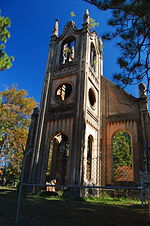
Keithfield Plantation is a historic rice plantation property and national historic district located near Georgetown, Georgetown County, South Carolina. The district encompasses 1 contributing building, 1 contributing site, and 3 contributing structures. They include a slave cabin, built about 1830, and agricultural features including examples of historic ricefields, canals, dikes, and trunks. The original main house burned in the mid-20th century. Keithfield was one of several productive rice plantations on the Black River.It was listed on the National Register of Historic Places in 1988.

Excerpt from the Wikipedia article Keithfield Plantation (License: CC BY-SA 3.0, Authors).

Geographical coordinates (GPS)

Latitude Longitude
N 33.439166666667 ° E -79.244166666667 °
placeShow on map

Address

Georgetown County


South Carolina, United States
mapOpen on Google Maps

Share experience

Nearby Places

South Carolina's 1st congressional district

South Carolina's 1st congressional district is a coastal congressional district in South Carolina, represented by Republican Nancy Mace since January 3, 2021. She succeeded Democrat Joe Cunningham, having defeated him in the 2020 election. Cunningham was the first Democrat to represent the district since the 1980s. The district has historically been based in Charleston. It has included Myrtle Beach, which became a major tourist destination in the late 20th century, as well as other coastal areas that have attracted retirees and seasonal visitors. From 1993 to 2013, the district boundaries extended from Seabrook Island in the south to the North Carolina border and included parts of Charleston, Dorchester, Berkeley and Georgetown counties and all of Horry County to the North Carolina line. In 2010, the state received another seat in Congressional apportionment due to an increase in population. The state's districts had to be redrawn, which was completed in 2013. In the final plan, the 1st congressional district was redrawn to reach from Hilton Head to mid-coast South Carolina, ending at the Santee River and comprising parts of Charleston, Berkeley, Dorchester and Beaufort counties. This configuration is similar to the one it had for most of the 20th century. Horry County was included in the new 7th congressional district. On January 6, 2023, the district was declared unconstitutional on account of racial gerrymandering and would have to be redrawn April of that year. The Supreme Court justices added Alexander v. South Carolina State Conference of the NAACP to their merits calendar for the 2023–24 term. At least fifteen amicus briefs were filed by various organizations and individuals with standing before the court. The case was argued on October 11, 2023, with a decision pending in 2024.

All Saints Church (Pawleys Island, South Carolina)

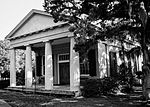
All Saints Church Pawleys Island is a historic church complex and national historic district located on Pawleys Island, Georgetown County, South Carolina. The district encompasses three contributing buildings and one contributing site—the sanctuary, cemetery, rectory, and chapel. In 2004, it left the Episcopal Church to join the Diocese of the Carolinas, now part of the Anglican Church in North America, a denomination within the Anglican realignment movement. The sanctuary, built 1916–1917, the fourth to serve this congregation, is significant as an excellent example of the Classical Revival style, adapting the design of the church's 19th century sanctuary which burned in 1915. It is a one-story rectangular brick building sheathed in scored stucco. It has an engaged pedimented portico supported by four fluted Greek Doric order columns. A Doric frieze, composed of triglyphs, metopes, and guttae, runs under the cornice around the building on three sides. The church has a large center aisle sanctuary with a coved tray ceiling. The church cemetery, established in the 1820s, is significant for the persons buried there, many of whom were the leading public figures of antebellum Georgetown County. It is also significant a collection of outstanding gravestone art from about 1820 to 1900. The church rectory, built in 1822, is an intact example of a Carolina I-house. Its first congregation was formed in 1739, and the church has been located at this site since then. Associated with the church is the separately listed Cedar Grove Plantation Chapel.It was added to the National Register of Historic Places in 1991.