place

Arena Coliseo

Boxing venues in MexicoIndoor arenas in MexicoSports venues in Mexico City
Embudo de la lagunilla

Arena Coliseo is an indoor arena in Mexico City, Mexico located at República del Perú 77 in the Cuauhtémoc borough. The arena is primarily used for professional wrestling, or lucha libre, shows promoted by Consejo Mundial de Lucha Libre (CMLL). The building was completed in 1943, built by Salvador Lutteroth, founder and owner of CMLL and served as the main venue for CMLL from 1943 until 1953 when Arena México was completed and became the main venue for Lutteroth's promotion. It has a seating capacity of 5,250 when configured for professional wrestling or boxing events.

Excerpt from the Wikipedia article Arena Coliseo (License: CC BY-SA 3.0, Authors, Images).

Arena Coliseo
Calle República de Perú, Mexico City

Geographical coordinates (GPS) Address External links Nearby Places
placeShow on map

Wikipedia: Arena ColiseoContinue reading on Wikipedia

Geographical coordinates (GPS)

Latitude Longitude
N 19.439444444444 ° E -99.134722222222 °
placeShow on map

Address

Arena Coliseo

Calle República de Perú
06010 Mexico City
Mexico
mapOpen on Google Maps

linkWikiData (Q16251625)
linkOpenStreetMap (217319361)

Embudo de la lagunilla
Share experience

Nearby Places

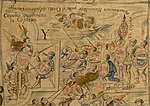
Battle of Colhuacatonco

The Battle of Colhuacatonco was fought on 30 June 1521 during the late stages of the Siege of Tenochtitlan between Spanish-Tlaxcalan forces and the Mexica Empire (also typically referred as Aztec Empire). It is regarded as the most important victory achieved by the Mexica during the siege.The battle was fought as a result of the Spanish soldiers growing dissatisfied with the lack of progress done during the siege thus far, as the Spanish-Tlaxcalan forces had failed to take any important amount of territory since the beginning of June. Captain Hernán Cortés of the Spanish decided to launch a massive assault onto the city to take the market of Tlatelolco. The Spanish faced a much stronger resistance than expected and were eventually forced to retreat, suffering their worst losses since La Noche Triste and the Battle of Otumba a year earlier. Though much of the fighting occurred elsewhere in Tlatelolco, northern Tenochtitlan and Tacuba, the battle became known as such because most of the fighting occurred in this neighborhood; the Spaniards suffered their worst losses in this battle in this site.The battle became famous among modern historians as a result of the Spanish defeat, which was perceived as humiliating and retroactively seen as a demonstration of indigenous resistance against colonialism even in the most dire circumstances, as by this point the city was already facing widespread starvation and disease and yet still achieved victory, though the battle did not stop the city from falling to the Spanish Empire in August of the same year. The battle also became famous because Cortés narrowly escaped death during the fighting, as he was captured by multiple Mexica warriors, who typically didn't spare their prisoners, before he was rescued.