place

Church of Cosmas and Damian, Moscow

15th-century Russian Orthodox church buildingsRussian Orthodox churches in Moscow
Kosma Damian Kitay gorod1

The Church of Saints Cosmas and Damian in Old Panei (Russian: Церковь Космы и Дамиана в Старых Панех), is a Russian Orthodox church dedicated to the twin Saints Cosmas and Damian, Christian martyrs of the 4th century. It is located in the Kitay-gorod, in Moscow, Russia. In the 16th-17th century. Since 1508 it was a location of the Polish diplomatic mission in Russia, since that time this place called Pany or Stary Pany.

Excerpt from the Wikipedia article Church of Cosmas and Damian, Moscow (License: CC BY-SA 3.0, Authors, Images).

Church of Cosmas and Damian, Moscow
Старопанский переулок, Moscow Tverskoy District

Geographical coordinates (GPS) Address External links Nearby Places
placeShow on map

Wikipedia: Church of Cosmas and Damian, MoscowContinue reading on Wikipedia

Geographical coordinates (GPS)

Latitude Longitude
N 55.756111111111 ° E 37.626111111111 °
placeShow on map

Address

Церковь Космы и Дамиана в Старых Панех

Старопанский переулок 4 с2
109012 Moscow, Tverskoy District
Moscow, Russia
mapOpen on Google Maps

linkWikiData (Q4504767)
linkOpenStreetMap (9308383)

Kosma Damian Kitay gorod1
Share experience

Nearby Places

2023 Presidential Address to the Federal Assembly

On 21 February 2023, almost a year after Russia launched a full-scale invasion of Ukraine, Russian president Vladimir Putin delivered an address to the Federal Assembly, at Gostiny Dvor in Moscow, Russia. This was the first Presidential Address to the Federal Assembly since the start of the invasion; Putin did not deliver such an address in 2022.During the address, Putin asserted that the West had started the war, and that Russia had been using force to end it. He stated that the Ukrainian people were hostages of the Ukrainian government. Putin also said that the West had planned to turn a local conflict into a global one, and that the conflict represented an existential threat to Russia. He added that it was impossible to defeat Russia, and vowed to continue fighting in Ukraine. He also praised the people of Luhansk, Donetsk, Kherson, and Zaporizhzhia for the choice they made during the previous year's annexation referendums. Near the end of his speech, Putin announced that Russia would be suspending its participation in the nuclear disarmament treaty New START.Putin's address was simultaneously broadcast on television and in schools and government buildings, as well as displayed on large screens in public places in Russia and the occupied territories of Ukraine. It was delivered a day after U.S. president Joe Biden had made a surprise visit to Kyiv, his first to Ukraine since the start of the invasion. Biden also delivered a speech in Warsaw, Poland, hours after Putin had made his presidential address. The following day, Putin made a brief appearance at a rally at Luzhniki Stadium in Moscow commemorating Defender of the Fatherland Day.

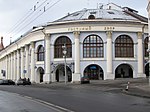
Moscow Gostiny Dvor
Moscow Gostiny Dvor

The Old Merchant Court (Russian: Старый гостиный двор, Stary gostiny dvor) in Moscow occupies a substantial portion of Kitai-gorod, as the old merchant district is known. It located near the famous Red Square, a few hundred metres away. Formerly accommodating both shops and warehouses, it was constructed of brick in the 1590s and underwent significant modifications from 1638–1641. As the Russian capital expanded and the old structure became overcrowded, a new indoor market was completed nearby in 1665. Giacomo Quarenghi, the favored architect of Catherine the Great, in 1789 replaced those medieval buildings with a new shopping mall designed in a sober Neoclassical style with innumerable Corinthian columns and arcades. Several local Moscow architects including S. Karin, I. Egotov and P. Selihov supervised the actual construction. The first phase was delayed because of the death of Catherine the Great and was not completed until 1805. Osip Bove made some modifications to adapt to the slope in the area and to finish following Quarenghi's original plans in 1830.Subsequently, Quarenghi's structure went through many reconstructions. After the Revolution in 1923, the space was subdivided into offices altering the original design significantly. In 1995 a modern glass roof was installed, when the building was being converted into a fashionable exhibition ground. Nowadays, the edifice is used as the setting for fashion shows, business parties, and even Viennese balls. Montserrat Caballé and José Carreras were among those who performed at the New Year parties in Gostiny Dvor.During the 1995 renovations, much archeological work was done on the site. A small museum was established to exhibit some of the numerous finds which include the contents of a pantry from a 17th-century merchant home that had been destroyed by fire. The exhibit hall is open for the public, Monday through Saturday from 11 a.m. until 5 p.m.

Epiphany Monastery
Epiphany Monastery

The Epiphany Monastery (Russian: Богоявленский монастырь, Bogoyavlensky monastyr; better translated as "Theophany Monastery") is the oldest male monastery in Moscow, situated in the Kitai gorod, just one block away from the Moscow Kremlin. According to a legend, it was founded by Daniel, the first prince of Moscow, around 1296. It is also believed that a would-be metropolitan Alexis was one of the monks at this monastery. Stefan, Sergii Radonezhski's older brother, was the first recorded hegumen of this cloister. The first stone church at the Bogoyavlensky monastery was founded in 1342. In 1382, the monastery was sacked by Tokhtamysh's horde. In 1427, it suffered an outbreak of pestilence. The monastery also survived numerous fires, the most important being recorded in 1547, 1551, 1687 and 1737. The Epiphany monastery has always been under the patronage of grand princes and tsars. By the order of Ivan the Terrible, the monastery became a collection facility for metayage, quitrent, and fodder. In 1584, the tsar donated a substantial amount of money for the remembrance of the disgraced. In 1632, the Epiphany monastery was granted an exclusive right for tax free floating of a certain amount of building materials and firewood. The monastery had its own stables, forge and rented out its own facilities. Vasili III, Ivan the Terrible, Boris Godunov, the Romodanovsky boyars, Xenia Repnina, and others donated some of their sizeable estates to the monastery. In 1680-1687, the Epiphany monastery was home to a school of the Likhud brothers, which would later be transferred to the Zaikonospassky monastery and transformed into the famous Slavic Greek Latin Academy. The now-existing Epiphany cathedral was consecrated in 1696. A splendid specimen of the Muscovite baroque style, it incorporated some notable medieval sepulchres. In the 1690s, they also built cells for monks and abbot's chamber, which would be re-built in the 1880s. In 1739, a belltower was erected. By 1744, the monastery had already owned 216 peasant homesteads and 1014 peasants. In 1764, monastic real estate was confiscated. Thenceforth monastery's staff rarely included more than 17 monks. In 1788, the Epiphany monastery was proclaimed a residence of the vicarian bishop of the Moscow bishopric. In the late 18th century, the buildings enclosing the monastery were rented out to the haberdashers. In 1905-1909, they built the so-called dokhodniy dom, or a building with "office space" for rent. By 1907, The Bogoyavlensky monastery had already had 14 monks and 18 novitiates and owned 60 desyatinas of land. It was also receiving an allowance of 1245 rubles from the state treasury. After the October Revolution, the Epiphany monastery was closed down. In 1929, they stopped holding services in the Bogoyavlensky cathedral. The monastic facilities were first transformed into a campus for students of the Mining Academy and workers, engaged in the subway construction, and later - into metalworks. In the 1950s, they built an office building on the site of the monastery. The cathedral, belltower, monk cells and abbot's chamber were the only buildings to survive. In May, 1991, the Epiphany monastery was restored and officially returned to the Russian Orthodox Church.