place

Hillside Engineering

Buildings and structures in DunedinCompanies based in DunedinRail transport in DunedinRailway workshops in New ZealandTransport buildings and structures in Otago
Use New Zealand English from August 2015
HillsideDunedin
HillsideDunedin

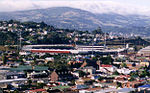
Hillside Engineering Group is a trading division of the rail operator KiwiRail in Dunedin, New Zealand. Most of its work is related to KiwiRail, but it also does work for the marine industry in Dunedin. On 19 April 2012 KiwiRail announced it was putting Hillside on the market for sale. In November 2012 KiwiRail announced it had sold part of the business to Australian firm Bradken, and the rest would be closed. The workshops continued to be used for some maintenance work by Kiwirail with a skeleton staff. In October 2019, the New Zealand Government announced that it would be investing NZ$20 million into revitalising Hillside Engineering as a major mechanical hub and engineering facility to service Kiwi Rail's locomotives and rollingstock.

Excerpt from the Wikipedia article Hillside Engineering (License: CC BY-SA 3.0, Authors, Images).

Hillside Engineering
Hillside Road, Dunedin South Dunedin

Geographical coordinates (GPS) Address Nearby Places
placeShow on map

Wikipedia: Hillside EngineeringContinue reading on Wikipedia

Geographical coordinates (GPS)

Latitude Longitude
N -45.895 ° E 170.494 °
placeShow on map

Address

Hillside Road

Hillside Road
9012 Dunedin, South Dunedin
Otago, New Zealand
mapOpen on Google Maps

HillsideDunedin
HillsideDunedin
Share experience

Nearby Places

Kensington, Dunedin
Kensington, Dunedin

Kensington is a small suburb of the New Zealand city of Dunedin, nestled to the south of a hilly spur between the central city and the major suburb of South Dunedin, some 2.4 kilometres (1.5 mi) to the south of the city centre. The suburb was named for the leafy London suburb, possibly by John Hyde Harris, who subdivided the area in the 1860s.Kensington is located on and around King Edward Street, close to the point at which it becomes Princes Street. This is one of Dunedin's main arterial routes, with King Edward Street stretching south to become the main road through South Dunedin, and Princes Street heading north to Dunedin's city centre. The suburb lies at the foot of a spur off Maryhill officially referred to as Montecillo Ridge, and close to the inner city sports ground, the Oval. This 9.3-hectare (23-acre) ground, originally called the Southern Recreation Ground, is now referred to as the Kensington Oval, so as to distinguish it from the University Oval in the north of the city. This ground is actually triangular, but at one time contained a separate oval cricket ground, which gave it its name. Dunedin Southern Cemetery sits on the slope of Montecillo Ridge immediately above Kensington, separated from it by South Road, a main route to Caversham, which joins with Princes Street close to the Oval. These two green areas mark the southernmost extreme of Dunedin's Town Belt, which sweeps around the central city in a broad crescent through the suburbs of Mornington, Belleknowes, Roslyn, Maori Hill, Woodhaugh, and Dunedin North. The lower slopes of Montecillo Ridge were at one time the site of "Hillside", the home of Dunedin city's founding father Captain William Cargill. Though the house is long gone, its name lives on in that of South Dunedin's Hillside Road. Kensington is largely separated from South Dunedin by an overbridge and railway embankment carrying the South Island Main Trunk railway. The long-closed Kensington railway halt was located immediately to the east of the bridge, and accessed by a flight of stairs in one of the bridge's supports, long since sealed up. A newer flyover 200 metres to the north carries State Highway 1 through Kensington, though there are no slip roads connecting the suburb with the highway. This flyover separates Kensington into two distinct parts, a light industrial zone to the south of the flyover, and a residential zone to the north, at the foot of the ridge. A notable feature of Kensington is the city's army drill hall, located in Bridgman Street immediately to the south of State Highway 1.

Dunedin Gasworks Museum

Dunedin Gasworks Museum is located in South Dunedin, in the South Island of New Zealand. It is one of only a few known preserved gasworks museums in the world. The main part of the museum is housed in the engine house of the former Dunedin Gasworks in Braemar Street, close to Cargill's Corner, which operated from 1863 until 1987. Other buildings which are included in the museum include the boiler room, boiler house, chimney stack, fitting shop, and blacksmith's shop. The museum includes a unique collection of five stationary steam engines, at least some of which are in working full order. There are also displays of domestic and industrial gas appliances. As well as being an operating museum open to the public, the gasworks museum is also a popular venue for event ranging from music performances to gatherings of steampunk enthusiasts. The Dunedin Gasworks were the first in New Zealand and also the last to cease production. At its peak in the 1970s coal gas was provided to over 18,000 customers in the city. The Edwardian buildings of the gasworks were saved by a trust headed by Elizabeth Hinds, Director of the Otago Settlers Museum, and several are now listed by the New Zealand Historic Places Trust as Category I Historic Places.Much of Dunedin's gasworks facility was pulled down during the 1980s. The idea of restoring the remaining part of the complex into a museum was mooted during the latter part of the decade, with the first work on structural restoration of the buildings beginning in 1989. The museum was opened on 3 February 2001 in a ceremony attended by Dr. George Emerson, Chair of the Dunedin Gasworks Museum Trust, and Sir Neil Cossons, Chairman of English Heritage.

Kensington Oval, Dunedin

The Kensington Oval, formerly known as the South Dunedin Recreation Ground, is a park and sports ground in Kensington, Dunedin, New Zealand. It is also known as just The Oval, although this name has become less common in recent years due to the potential confusion with the University Oval in the north of the city.The Kensington Oval is officially regarded as the southern end of the city's Town Belt. The park, which is actually roughly triangular in shape, covers 9.25 hectares (22.9 acres). It is bounded by Princes Street, the northern end of Anderson's Bay Road, and the Dunedin Southern Motorway. Its name dates from 22 March 1864, when it was decided to enclose the main cricket pitch within a formal oval. From that time the former name rapidly fell out of use, and has been rarely used since the beginning of the twentieth century. The first recorded first-class match cricket match was held on the ground in February 1864 when Otago played Canterbury in what was the first ever first-class match to be held in New Zealand. Otago played eight further first-class matches there, the last of which saw them play Canterbury in February 1878. The condition of the playing surface was generally unsatisfactory, with old tree roots protruding from the ground and the pitch unpredictable and at times dangerous to batsmen. In 1879 the Otago Cricket Association requested that the Dunedin City Council make improvements to the ground. When the Council decided not to make improvements, and refused to restrict access to the ground to cricket only, the Association decided to find another venue to play at. The enclosing bounds of the oval were removed in about 1899. Although representative matches are no longer played at the Kensington Oval, it is widely used for club, grade, and social cricket, and has two grass and three artificial wickets, as well as a pavilion. It is also used for softball in summer, and for football and rugby union in winter. The city's Boer War memorial, which stands at the northern corner of the Oval, was designed by Carlo Bergamini and erected in November 1906.

Forbury, New Zealand

Forbury is a small residential suburb of the New Zealand city of Dunedin. It is 3 kilometres (1.9 mi) south-southwest of the city centre and lies immediately to the north of St Clair, between it and Caversham. The suburb is low lying, having originally been marshy land reclaimed in the later 19th century. As such, it is often prone to flooding. It lies at the northwest corner of a plain that stretches across South Dunedin and St Kilda known locally as "The Flat". The land rises to the northwest of the suburb to form Caversham Valley, and immediately to the west the land rises abruptly in a cliff face that is located one kilometre inland from St Clair Beach. The suburb stretches to the east of this cliff across the plain towards South Dunedin. Apart from Caversham and St Clair, Forbury is bounded by St Kilda in the south, Kew in the west, and South Dunedin in the east. The name Forbury is somewhat confusing, as it is used for several local features, not all of them within the suburb. Notable among these is the former Forbury Park Raceway, one of the city's main horse-racing venues, which actually lies in St Kilda. Forbury Corner, an important road junction, lies in Caversham, though not far from the northern boundary of Forbury. Prominent features of Forbury include Tonga Park, a sports ground used by Caversham Football Club, and the twin single-sex secondary schools, King's and Queen's. Forbury Road is the suburb's main arterial route, aligned roughly north-south and linking Caversham at Forbury Corner with St Clair at the Esplanade. The suburb's other main roads include Bay View Road, Macandrew Road, Surrey Street, and Easther Crescent. Dunedin's main LDS church sits close to the cliff face at the suburb's western edge, and one of the city's main retirement villages, the Frances Hodgkins Retirement Village is built against the cliff face immediately to the north.