place

Palacio Bruna

Buildings and structures in Santiago
Palacio Bruna, Santiago de Chile

The Palacio Bruna is a palace located on the southern edge of the Parque Forestal in Santiago, Chile. The three story building has an Italian Renaissance character. It is entirely surrounded by a frieze decorated with garlands and putti, and was constructed between 1916 and 1921 to serve as the residence for the saltpeter magnate Augusto Bruna. Julio Bertrand, a Chilean architect, was designated as responsible for its design and construction. He died before seeing the palace completed and his friend Pedro Prado took over and completed the building.Industrial-scale production of synthetic sodium nitrate and the resulting collapse of the saltpeter price led to the bankruptcy of Bruna's business. In 1921, as a consequence of this event, the palace had to be offered for sale. It was purchased by the U.S. ambassador to Chile, never having been occupied by Augusto Bruna. It housed the American Embassy until 1962 and then served as the U.S. consulate in Santiago from 1962 to 1994. Since 1995, the building has housed the Chilean National Commerce Chamber.

Excerpt from the Wikipedia article Palacio Bruna (License: CC BY-SA 3.0, Authors, Images).

Palacio Bruna
Estados Unidos, Santiago

Geographical coordinates (GPS) Address External links Nearby Places
placeShow on map

Wikipedia: Palacio BrunaContinue reading on Wikipedia

Geographical coordinates (GPS)

Latitude Longitude
N -33.437222222222 ° E -70.639166666667 °
placeShow on map

Address

Palacio Bruna

Estados Unidos
8320129 Santiago
Santiago Metropolitan Region, Chile
mapOpen on Google Maps

linkWikiData (Q2880242)
linkOpenStreetMap (1841288594)

Palacio Bruna, Santiago de Chile
Share experience

Nearby Places

Centro Cultural Gabriela Mistral

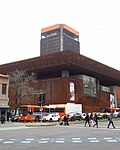
The Centro Cultural Gabriela Mistral (GAM) (formerly known as the Diego Portales Building) is a cultural center located on 227 Av. Libertador Bernardo O'Higgins, in Santiago de Chile. The complex was originally built to serve as the headquarters for the third UNCTAD conference, which was held in Santiago in 1972, and consisted of a convention center and an adjoining 22-stories building. The building was finished in only 275 days in a significant effort supported by several thousand volunteers. This effort was part of a major propaganda initiative performed by the socialist government of Salvador Allende, in power between the end of 1970 and September 1973 .After the conference, the building was used as a cultural center until the 1973 Chilean coup d'état. After the end of the Pinochet regime, it hosted a number of conventions and the adjacent tower became the main building for the Ministry of National Defense. In early 2006, a fire destroyed parts of the building, which led the government of Michelle Bachelet to rethink the original sense of the building and return it into a cultural center, open to the public. Adapting the structure of its urban environment, the building takes on the concept of transparency and many artworks from the original design. The second phase that contains an auditorium with space for more than 2000 is going to start soon.The Centro Cultural Gabriela Mistral was inaugurated in September 2010 and is named after Chilean poet-diplomat, educator and humanist Gabriela Mistral. Today it's a cultural centre devoted to disseminate and promote performing arts and music. Among many other activities, it offers contemporary drama and dance, as well as classic and popular music, a space to continuous development and experimentation. Furthermore, with an emphasis on contemporary photography and popular arts, the GAM houses a range for visual arts. Due to its high demands for transparency, variety and quality, it is orientated to generate direct encounters between artists and diverse audiences.