place

Boomerang (Six Flags México)

Amusement ride stubsBoomerang roller coastersOperating roller coastersRemoved roller coastersRoller coasters in Mexico
Roller coasters introduced in 1984Roller coasters introduced in 1988Roller coasters manufactured by VekomaRoller coasters operated by Six FlagsRoller coasters that closed in 1986Six Flags MéxicoSix Flags stubsSteel roller coasters
Boomerang (Six Flags México)

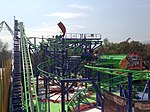
Boomerang is a Vekoma roller coaster currently operating at Six Flags México since 1988.

Excerpt from the Wikipedia article Boomerang (Six Flags México) (License: CC BY-SA 3.0, Authors, Images).

Boomerang (Six Flags México)
Boulevard Picacho Ajusco, Santa Fe Tlalpan

Geographical coordinates (GPS) Address Phone number Website Nearby Places
placeShow on map

Wikipedia: Boomerang (Six Flags México)Continue reading on Wikipedia

Geographical coordinates (GPS)

Latitude Longitude
N 19.293406 ° E -99.207814 °
placeShow on map

Address

Six Flags Mexico

Boulevard Picacho Ajusco Km. 1.5
14209 Santa Fe, Tlalpan
Mexico
mapOpen on Google Maps

Phone number

call01(55)53393600

Website
sixflags.com.mx

linkVisit website

Boomerang (Six Flags México)
Share experience

Nearby Places

El Colegio de México

El Colegio de México, A.C. (commonly known as Colmex, English: The College of Mexico) is a Mexican institute of higher education, specializing in teaching and research in social sciences and humanities. The college was founded in 1940 by the Mexican Federal Government, the Bank of Mexico (Banco de México), the National Autonomous University of Mexico (UNAM), and the Fondo de Cultura Económica. In the late 1930s, following the end of the Spanish Civil War, Mexican president Lázaro Cardenas created the House of Spain in Mexico (1938–1940) to host Spanish intellectuals in exile in Mexico; Mexico was the only country that in 1939 welcomed Spanish refugees. Under the direction of intellectual Alfonso Reyes, the House of Spain became a higher education center, and was renamed El Colegio de México in 1940. The College now operates under a 1961 charter that allows the institution to provide college-level teaching in the fields of humanistic knowledge and social and political sciences. In 1976, the university's campus was moved from the Colonia Roma (a historic neighborhood just west of the city's center) to its current location in the southern portion of the capital; the main building of the campus was designed by the Mexican architect Teodoro González de León. The college contains seven separate academic centers collectively offering three undergraduate degrees, seven master's degrees and eight doctoral degrees. El Colegio de México received the Prince of Asturias Award for Social Sciences in 2001. Colmex's library (Biblioteca Daniel Cosío Villegas), one of the largest academic libraries in Mexico, contains one of the most important Latin American collections in the fields of the social sciences and humanities.

Liceo Mexicano Japonés

Liceo Mexicano Japonés, A.C. (Spanish for 'Mexican-Japanese Lyceum'); Japanese: 社団法人日本メキシコ学院, romanized: Shadan Hōjin Nihon Mekishiko Gakuin, or 日墨学院, transl. Japan-Mexico Institute) is a Japanese school based in the Pedregal neighborhood of the Álvaro Obregón borough in southern Mexico City, Mexico.It is a school for Japanese Mexicans and the sons of Japanese temporary workers who are often brought to Mexico by companies like Nissan. There is also a section for Mexicans with no Japanese origin or descent, but Japanese is taught beginning in kindergarten and the system is in both languages until high school.Carlos Kasuga Osaka, who served as the director of Yakult Mexico, founded the school and served as its chair. Within any Nikkei community, it was the first transnational educational institution.María Dolores Mónica Palma Mora, author of De tierras extrañas: un estudio sobre las inmigración en México, 1950–1990, wrote that the school is a "central institution in the life" of the Japanese Mexican group. Chizuko Hōgen Watanabe (千鶴子・ホーゲン・渡邊), the author of the master's thesis "The Japanese Immigrant Community in Mexico Its History and Present" at the California State University, Los Angeles, stated that Japanese parents chose the school because they wanted to "maintain their ethnic identity and pride, to implant a spiritual heritage that they claim is the basis for success, and to establish close ties with other Nikkei children who live in distant areas."As of 1983 many Nikkei and Japanese persons come to the school to study its management techniques and problems.