place

Arena da Baixada

1999 establishments in Brazil2014 FIFA World Cup stadiumsClub Athletico ParanaenseCovered stadiumsFootball venues in Paraná (state)
Retractable-roof stadiumsSport in CuritibaSports venues completed in 1999Sports venues in Paraná (state)Use American English from July 2013Use mdy dates from July 2013
Arenadabaixada2
Arenadabaixada2

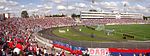
Estádio Joaquim Américo Guimarães, known commonly as Arena da Baixada, is a stadium located in Curitiba, the state capital of Paraná, Brazil. It is the home stadium of Club Athletico Paranaense, and has a capacity of 42,372 people. The stadium was the first in Brazil to sell its naming rights; it was known as Kyocera Arena between 2005 and 1 April 2008. It was the first retractable roof stadium built in South America.With Curitiba selected as one of the host cities of the 2014 FIFA World Cup, the stadium was rebuilt between 2012 and 2014. Its capacity was expanded to 42,372 seats. Located in the Água Verde borough near the center of Curitiba, the history of the stadium began in the early twentieth century, when in 1914, Joaquim Américo Guimarães (1879–1917), then president of the International (the forefathers of Club Athletico Paranaense), led the construction of the then Arena da Baixada stadium. Athletico came into existence ten years later, inheriting the assets, including the stadium.

Excerpt from the Wikipedia article Arena da Baixada (License: CC BY-SA 3.0, Authors, Images).

Arena da Baixada
Rua Buenos Aires, Curitiba Água Verde

Geographical coordinates (GPS) Address Nearby Places
placeShow on map

Wikipedia: Arena da BaixadaContinue reading on Wikipedia

Geographical coordinates (GPS)

Latitude Longitude
N -25.448333333333 ° E -49.276944444444 °
placeShow on map

Address

Ligga Arena (Estádio Joaquim Américo Guimarães)

Rua Buenos Aires
80250-070 Curitiba, Água Verde
Paraná, Brazil
mapOpen on Google Maps

Arenadabaixada2
Arenadabaixada2
Share experience

Nearby Places

Curitiba
Curitiba

Curitiba (Brazilian Portuguese: [kuɾiˈtʃibɐ]) is the capital and largest city in the state of Paraná in Southern Brazil. The city's population was 1,963,726 as of 2021, making it the eighth most populous city in Brazil and the largest in Brazil's South Region. The Curitiba Metropolitan area comprises 29 municipalities with a total population of over 3,731,769 (IBGE estimate in 2021), making it the ninth most populous metropolitan area in the country. The city sits on a plateau at 932 m (3,058 ft) above sea level. It is located west of the seaport of Paranaguá and is served by the Afonso Pena International and Bacacheri airports. Curitiba is an important cultural, political, and economic center in Latin America and hosts the Federal University of Paraná, established in 1912. In the 1700s, Curitiba's favorable location between cattle-breeding countryside and marketplaces led to a successful cattle trade and the city's first major expansion. Later, between 1850 and 1950, it grew due to logging and agricultural expansion in Paraná State (first Araucaria angustifolia logging, later mate and coffee cultivation and in the 1970s wheat, corn and soybean cultivation). In the 1850s, waves of European immigrants arrived in Curitiba, mainly Germans, Italians, Poles and Ukrainians, contributing to the city's economic and cultural development and richness in diversity. Nowadays, only small numbers of immigrants arrive, primarily from Middle Eastern and other South American countries. Curitiba's biggest expansion occurred after the 1960s, with innovative urban planning that allowed the population to grow from some hundreds of thousands to more than a million people. Curitiba's economy is based on industry and services and is the fourth largest in Brazil. Economic growth occurred in parallel to a substantial inward flow of Brazilians from other parts of the country, as approximately half of the city's population was not born in Curitiba.Curitiba is one of the few Brazilian cities with a very high Human Development Index (0.856) and in 2010 it was awarded the Global Sustainable City Award, given to cities and municipalities that excel in sustainable urban development. According to US magazine Reader's Digest, Curitiba is the best "Brazilian Big City" in which to live. Curitiba's crime rate is considered low by Brazilian standards and the city is considered one of the safest cities in Brazil for youth. The city is also regarded as the best in which to invest in Brazil. Curitiba was one of the host cities of the 1950 FIFA World Cup, and again for the 2014 FIFA World Cup. Despite its good social indicators, the city has a higher unemployment rate than other cities in the state.