place

Convent of San Francisco, Madero Street, Mexico City

1710s establishments in Mexico18th-century Roman Catholic church buildings in Mexico18th century in Mexico CityBaroque church buildings in MexicoChurrigueresque architecture in Mexico
Historic center of Mexico CityRoman Catholic churches completed in 1716Roman Catholic churches in Mexico CitySpanish Colonial architecture in Mexico
FacadeSanFranDF
FacadeSanFranDF

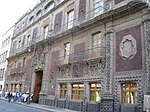
The Convent of San Francisco (historically known in Spanish as the 'Convento Grande de San Francisco') is located at the western end of Madero Street in the historic center of Mexico City, near the Torre Latinoamericana and is all that remains of the church and monastery complex. This complex was the headquarters of the first twelve Franciscan friars headed by Martín de Valencia who came to Mexico after receiving the first authorization from the Pope to evangelize in New Spain. In the early colonial period, this was one of the largest and most influential monasteries in Mexico City. It was built on the site of where Moctezuma II’s zoo once was. At its peak, the church and monastery covered the blocks now bordered by Bolivar, Madero, Eje Central and Venustiano Carranza Streets, for a total area of 32,224 square metres (3.2 ha; 8.0 acres).In the patio of the first cloister, there was a cross that was reputedly taller than the highest tower in the city and made from a cypress tree from the “Chapultepec Forest”, meaning the forested area to the west of the Zocalo, where San Francisco was built.The church and monastery saw a number of historic events in its time. A funeral mass for Hernán Cortés was here when it was thought that he died in Central America. In 1629, the Marquis of Gelves arrived in disguise to hide after quarreling with the archbishop. In 1692, the Count of Galve and his wife were granted refuge there due to a large-scale rebellion in the city. The end of the Mexican War of Independence was celebrated with a Te Deum at the monastery as the Trigarante Army of 16,000 troops marched past on Madero Street headed by Agustín de Iturbide. After the Reform War, the monastery of San Francisco, like many others, was disbanded and most of the property seized by the government. Much of the old monastery was demolished for the construction of new roads. Other parts of the old building are now a Methodist church facing Gante Street and a Panadería Ideal bakery. Where the bakery is now on 16 de Septiembre Street used to be the De Profundus Room, and the church is housed in the old cloister. On the corner of Venustiano Carranza and Eje Central are what used to be the Calvario and San Antonio chapels. These buildings still exist only because it was more expensive to demolish them than to leave them standing. All that is still left in church hands is the church itself.The church standing today is the third to be built on the site. The first two sunk into the soft soil underneath Mexico City and had to be torn down. This church was built between 1710 and 1716. Although the entire building is known as the San Francisco Church, the entrance on Madero Street is actually the entrance to the Balvanera Chapel. In front of this is an atrium with several sets of stairs leading down to the church building because it, too, is sinking. The church’s main facade, dating from 1710, is walled in and cannot be seen. Entrance is now through the side door into the Balvanera Chapel, then into the main church. The facade of the chapel was constructed in 1766 and it is not sure who constructed it but most think it was the work of Lorenzo Rodríguez, best known for his work on the Metropolitan Tabernacle. The chapel’s statues were removed when the chapel was in the hands of an Evangelical sect, but it kept other decorative elements such as volutes, sculpted leaves and flowers and the estipite (inverted truncated pyramid) columns with medallions. Inside there is an 18th-century altarpiece dedicated to the Virgin of Guadalupe as well as the entrance to what was once the Chapel of the Second Station of the Stations of the Cross.In the main church, there is a large gilded main altar, which is one that replaced the original Baroque one. This original one has been reconstructed because Neoclassic artist Jerónimo Antonio Gil left a drawing of it. Only the walls of the original De Profundis Room remain, the rest is remodeled into a bakery. The old cloister on Gante Street has fared a bit better. It is now a Methodist church, where inside both floors of the cloister have been well preserved. It can be visited only with prior authorization.

Excerpt from the Wikipedia article Convent of San Francisco, Madero Street, Mexico City (License: CC BY-SA 3.0, Authors, Images).

Convent of San Francisco, Madero Street, Mexico City
Francisco I. Madero, Mexico City

Geographical coordinates (GPS) Address External links Nearby Places
placeShow on map

Wikipedia: Convent of San Francisco, Madero Street, Mexico CityContinue reading on Wikipedia

Geographical coordinates (GPS)

Latitude Longitude
N 19.43345 ° E -99.140197222222 °
placeShow on map

Address

Iglesia de San Francisco

Francisco I. Madero
06010 Mexico City
Mexico
mapOpen on Google Maps

linkWikiData (Q5117093)
linkOpenStreetMap (158032446)

FacadeSanFranDF
FacadeSanFranDF
Share experience

Nearby Places

Porta Coeli Cathedral, Mexico City

The Porta Coeli Cathedral (Spanish: Catedral de Porta Coeli ) also called Church of the Gate of Heaven or Church of Porta Coeli Is a Roman Catholic cathedral that follows the Greek Melkite or Byzantine rite in full communion with the Pope in Rome. It is located in Mexico City, the capital of Mexico. Porta Coeli is one of the five Christian cathedrals of the city being the others the Metropolitan Cathedral of the Ascension (Roman or Latin rite), the Iztapalapa Cathedral (Roman or Latin rite), the Cathedral of Our Lady of Valvanera (Maronite rite) and the Cathedral of San José de Gracia (Anglican rite). It is currently the Mexico City Cathedral of the Melkite Greek Catholic Church. The temple is the main church of the Greek Melkite Catholic Eparchy of Our Lady of Paradise in Mexico City (Eparchia Dominae Nostrae Paradisi in Civitate Mexicana Graecorum Melkitarum) which was created in 1952, and Pope Paul VI gave his approval, to meet the religious needs of the local Melkite Catholic community.The building was originally a Dominican Catholic church called Porta Coeli Church, founded in 1603. The building was completed in 1711, and is an example of Neoclassical architecture.It was originally the church of the Dominican College of Porta Coeli, that came to occupy the entire block between the present streets of Carranza, Pino Suárez, Uruguay and the alley of Tabaqueros, the latter separating it from the Concepcionist Convent of Valvanera. Although the college was lost, the church we see today is preserved. The church housed the beautiful colonial Cristo Negro, and from 1935 it was moved to the Mexico City Metropolitan Cathedral, the church retains an exact replica.The interior of the church was renovated with eight Byzantine murals painted between 1970-1979, after that was turned into the Melkite Greek Catholic Cathedral.It is under the pastoral responsibility of Nicholas James Samra who was appointed leader of the Catholics of Melkite Rite by Pope Francis in 2015.

Instituto Nacional de Bellas Artes y Literatura

The Instituto Nacional de Bellas Artes y Literatura (INBAL, English: National Institute of Fine Arts and Literature), located in the Palacio de Bellas Artes in Mexico City, is the Mexican institution in charge of coordinating artistic and cultural activities (both at the political and the educational level) in the country. On November 23, 1946, president Miguel Alemán Valdés proposed the creation of the INBA, and it was formally opened on 1 January 1947, as a branch of the Secretaría de Educación Pública (SEP). The first head of the INBA was Carlos Chávez, who created a new orchestra for the Conservatory, the current Orquesta Sinfónica Nacional.The institute includes many departments, artistic ensembles, three national centers for storage of the literary stock, 29 schools and further institutions. The school of design and handicrafts was founded by José Chávez Morado in 1962.One of the important services the institute provides for the nation is to protect, along with the Instituto Nacional de Antropología e Historia, monuments and buildings deemed cultural patrimony. INAH is entrusted with 'archaeological' (pre-Hispanic and paleontological) and 'historical' (post-Conquest 16th to 19th centuries) structures, zones and remnants, while INBAL is entrusted with 'artistic' buildings and monuments (properties that are of significant aesthetic value). The valuation of aesthetic value is left to the Comisión Nacional de Zonas y Monumentos Artísticos (National Commission of Artistic Zones and Monuments). This commission is composed of the Director of INBAL, a representative of the Secretaría de Desarrollo Urbano y Ecología, a representative of UNAM, and three individuals affiliated with the arts picked by the Director. Edifices deemed worthy by the commission are catalogued in the Registro Público de Monumentos y Zonas Artísticos (Public Register of Artistic Monuments and Zones).The institute provides education from elementary school through to postgraduate level; one of the educational institutions that INBAL manages is CEDARTS (centros de educación artística or artistic education centers, in English) which is focused on artistic education. There are 12 CEDARTS in Mexico, three in Mexico City and the rest in some other states. CEDART "Alfonso Reyes" Monterrey, Nuevo León CEDART "David Alfaro Siqueiros" Chihuahua, Chihuahua CEDART "Diego Rivera" Ciudad de México, CDMX CEDART "Emilio Abreu Gómez" Mérida, Yucatán CEDART "Frida Kahlo" Ciudad de México, CDMX CEDART "Ignacio Mariano de las Casas" Querétaro, Querétaro CEDART "José Clemente Orozco" Guadalajara, Jalisco CEDART "José Eduardo Pierson" Hermosillo, Sonora CEDART "Juan Rulfo" Colima, Colima CEDART "Luis Spota Saavedra" Ciudad de México, CDMX CEDART "Miguel Bernal Jiménez" Morelia, Michoacán CEDART "Miguel Cabrera" Oaxaca, OaxacaIn addition to the educational offerings, there are museums, galleries and buildings under the INBAL management, that the institute often uses to present different types of artistic entertainment to the general public, such as "tempestad" or a season of flamenco dance.