place

Old Portal de Mercaderes (Mexico City)

16th century in Mexico17th century in Mexico18th century in Mexico19th century in Mexico City20th century in Mexico City
Buildings and structures in Mexico CityColonial MexicoDepartment stores of MexicoHistoric center of Mexico CityLandmarks in Mexico City
West side of the Zócalo (Mexico City)

Old Portal de Mercaderes in the historic center of Mexico City was and is the west side of the main plaza (otherwise known as the "Zócalo"). This side of the plaza has been occupied by commercial structures since the Spanish Conquest of Mexico in 1521. Today the west side of the square is dominated by two sets of buildings with Madero Street dividing them as it runs west from the Zocalo to the Palace of Bellas Artes. The buildings on the north side of Madero is occupied by offices on the upper floors and shops at ground level. The southside buildings are dominated on the ground floor by fine jewelry stores, marking the beginning of the "Centro Joyero Zocalo." This center extends west for two block engulfing Palma Street between Madero and 16 de Septiembre streets. Most of the upper floors of the buildings here are occupied by rooms associated with the Hotel de Ciudad de Mexico and the Hotel Majestic.

Excerpt from the Wikipedia article Old Portal de Mercaderes (Mexico City) (License: CC BY-SA 3.0, Authors, Images).

Old Portal de Mercaderes (Mexico City)
5 de Febrero, Mexico City

Geographical coordinates (GPS) Address Nearby Places
placeShow on map

Wikipedia: Old Portal de Mercaderes (Mexico City)Continue reading on Wikipedia

Geographical coordinates (GPS)

Latitude Longitude
N 19.432641666667 ° E -99.134380555556 °
placeShow on map

Address

Oficinas de la Asamblea Legislativa 7

5 de Febrero
06000 Mexico City
Mexico
mapOpen on Google Maps

West side of the Zócalo (Mexico City)
Share experience

Nearby Places

Mexico City
Mexico City

Mexico City (Spanish: Ciudad de México, locally [sjuˈða(ð) ðe ˈmexiko] (listen); abbr.: CDMX; Nahuatl: Altepetl Mexico) is the capital, largest city of Mexico, and the most populous city in North America. It is one of the country's 32 federal entities. Mexico City is one of the most important cultural and financial centers in the world. It is located in the Valley of Mexico in the high central plateau, at an altitude of 2,240 meters (7,350 ft). The city has 16 boroughs or demarcaciones territoriales, which are in turn divided into neighborhoods or colonias. The 2020 population for the city proper was 9,209,944, with a land area of 1,495 square kilometers (577 sq mi). According to the most recent definition agreed upon by the federal and state governments, the population of Greater Mexico City is 21,804,515, which makes it the sixth-largest metropolitan area in the world, the second-largest urban agglomeration in the Western Hemisphere (behind São Paulo, Brazil), and the largest Spanish-speaking city (city proper) in the world. Greater Mexico City has a GDP of $411 billion in 2011, which makes it one of the most productive urban areas in the world. The city was responsible for generating 15.8% of Mexico's GDP, and the metropolitan area accounted for about 22% of the country's GDP. If it were an independent country in 2013, Mexico City would be the fifth-largest economy in Latin America.Mexico's capital is both the oldest capital city in the Americas and one of two founded by indigenous people. The city was originally built on a group of islands in Lake Texcoco by the Mexica (Azteca) in 1325 as Tenochtitlan. It was almost completely destroyed in the 1521 Siege of Tenochtitlan and subsequently redesigned and rebuilt in accordance with the Spanish urban standards. In 1524, the municipality of Mexico City was established, known as México Tenochtitlán, and as of 1585, it was officially known as Ciudad de México (Mexico City). Mexico City was the political, administrative, and financial center of a major part of the Spanish colonial empire. After independence from Spain was achieved, the federal district was created in 1824. After years of demanding greater political autonomy, residents were finally given the right to elect both a head of government and the representatives of the unicameral Legislative Assembly by election in 1997. Ever since, left-wing parties (first the Party of the Democratic Revolution and later the National Regeneration Movement) have controlled both of them. The city has several progressive policies, such as abortion on demand, a limited form of euthanasia, no-fault divorce, and same-sex marriage. On 29 January 2016, it ceased to be the Federal District (Spanish: Distrito Federal or D.F.) and is now officially known as Ciudad de México (or CDMX), with a greater degree of autonomy. A clause in the Constitution of Mexico, however, prevents it from becoming a state within the Mexican federation, as it is the seat of power in the country, unless the capital of the country were to be relocated elsewhere.

First Mexican Republic

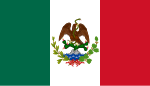
The First Mexican Republic, known also as the First Federal Republic (Spanish: Primera República Federal), was a federated republic, under the Constitution of 1824. It was a nation-state officially designated the United Mexican States (Spanish: Estados Unidos Mexicanos, listen ). The First Mexican Republic lasted from 1824 to 1835, when conservatives under Antonio López de Santa Anna transformed it into a unitary state, the Centralist Republic of Mexico. The republic was proclaimed on November 1, 1823 by the Constituent Congress, months after the fall of the Mexican Empire ruled emperor Agustin I, a former royalist military officer-turned-insurgent for independence. The federation was formally and legally established on October 4, 1824, when the Federal Constitution of the United Mexican States came into force.The First Republic was plagued through its entire twelve-year existence by severe financial and political instability. Political controversies, ever since the drafting of the constitution tended to center around whether Mexico should be a federal or a centralist state, with wider liberal and conservative causes attaching themselves to each faction respectively. With the exception of the inaugural office holder, Guadalupe Victoria, every single administration during the First Republic was overthrown by military coup d'état. The First Republic would finlly collapse after the overthrow of the liberal president Valentín Gómez Farías, through a rebellion led by his former vice-president, General Antonio López de Santa Anna who had switched sides. Once in power, the conservatives, who had long been critical of the federal system and blamed it for the nation's instability, repealed the Constitution of 1824 on October 23, 1835, and the Federal Republic became a unitary state, the Centralist Republic. The unitary regime was formally established on December 30, 1836, with the enactment of the seven constitutional laws.

Second Federal Republic of Mexico

The Second Federal Republic of Mexico (Spanish: Segunda República Federal de México) is the name given to the second attempt to achieve a federalist government in Mexico after a period of centralism. Officially called the United Mexican States (Estados Unidos Mexicanos), a federal republic was established again on August 22, 1846 when interim president José Mariano Salas issued a decree restoring the 1824 constitution. The Second Republic continued to be rocked by the political instability that had characterized Mexico since independence. Mexico's loss in the war with the United States during this time saw half of Mexican territory become part of the United States. Antonio López de Santa Anna who had played a major role in the war, and been disgraced as a result, afterwards returned to the presidency, selling more territory to the United States and becoming increasingly autocratic. In response, liberals promulgated of the Plan of Ayutla in 1854, calling for the overthrow of Santa Anna's dictatorship. Santa Anna was overthrown and liberals enacted a series of sweeping reforms, including a new federalist constitution, collectively known as the Liberal Reform, which then sparked a civil war with conservatives, known as the War of the Reform, from 1857 to 1860. The conservatives lost the war, but the liberals' triumph however was soon interrupted by a French invasion in 1861, which gained collaboration from the recently defeated conservatives. The French attempted to set up a client state known as the Second Mexican Empire. Conservatives invited Maximilian Habsburg to serve as monarch of the Empire. Mexican republicans nonetheless fought against the French invaders, led by Benito Juárez's government in exile, which was backed by the United States. Ultimately the French were unable to consolidate control of the entire nation and under pressure from the United States which after the end of the Civil War, could more effectively enforce the Monroe Doctrine, withdrew from Mexico, leading to the Empire's collapse in 1867. The period of the Second Republic following the end of the Second Empire, is known as the Restored Republic.