place

Dr. Percy L. Julian High School

1955 establishments in AlabamaEducational institutions established in 1955High schools in Montgomery, AlabamaName changes due to the George Floyd protestsPublic high schools in Alabama

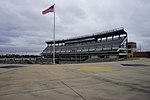
Dr. Percy L. Julian High School (formerly Robert E. Lee High School) is a public secondary school in Montgomery, Alabama, United States, serving grades 9–12. The school is part of the Montgomery Public Schools system. Dr. Percy L. Julian High School is zoned for the northside of Montgomery, including residents of the Gunter Air Force Base and Maxwell Air Force Base, however, few military students attend Montgomery public schools.

Excerpt from the Wikipedia article Dr. Percy L. Julian High School (License: CC BY-SA 3.0, Authors).

Dr. Percy L. Julian High School
Brewton Street, Montgomery

Geographical coordinates (GPS) Address Nearby Places
placeShow on map

Wikipedia: Dr. Percy L. Julian High SchoolContinue reading on Wikipedia

Geographical coordinates (GPS)

Latitude Longitude
N 32.378 ° E -86.271 °
placeShow on map

Address

Brewton Street
36107 Montgomery
Alabama, United States
mapOpen on Google Maps

Share experience

Nearby Places

Montgomery, Alabama
Montgomery, Alabama

Montgomery is the capital city of the U.S. state of Alabama and the county seat of Montgomery County. Named for Continental Army Major General Richard Montgomery, it stands beside the Alabama River, on the coastal Plain of the Gulf of Mexico. In the 2020 census, Montgomery's population was 200,603. It is now the third most populous city in the state, after Mobile and Huntsville, and is the 119th most populous in the United States. The Montgomery Metropolitan Statistical Area's population in 2020 was 386,047; it is the fourth largest in the state and 142nd among United States metropolitan areas.The city was incorporated in 1819 as a merger of two towns situated along the Alabama River. It became the state capital in 1846, representing the shift of power to the south-central area of Alabama with the growth of cotton as a commodity crop of the Black Belt and the rise of Mobile as a mercantile port on the Gulf Coast. In February 1861, Montgomery was chosen the first capital of the Confederate States of America, which it remained until the Confederate seat of government moved to Richmond, Virginia, in May of that year. In the middle of the 20th century, Montgomery was a major center of events and protests in the Civil Rights Movement, including the Montgomery bus boycott and the Selma to Montgomery marches. In addition to housing many Alabama government agencies, Montgomery has a large military presence, due to Maxwell Air Force Base; public universities Alabama State University, Troy University (Montgomery campus), and Auburn University at Montgomery; two private post-secondary institutions, Faulkner University and Huntingdon College; high-tech manufacturing, including Hyundai Motor Manufacturing Alabama; and many cultural attractions, such as the Alabama Shakespeare Festival and the Montgomery Museum of Fine Arts. Two ships of the United States Navy have been named after the city, including USS Montgomery.Montgomery has also been recognized nationally for its downtown revitalization and new urbanism projects. It was one of the first cities in the nation to implement SmartCode Zoning.

Paterson Field
Paterson Field

Paterson Field is a baseball stadium in Montgomery, Alabama. The stadium, named after William Burns Paterson junior, has a maximum capacity of 7,000 people and was opened in 1949. Paterson Field has played host to, among other professional teams, the Montgomery Rebels, a AA-class minor-league team affiliated with the Detroit Tigers, and the Montgomery Wings, an independent minor-league team. The stadium is still in use today, having recently been used as the home field of Alabama State University, a Division I program that competes in the Southwestern Athletic Conference. A majority of seating inside Paterson Field is metallic bleachers with a few rows of box seats. Roof coverings shelter the three sections of the park behind home plate. The concourse is entirely covered, and situated below the seating. The concourse also provides no views of the playing field. Its location is in the downtown Montgomery area on Madison Avenue, near its intersection with Hall Street and in close proximity to Cramton Bowl. The stadium affords no view of downtown Montgomery to the large majority of fans in the seating inside the park. Soon after its construction, Paterson Field was the home of several Montgomery minor-league professional baseball teams. Chief among these was the 1965–80 incarnation of the Montgomery Rebels as a Detroit Tigers affiliate. During their 16 years in Montgomery, the Rebels won five Southern League championships as the Tigers developed the nucleus of a club that would win the 1984 World Series, and future MLB notables such as Jack Morris, Lou Whittaker, and Alan Trammell played under Paterson Field's lights before becoming big leaguers. The Rebels moved to Birmingham, after the 1980 Southern League season, becoming the Birmingham Barons, while Paterson Field lay relatively dormant. Riding the wave of increased popularity in minor league baseball of any level, the independent All-American Association opened play in June 2001 with teams in six cities. With the city's population count reaching 200,000, Montgomery was a logical choice for a franchise, and the city heartily welcomed the return of professional baseball to Alabama's capital city. In 2001, the Wings were part of the All-American Association; when the league folded, the Southeastern League of Professional Baseball picked them up for the 2002 season. The Wings were brought back for a final season in 2003 before an affiliate team from the Southern League, the Montgomery Biscuits, took up residence in a new waterfront park, Montgomery Riverwalk Stadium, which opened in 2004. Paterson Field was home to the NCAA Division II Baseball Championship from 1985 to 2004, after which the event was moved to Riverwalk Stadium.

Oakwood Cemetery (Montgomery, Alabama)

Oakwood Cemetery is a historic cemetery in Montgomery, Alabama. Strictly speaking, it is two cemeteries, Oakwood itself that is owned by the city and the next-door Oakwood Cemetery Annex, the location of the Hank Williams Memorial and the graves of four governors of Alabama, which was in private hands until its owner died in 2004 without directing to whom the property should pass, ownership of which thus passed to the state of Alabama, although the Annex has been maintained by the city since 2009 and a proposal was put forward in 2013 to transfer ownership to the city.Partly sandwiched in between the two is the St Margaret’s Cemetery owned by the Roman Catholic Archdiocese of Mobile. Until rectified in 2017, the Archdiocese had been accidentally burying Catholics on city property since 1863, the deeds to St Margaret's having been drawn up in the 1850s and the error not having been spotted in the 1863, 1945, or 1981 extensions but only when the records were checked for a fourth extension. In 2017 the Archdiocese swapped some of its land, on which the city had similarly placed an access road running on what had theretofore been thought to be city property in between the Archdiocesian and Annex cemeteries, for the city land that it had accidentally been using; redrawing the boundaries between the Archdiocesian and city property, expanding St Margaret's to cover 7.512 acres (3.040 ha), and returning existing gravesites to Catholic-owned land without the need for reinterrment.The cemeteries are accessed from Upper Wetumpka Road, with three entrances for Oakwood proper, St Margaret's, and the Annex in order along that road in the direction from the intersection of Ripley Street and Jefferson Street. They are close to Montgomery Police Station.