place

Tennessee State Capitol

Buildings and structures in Nashville, TennesseeGovernment buildings completed in 1859Government buildings in TennesseeGovernment buildings on the National Register of Historic Places in TennesseeGovernment of Tennessee
Greek Revival architecture in TennesseeHistoric Civil Engineering LandmarksJames K. PolkNational Historic Landmarks in TennesseeNational Register of Historic Places in Nashville, TennesseeState capitols in the United StatesStatues of Andrew JacksonTombs of presidents of the United StatesTourist attractions in Nashville, TennesseeUse mdy dates from August 2023
Tennessee State Capitol 2022f

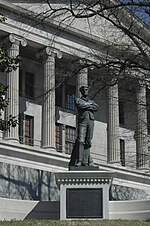
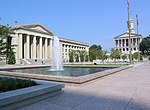
The Tennessee State Capitol, located in Nashville, Tennessee, is the seat of government for the U.S. state of Tennessee. It serves as the home of both houses of the Tennessee General Assembly–the Tennessee House of Representatives and the Tennessee Senate–and also contains the governor's office. Designed by architect William Strickland (1788–1854) of Philadelphia and Nashville, it was built between 1845 and 1859 and is one of Nashville's most prominent examples of Greek Revival architecture. The building, one of 12 state capitols that does not have a dome, was added to the National Register of Historic Places in 1970 and named a National Historic Landmark in 1971. The tomb of James K. Polk, the 11th president of the United States, is on the capitol grounds.

Excerpt from the Wikipedia article Tennessee State Capitol (License: CC BY-SA 3.0, Authors, Images).

Tennessee State Capitol
7th Avenue North, Nashville-Davidson

Geographical coordinates (GPS) Address Nearby Places
placeShow on map

Wikipedia: Tennessee State CapitolContinue reading on Wikipedia

Geographical coordinates (GPS)

Latitude Longitude
N 36.165833333333 ° E -86.784166666667 °
placeShow on map

Address

7th Avenue North
37203 Nashville-Davidson
Tennessee, United States
mapOpen on Google Maps

Tennessee State Capitol 2022f
Share experience

Nearby Places

Tennessee Senate
Tennessee Senate

The Tennessee Senate is the upper house of the U.S. state of Tennessee's state legislature, which is known formally as the Tennessee General Assembly. The Tennessee Senate has the power to pass resolutions concerning essentially any issue regarding the state, country, or world. The Senate also has the power to create and enforce its own rules and qualifications for its members. The Senate shares these powers with the Tennessee House of Representatives. The Senate alone has the power to host impeachment proceeding and remove impeached members of office with a 2/3 majority. The Tennessee Senate, according to the state constitution of 1870, is composed of 33 members, one-third the size of the Tennessee House of Representatives. Senators are to be elected from districts of substantially equal population. According to the Tennessee constitution, a county is not to be joined to a portion of another county for purposes of creating a district; this provision has been overridden by the rulings of the Supreme Court of the United States in Baker v. Carr (369 U.S. 182, 1962) and Reynolds v. Sims (337 U.S. 356, 1964). The Tennessee constitution has been amended to allow that if these rulings are ever changed or reversed, a referendum may be held to allow the senate districts to be drawn on a basis other than substantially equal population. Until 1966, Tennessee state senators served two-year terms. That year the system was changed, by constitutional amendment, to allow four-year terms. In that year, senators in even-numbered districts were elected to two-year terms and those in odd-numbered districts were elected to four-year terms. This created a staggered system in which only half of the senate is up for election at any one time. Senators from even-numbered districts are elected in the same years as presidential elections, and senators from odd-numbered districts are elected in the same years as mid-term elections. Districts are to be sequentially and consecutively numbered; the scheme basically runs from east to west and north to south.Republicans attained an elected majority in the Senate in the 104th General Assembly (2005–07) for the first time since Reconstruction; a brief majority in the 1990s was the result of two outgoing senators switching parties. Following the 2018 elections, there were no Democratic senators from East Tennessee. There were three Democrats from Memphis in West Tennessee, and three from Middle Tennessee, two from Nashville and one from the Nashville suburb of Goodlettsville.