place

Church of the Company Fire

1863 fires1863 in Chile19th century in Santiago, ChileFire disasters involving barricaded escape routesFires in Chile
History of Santiago, Chile
Incendio de la Compañía

The Church of the Society fire (8 December 1863) is the largest fire ever to have affected the city of Santiago, Chile. Between 2,000 and 3,000 people died, probably the largest number of people to die in an accidental fire in any one building in the world.

Excerpt from the Wikipedia article Church of the Company Fire (License: CC BY-SA 3.0, Authors, Images).

Church of the Company Fire
Compañía de Jesús, Santiago

Geographical coordinates (GPS) Address Nearby Places
placeShow on map

Wikipedia: Church of the Company FireContinue reading on Wikipedia

Geographical coordinates (GPS)

Latitude Longitude
N -33.438474 ° E -70.652772 °
placeShow on map

Address

Ex-Congreso Nacional

Compañía de Jesús
8320202 Santiago
Santiago Metropolitan Region, Chile
mapOpen on Google Maps

Incendio de la Compañía
Share experience

Nearby Places

Former National Congress Building

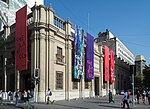
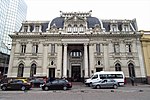
The Former National Congress Building (ex Congreso Nacional) is the former home of the Chilean Congress. Congress met in this building in central Santiago until Salvador Allende's socialist government was overthrown by Augusto Pinochet's military coup d'état on September 11, 1973.During the Pinochet dictatorship, Congress was moved to new premises in Valparaíso; the old building was declared a national monument in 1976 and between 1990 and 2006 housed the ministry of foreign affairs. The Senate moved its offices in Santiago to this building in December 2000. On January 26, 2006 the Chamber of Deputies recovered its old offices. Work began on the original building under President Manuel Montt Torres (1851–1861), but the construction was not completed until 1876, during the presidency of Federico Errázuriz Zañartu. The building was destroyed by fire in 1895, rebuilt, and reopened in 1901, during the Parliamentary Era. It stands on Morandé 441 near the Blvd. Liberador Bernardo O'Higgins, partially surrounded by gardens that contain a variety of exotic trees and plant life. The eastern portion of the gardens was the former site of the Church of the Company. The building has a cross within a square plan, which creates four courtyards. It also features classical pedimented porticos with Corinthian columns on the north and east facades. The building and its gardens occupy a complete city block, which is adjacent to city blocks containing other nationally significant buildings such as the Santiago Metropolitan Cathedral, the Palacio de los Tribunales de Justicia de Santiago and the building that currently houses the Museo Chileno de Arte Precolombino. The building is open to the public on a limited basis.

Santiago Metropolitan Cathedral

Santiago Metropolitan Cathedral (Spanish: Catedral Metropolitana de Santiago) is the seat of the Archbishop of Santiago de Chile, currently Celestino Aós Braco, and the center of the archdiocese of Santiago de Chile. Construction of the neoclassical cathedral began in 1753 and ended in 1799. The architect was the Italian Gioacchino Toesca. Further alterations ordered at the end of the 19th century gave it its present appearance. Previous cathedrals in the archdiocese had been destroyed by earthquakes.The cathedral, located in the city's historic center, faces the northwest corner of Santiago's Plaza de Armas and stands near the Palacio Arzobispal de Santiago, the administrative center for the archdiocese. The cathedral is also close to the Parroquia El Sagrario, a Catholic temple and a Chilean national monument. Santiago Metropolitan Cathedral is of a Baroque style, with many ornaments, frescos, and gilded columns. Showing that architecture has layers of history, the two towers of the cathedral were added almost a whole century later.This cathedral being built 220 years ago didn't have the kind of technology or considerations that modern building today have. the main consideration being earthquakes. Since Chile is on the Atacama fault line, it experiences quite a lot of earthquakes. Large masonry buildings like the Metropolitan Cathedral weren't built with earthquake considerations, and since masonry has low tensile strength the building suffered damages and destruction due to the earthquakes. Due to all the destruction and rebuilding/remodeling the cathedral became a national historic monument in 1951.Because of all the damage due to earthquakes, tests were done to the structure of the building to see if any structural updates were necessary, which there were. Tests were needed to be done to carry out any sort of renovations or updates of the cathedral.