place

Palacio de Correos de México

1907 establishments in Mexico20th-century architecture in MexicoArt Nouveau architecture in Mexico CityArt Nouveau government buildingsBuildings and structures in Mexico City
Cuauhtémoc, Mexico CityGovernment buildings completed in 1907Government buildings in MexicoHistoric center of Mexico CityLandmarks in Mexico CityNational Monuments of MexicoNeoclassical architecture in MexicoPost office buildingsRenaissance Revival architectureSpanish Revival architectureTourist attractions in Mexico CityVenetian Gothic architecture
Palacio Postal Version 2

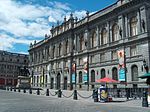
The Palacio de Correos de México (Postal Palace of Mexico City) also known as the "Correo Mayor" (Main Post Office) is located in the historic center of Mexico City, on the Eje Central (Lazaro Cardenas) near the Palacio de Bellas Artes. It was built in 1907, when the Post Office here became a separate government entity. Its design and construction was the most modern of the time, including a very eclectic style mixing several different traditions mainly Neo-Plateresque into a very complex design. In the 1950s, the building was modified in a way that caused stress and damage, so when the 1985 earthquake struck Mexico City, this building was heavily damaged. In the 1990s, restoration work has brought the building back to original construction and appearance.

Excerpt from the Wikipedia article Palacio de Correos de México (License: CC BY-SA 3.0, Authors, Images).

Palacio de Correos de México
Calle Condesa, Mexico City

Geographical coordinates (GPS) Address External links Nearby Places
placeShow on map

Wikipedia: Palacio de Correos de MéxicoContinue reading on Wikipedia

Geographical coordinates (GPS)

Latitude Longitude
N 19.435686 ° E -99.1404 °
placeShow on map

Address

Palacio Postal (Palacio de Correos-Museo Naval)

Calle Condesa
06000 Mexico City
Mexico
mapOpen on Google Maps

linkWikiData (Q978161)
linkOpenStreetMap (157051114)

Palacio Postal Version 2
Share experience

Nearby Places

Palacio de Bellas Artes

The Palacio de Bellas Artes (Palace of Fine Arts) is a prominent cultural center in Mexico City. It has hosted notable events in music, dance, theatre, opera and literature in Mexico and has held important exhibitions of painting, sculpture and photography. Consequently, the Palacio de Bellas Artes has been called the "Cathedral of Art in Mexico". The building is located on the western side of the historic center of Mexico City next to the Alameda Central park. The first National Theater of Mexico was built in the late 19th century, but it was soon decided to tear this down in favor of a more opulent building in time for Centennial of the Mexican War of Independence in 1910. The initial design and construction was undertaken by Italian architect Adamo Boari in 1904, but complications arising from the soft subsoil and the political problem both before and during the Mexican Revolution, hindered then stopped construction completely by 1913. Construction began again in 1932 under Mexican architect Federico Mariscal and was completed in 1934. It was then inaugurated on November 29, 1934 and was the first art museum in Mexico dedicated to exhibiting artistic objects for contemplation. The exterior of the building is primarily Art Nouveau and Neoclassical and the interior is primarily Art Deco. The building is best known for its murals by Diego Rivera, Siqueiros and others, as well as the many exhibitions and theatrical performances it hosts, including the Ballet Folklórico de México.

Instituto Nacional de Bellas Artes y Literatura

The Instituto Nacional de Bellas Artes y Literatura (INBAL, English: National Institute of Fine Arts and Literature), located in the Palacio de Bellas Artes in Mexico City, is the Mexican institution in charge of coordinating artistic and cultural activities (both at the political and the educational level) in the country. On November 23, 1946, president Miguel Alemán Valdés proposed the creation of the INBA, and it was formally opened on 1 January 1947, as a branch of the Secretaría de Educación Pública (SEP). The first head of the INBA was Carlos Chávez, who created a new orchestra for the Conservatory, the current Orquesta Sinfónica Nacional.The institute includes many departments, artistic ensembles, three national centers for storage of the literary stock, 29 schools and further institutions. The school of design and handicrafts was founded by José Chávez Morado in 1962.One of the important services the institute provides for the nation is to protect, along with the Instituto Nacional de Antropología e Historia, monuments and buildings deemed cultural patrimony. INAH is entrusted with 'archaeological' (pre-Hispanic and paleontological) and 'historical' (post-Conquest 16th to 19th centuries) structures, zones and remnants, while INBAL is entrusted with 'artistic' buildings and monuments (properties that are of significant aesthetic value). The valuation of aesthetic value is left to the Comisión Nacional de Zonas y Monumentos Artísticos (National Commission of Artistic Zones and Monuments). This commission is composed of the Director of INBAL, a representative of the Secretaría de Desarrollo Urbano y Ecología, a representative of UNAM, and three individuals affiliated with the arts picked by the Director. Edifices deemed worthy by the commission are catalogued in the Registro Público de Monumentos y Zonas Artísticos (Public Register of Artistic Monuments and Zones).The institute provides education from elementary school through to postgraduate level; one of the educational institutions that INBAL manages is CEDARTS (centros de educación artística or artistic education centers, in English) which is focused on artistic education. There are 12 CEDARTS in Mexico, three in Mexico City and the rest in some other states. CEDART "Alfonso Reyes" Monterrey, Nuevo León CEDART "David Alfaro Siqueiros" Chihuahua, Chihuahua CEDART "Diego Rivera" Ciudad de México, CDMX CEDART "Emilio Abreu Gómez" Mérida, Yucatán CEDART "Frida Kahlo" Ciudad de México, CDMX CEDART "Ignacio Mariano de las Casas" Querétaro, Querétaro CEDART "José Clemente Orozco" Guadalajara, Jalisco CEDART "José Eduardo Pierson" Hermosillo, Sonora CEDART "Juan Rulfo" Colima, Colima CEDART "Luis Spota Saavedra" Ciudad de México, CDMX CEDART "Miguel Bernal Jiménez" Morelia, Michoacán CEDART "Miguel Cabrera" Oaxaca, OaxacaIn addition to the educational offerings, there are museums, galleries and buildings under the INBAL management, that the institute often uses to present different types of artistic entertainment to the general public, such as "tempestad" or a season of flamenco dance.