place

Saint Basil's Cathedral

1561 establishments in Russia16th-century Eastern Orthodox church buildings16th-century churches in RussiaCathedrals in MoscowChurch buildings with domes
Cultural heritage monuments of federal significance in MoscowRed SquareReligious buildings and structures completed in 1561Russian Orthodox cathedrals in RussiaWorld Heritage Sites in Russia
Saint Basil's Cathedral in Moscow

The Cathedral of Vasily the Blessed (Russian: Собо́р Васи́лия Блаже́нного, tr. Sobór Vasíliya Blazhénnogo), commonly known as Saint Basil's Cathedral, is an Orthodox church in Red Square of Moscow, and is one of the most popular cultural symbols of Russia. The building, now a museum, is officially known as the Cathedral of the Intercession of the Most Holy Theotokos on the Moat, or Pokrovsky Cathedral. It was built from 1555 to 1561 on orders from Ivan the Terrible and commemorates the capture of Kazan and Astrakhan. It was the city's tallest building until the completion of the Ivan the Great Bell Tower in 1600.The original building, known as Trinity Church and later Trinity Cathedral, contained eight chapels arranged around a ninth, central chapel dedicated to the Intercession; a tenth chapel was erected in 1588 over the grave of the venerated local saint Vasily (Basil). In the 16th and 17th centuries, the church, perceived (as with all churches in Byzantine Christianity) as the earthly symbol of the Heavenly City, was popularly known as the "Jerusalem" and served as an allegory of the Jerusalem Temple in the annual Palm Sunday parade attended by the Patriarch of Moscow and the Tsar.The cathedral has nine domes (each one corresponding to a different church) and is shaped like the flame of a bonfire rising into the sky. Dmitry Shvidkovsky, in his book Russian Architecture and the West, states that "it is like no other Russian building. Nothing similar can be found in the entire millennium of Byzantine tradition from the fifth to the fifteenth century ... a strangeness that astonishes by its unexpectedness, complexity and dazzling interleaving of the manifold details of its design." The cathedral foreshadowed the climax of Russian national architecture in the 17th century.As part of the program of state atheism, the church was confiscated from the Russian Orthodox community as part of the Soviet Union's antireligious campaigns and has operated as a division of the State Historical Museum since 1928. It was completely secularized in 1929, and remains a federal property of the Russian Federation. The church has been part of the Moscow Kremlin and Red Square UNESCO World Heritage Site since 1990. With the dissolution of the Soviet Union in 1991, weekly Orthodox Christian services with prayer to St. Basil have been restored since 1997.

Excerpt from the Wikipedia article Saint Basil's Cathedral (License: CC BY-SA 3.0, Authors, Images).

Saint Basil's Cathedral
Red Square, Moscow Tverskoy District

Geographical coordinates (GPS) Address External links Nearby Places
placeShow on map

Wikipedia: Saint Basil's CathedralContinue reading on Wikipedia

Geographical coordinates (GPS)

Latitude Longitude
N 55.7525 ° E 37.623055555556 °
placeShow on map

Address

Собор Василия Блаженного (Покровский собор)

Red Square 2
109012 Moscow, Tverskoy District
Moscow, Russia
mapOpen on Google Maps

linkWikiData (Q129846)
linkOpenStreetMap (3030568)

Saint Basil's Cathedral in Moscow
Share experience

Nearby Places

Monument to Minin and Pozharsky

The Monument to Minin and Pozharsky (Russian: Па́мятник Ми́нину и Пожа́рскому) is a bronze statue designed by Ivan Martos and located on the Red Square in Moscow, Russia, in front of Saint Basil's Cathedral. The statue commemorates Prince Dmitry Pozharsky and Kuzma Minin, who gathered an all-Russian volunteer army and expelled the forces of the Polish–Lithuanian Commonwealth under the command of King Sigismund III of Poland from Moscow, thus putting an end to the Time of Troubles in 1612. The monument was conceived by the Free Society of Lovers of Literature, Science, and the Arts to commemorate the 200th anniversary of those events. Construction was funded by public conscription in Nizhny Novgorod, the city from where Minin and Pozharsky came to save Moscow. Tsar Alexander I, however, decided the monument should be installed on Red Square next to the Moscow Kremlin rather than in Nizhny Novgorod. The competition for the best design was won by the celebrated sculptor Ivan Martos in 1808. Martos completed a model, which was approved by Dowager Empress Maria Feodorovna and the Russian Academy of Fine Arts in 1813. Casting work using 500 kilograms (1,100 lb) of copper was carried out in 1816 in St Petersburg. The base, made of three massive blocks of granite from Finland, was also carved at St Petersburg. Moving the statue and base to Moscow presented logistical challenges and was accomplished in winter by using the frozen waterways. However, in the wake of Napoleon's invasion of Russia, the monument could not be unveiled until 1818. The front of the base carries a bronze plaque depicting a scene of patriotic citizens sacrificing their property for the benefit of the motherland. On the left is an image of the sculptor Martos giving away his two sons (one of whom was killed in 1813). The plaque reads "Гражданину Минину и Князю Пожарскому благодарная Россія. Лѣта 1818", or in English, "In memory of citizens Minin and Grand Duke Pozharsky, in 1818 by grateful Russians". Originally, the statue stood in the centre of Red Square, with Minin extending his hand towards the Moscow Kremlin. However, after the 1917 Revolution, the Communist authorities found the monument was obstructing parades on the square and discussed its demolition or transfer to some indoor museum. In 1936, the statue was moved closer to the cathedral where it remains to the present day. On the first celebration of the Unity Day (November 4, 2005) an almost exact copy of this monument by Zurab Tsereteli was erected in Nizhny Novgorod. The copy is 5 cm shorter than the Moscow original. As it was originally conceived by the sculptor Martos, Prince Pozharsky and Minin were standing side by side. But nobility opposed the concept. It wasn't appropriate for people of different classes to be portrayed on equal terms. Martos redesigned the concept. He has turned the 17th-century heroes of the resistance into ancient history characters. Inequality is highlighted by clothing. Noble prince is in a toga, Minin is in a shirt and trousers.In 2021-22 the monument underwent an extensive restoration, which was performed without displacing or moving the monument.

Moscow Gostiny Dvor
Moscow Gostiny Dvor

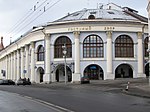
The Old Merchant Court (Russian: Старый гостиный двор, Stary gostiny dvor) in Moscow occupies a substantial portion of Kitai-gorod, as the old merchant district is known. It located near the famous Red Square, a few hundred metres away. Formerly accommodating both shops and warehouses, it was constructed of brick in the 1590s and underwent significant modifications from 1638–1641. As the Russian capital expanded and the old structure became overcrowded, a new indoor market was completed nearby in 1665. Giacomo Quarenghi, the favored architect of Catherine the Great, in 1789 replaced those medieval buildings with a new shopping mall designed in a sober Neoclassical style with innumerable Corinthian columns and arcades. Several local Moscow architects including S. Karin, I. Egotov and P. Selihov supervised the actual construction. The first phase was delayed because of the death of Catherine the Great and was not completed until 1805. Osip Bove made some modifications to adapt to the slope in the area and to finish following Quarenghi's original plans in 1830.Subsequently, Quarenghi's structure went through many reconstructions. After the Revolution in 1923, the space was subdivided into offices altering the original design significantly. In 1995 a modern glass roof was installed, when the building was being converted into a fashionable exhibition ground. Nowadays, the edifice is used as the setting for fashion shows, business parties, and even Viennese balls. Montserrat Caballé and José Carreras were among those who performed at the New Year parties in Gostiny Dvor.During the 1995 renovations, much archeological work was done on the site. A small museum was established to exhibit some of the numerous finds which include the contents of a pantry from a 17th-century merchant home that had been destroyed by fire. The exhibit hall is open for the public, Monday through Saturday from 11 a.m. until 5 p.m.

Ascension Convent
Ascension Convent

Ascension Convent, known as the Starodevichy Convent or Old Maidens' Convent until 1817 (Russian: Вознесенский монастырь, Voznesensky monastyr'), was an Orthodox nunnery in the Moscow Kremlin which contained the burials of grand princesses, tsarinas, and other noble ladies from the Muscovite royal court. It is believed that Ascension Convent was founded in 1389 next to the Saviour Gates of the Kremlin by Dmitry Donskoy's widow, Eudoxia Dmitriyevna, who would take the veil there. The foundation stone for the cathedral was laid in 1407, just before her death. Eight years later, the cathedral was gutted by fire and then rebuilt in 1467 by princess Maria of Borovsk, wife of Vasili II of Russia. Sixteen years later the convent was again damaged by fire and then restored in 1518–1519 to a design by Aloisio the New. This church was completely rebuilt in 1587–1588, when a new five-domed structure, mirroring the nearby Archangel Cathedral, was erected. It was a major monument to embody the conservative architectural approach of Boris Godunov's circle (illustrated, to the right). Among those buried in the cathedral vault were Sophia Vitovtovna (wife of Vasili I), Sophia Paleologue (wife of Ivan III), several wives of Ivan the Terrible, Grand Duchess Eudoxia Alexeyevna (daughter of Alexei Mikhailovich), and tsarina Maria Vladimirovna (first wife of Mikhail Feodorovich). The convent was also used as a residence for royal fiancees prior to the wedding. It was there that Ivan IV's widow, Maria Nagaya, greeted Marina Mnishek, who would spend there a few days before her wedding with Nagaya's purported son, False Dmitry I. In 1634, Michael I of Russia commissioned a new convent church to be built and dedicated to his patron saint, Michael Maleinos. A belltower next to this church was constructed in the late 17th century. The Church of Michael Maleinos used to be home to a rare sculpture of St George, made by Vasili Yermolin and installed there in 1808. In 1721, the convent was renovated on behest of Peter the Great. In 1737, it was damaged by fire and again renovated by the order of Anna Ioannovna. During the Patriotic War of 1812, the sacristy of Ascension Convent, with the Icon of the Virgin Hodegetria, painted by Dionisius in 1482, was moved to Vologda. A two-storey almshouse was added in 1823. But the most important 19th-century addition was the Church of Saint Catherine, built to a fanciful Neo-Gothic design by Carlo Rossi (illustrated, to the right). By 1907, the monastery had a mother superior, 62 nuns and 45 lay sisters. Ten years later, the ancient buildings were damaged by artillery fire during the October Revolution. In 1929, the convent complex - including the majestic 16th-century cathedral - was dismantled by the Soviets in order to make room for the Red Commanders School, named after the All-Russian Central Executive Committee. Some of the icons of Ascension Convent were made over to the State Tretyakov Gallery and State museums of the Moscow Kremlin. The iconostasis of the Ascension Cathedral was moved into the Cathedral of Twelve Apostles (also in the Kremlin), while the tombs of the Muscovite royalty were transferred into an annex of the Archangel Cathedral, where they reside to this day.

2023 Presidential Address to the Federal Assembly

On 21 February 2023, almost a year after Russia launched a full-scale invasion of Ukraine, Russian president Vladimir Putin delivered an address to the Federal Assembly, at Gostiny Dvor in Moscow, Russia. This was the first Presidential Address to the Federal Assembly since the start of the invasion; Putin did not deliver such an address in 2022.During the address, Putin asserted that the West had started the war, and that Russia had been using force to end it. He stated that the Ukrainian people were hostages of the Ukrainian government. Putin also said that the West had planned to turn a local conflict into a global one, and that the conflict represented an existential threat to Russia. He added that it was impossible to defeat Russia, and vowed to continue fighting in Ukraine. He also praised the people of Luhansk, Donetsk, Kherson, and Zaporizhzhia for the choice they made during the previous year's annexation referendums. Near the end of his speech, Putin announced that Russia would be suspending its participation in the nuclear disarmament treaty New START.Putin's address was simultaneously broadcast on television and in schools and government buildings, as well as displayed on large screens in public places in Russia and the occupied territories of Ukraine. It was delivered a day after U.S. president Joe Biden had made a surprise visit to Kyiv, his first to Ukraine since the start of the invasion. Biden also delivered a speech in Warsaw, Poland, hours after Putin had made his presidential address. The following day, Putin made a brief appearance at a rally at Luzhniki Stadium in Moscow commemorating Defender of the Fatherland Day.