place

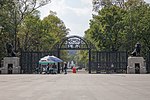
Chapultepec metro station

1969 establishments in MexicoMexico City Metro Line 1 stationsMexico City Metro stations in Cuauhtémoc, Mexico CityRailway stations opened in 1969
MetroChapultepecTrack

Chapultepec is a station on the Mexico City Metro. It is located in the Cuauhtémoc borough in the center of Mexico City. In 2019, the station had an average ridership of 57,873 passengers per day, making it the 14th busiest station in the network.

Excerpt from the Wikipedia article Chapultepec metro station (License: CC BY-SA 3.0, Authors, Images).

Chapultepec metro station
Avenida Chapultepec, Mexico City

Geographical coordinates (GPS) Address Nearby Places
placeShow on map

Wikipedia: Chapultepec metro stationContinue reading on Wikipedia

Geographical coordinates (GPS)

Latitude Longitude
N 19.420783 ° E -99.176288 °
placeShow on map

Address

Avenida Chapultepec (Eje 1 Sur;Eje Vial 1 Sur)

Avenida Chapultepec
06600 Mexico City
Mexico
mapOpen on Google Maps

MetroChapultepecTrack
Share experience

Nearby Places

Torre del Caballito
Torre del Caballito

Torre del Caballito is a skyscraper located on the Paseo de la Reforma #10 at the Cuauhtemoc delegation in Mexico City. It was designed by Grupo Posadas de Mexico. It is 135 metres (443 feet) and 35 storeys tall. 33 of the floors are used as office space which measures 60,000 square meters. It also has 15 underground parking levels. The building's total area is 131,000 square meters. The building houses the offices of MPs and senators. Torre Prisma, Edificio El Moro, the Melia Mexico Reforma Hotel, and the Fuente de la Republica are located nearby. The building is equipped with 20 high-speed elevators which move at 6.3 meters per second. In 1978 construction began with an ambitious project of a hotel which would have stood 220 metres 60 floors tall and have 700 rooms. It would be owned by the Holiday Inn chain. Due to Mexico's unstable political and economic conditions, construction was stopped several times. The works resumed in 1984 with the central concrete structure reaching 40 meters high. The metallic-structure assembly began but all works stopped again for a year. Works were delayed further when the main crane and some concrete elements were partially destroyed by the 1985 Mexico City earthquake. The damaged crane was moved away and the hotel project was cancelled altogether. In 1987, the damaged concrete and steel components were repaired and the height was shortened to 134 metres and by the end of 1988 construction was completed at last with a black mirror facade covering the structure. Due to Mexico City's high propensity to earthquakes, the tower incorporates several anti-earthquake measures such as the inclusion of 70 seismic shocks. It is anchored to the ground with 185 concrete piles which penetrate 60 meters surpassing the old swampy landfill lake below Mexico City. The tower could support other 25 floors if needed, though it is not planned to do so. The building is currently owned by Fibra Mexicana de Inmuebles (FIBRAMEX).

Torre Mayor
Torre Mayor

The Torre Mayor (literally "Major Tower") is a skyscraper in Mexico City, Mexico. With a height of 225 meters (738 feet) to the top floor and 55 stories, it is the third tallest building in Mexico. It was surpassed in height by Torre BBVA Bancomer in 2015, which in turn was surpassed by Torre Reforma. From its completion in 2003 until 2010 (when it was surpassed by the residential 236 meter (774 ft) high Ocean Two in Panama City, Panama) it was also the tallest building in Latin America. The Torre Mayor was developed by Canadian businessman Paul Reichmann, who also maintained part ownership until his death in 2013. It is also part-owned by a group of institutional investors. The building was designed by the architectural firms of Zeidler Partnership Architects and Executive Architects Adamson Associates Architects, both of Toronto. The structural engineers and designers were The Cantor Seinuk Group from New York City in association with Enrique Martínez Romero S.A. in Mexico City (Engineering News-Record, 30 June 2003). Located at Paseo de la Reforma, it was built by Canadian-owned Reichmann International on the former location of the Cine Chapultepec. Construction work began in 1999 and was finished in late 2003. Due to Mexico City's high propensity to earthquakes, the tower incorporates several anti-earthquake measures. Torre Mayor is one of the strongest buildings on Earth in terms of earthquake resistance, being designed to withstand earthquakes measuring 8.5 on the Richter Scale. The U.S. Bank Tower in earthquake prone Los Angeles, California by comparison, is designed to withstand an 8.3 intensity earthquake.

Obelisco a los Niños Héroes

The Obelisco a los Niños Héroes is a monument installed in Chapultepec, Mexico City. The cenotaph was created in 1881 by architect Ramón Rodríguez Arangoity, one of the cadets captured in the Battle of Chapultepec. The marble cenotaph was a typical nineteenth-century monument. This one lists the names of the six cadets, the Niños Héroes, killed in the fierce fighting in the Mexican-American War as military cadets defended as well as the 40 who survived the attack. For his own political purposes, General Porfirio Díaz inaugurated the monument with a military and civilian audience of dignitaries. Subsequently, the obelisk became an annual site of remembrance for the Association of the Military College, a group of veterans who had been cadets. This modest-sized monument was superseded in 1952 by the massive Monumento a los Niños Héroes. The prisoners of the First Company were Captain Domingo Alvarado; Lieutenants José Espinosa, Agustín de la Peza; Cabo José T. de Cuellar; and Tambor Simón Álvarez; Cadets Francisco Molina, Mariano Covarrubias, Bartolomé Díaz León, Ignacio Molina, Antonio Sierra, Justino García, Lorenzo Pérez Castro, Agustín Camarena, Ignacio Ortiz, Manuel Ramírez de Arellano, Carlos Bejarano, Isidro Hernández, Esteban Zamora, Santiago Hernández, Ignacio Burgoa Lagos and Ramón Rodríguez Arangoity. Prisoners of Second Company were Lieutenant Joaquín Argaez; Sargeant Teófilo Noris; Corneta Antonio Rodríguez; Cadet alumni Joaquín Moreno, Pablo Banuet, Ignacio Valle, Francisco Leso, Antonio Sola, Sebastián Trejo, Luis Delgado, Ruperto Pérez de León, Cástulo García, Feliciano Contreras, Francisco Morelos, Miguel Miramón, Gabino Montesdedca, Luciano Becerra, Adolfo Unda, Manuel Díaz, Francisco Morel, Vicente Herrera, Onofre Capelo, Magdaleno Yta and Emilio Laurent.