place

Missionary Church and Monastery, Lublin

Churches in LublinPolish church stubs

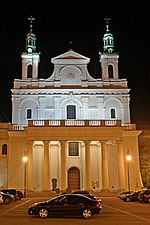
Post-missionary church and monastery in Lublin - the church of the Transfiguration of Our Lord in Lublin was erected in the years 1717–1730 for a seminary of the Congregation of the Mission, after the suppression of the monastery by Russians during the time of the Partitions of Poland taken over by the diocese. It was built in the Baroque style, laid out on the plan of a Greek cross with a cupola above the transept. The 19th century neo-Gothic chapel adjacent to the church has a modern iconostasis designed by Jerzy Nowosielski and is today used by Greek Catholic alumni. The palace from the first half of the 17th century, with its relief decorated with scenes from Polish history is the oldest part of the monastery. The Neo-Baroque monumental wing of the monastery, designed by Władysław Siennicki, dates back to 1908. The complex is surrounded with a 19th-century neo-Gothic wall.

Excerpt from the Wikipedia article Missionary Church and Monastery, Lublin (License: CC BY-SA 3.0, Authors).

Missionary Church and Monastery, Lublin
Misjonarska, Lublin Stare Miasto

Geographical coordinates (GPS) Address Nearby Places
placeShow on map

Wikipedia: Missionary Church and Monastery, LublinContinue reading on Wikipedia

Geographical coordinates (GPS)

Latitude Longitude
N 51.245077777778 ° E 22.569033333333 °
placeShow on map

Address

Misjonarska 1
20-107 Lublin, Stare Miasto
Lublin Voivodeship, Poland
mapOpen on Google Maps

Share experience

Nearby Places

Lublin
Lublin

Lublin is the ninth-largest city in Poland and the second-largest city of historical Lesser Poland. It is the capital and the centre of Lublin Voivodeship with a population of 336,339 (December 2021). Lublin is the largest Polish city east of the Vistula River and is about 170 km (106 mi) to the southeast of Warsaw by road. One of the events that greatly contributed to the city's development was the Polish-Lithuanian Union of Krewo in 1385. Lublin thrived as a centre of trade and commerce due to its strategic location on the route between Vilnius and Kraków; the inhabitants had the privilege of free trade in the Grand Duchy of Lithuania. The Lublin Parliament session of 1569 led to the creation of a real union between the Crown of the Kingdom of Poland and the Grand Duchy of Lithuania, thus creating the Polish–Lithuanian Commonwealth. Lublin witnessed the early stages of Reformation in the 16th century. A Calvinist congregation was founded and groups of radical Arians appeared in the city, making it an important global centre of Arianism.Until the partitions at the end of the 18th century, Lublin was a royal city of the Crown Kingdom of Poland. Its delegates and nobles had the right to participate in the royal election. In 1578, Lublin was chosen as the seat of the Crown Tribunal, the highest appeal court in the Polish–Lithuanian Commonwealth, and for centuries, the city has been flourishing as a centre of culture and higher learning. In 2011, the analytical Financial Times Group found Lublin to be one of the best cities for business in Poland. The Foreign Direct Investment ranking placed Lublin second among larger Polish cities in the cost-effectiveness category. Lublin is noted for its green spaces and a high standard of living; the city has been selected as the 2023 European Youth Capital. Its historical Old Town is one of Poland's national monuments (Pomnik historii) tracked by the National Heritage Board of Poland.