place

Sejong City

2007 establishments in South KoreaAutonomous citiesPages including recorded pronunciationsPages with Korean IPAPages with disabled graphs
Pages with non-numeric formatnum argumentsPlanned capitalsPlanned communities in South KoreaSejong CitySelf-governanceSmart cities
Hannuridaero and Bangchukcheon

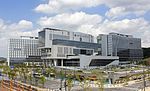
Sejong or Sejong City (Korean: [seːdʑoŋ] ; Korean: 세종; Hanja: 世宗), officially the Sejong Special Self-Governing City (세종특별자치시; 世宗特別自治市), is a special self-governing city and the de facto administrative capital of South Korea. Sejong was founded in 2007 as the new planned capital of South Korea from many parts of the South Chungcheong province and some parts of North Chungcheong province to ease congestion in South Korea's current capital and largest city, Seoul, and encourage investment in the country's central region. Since 2012, the government of South Korea has relocated numerous ministries and agencies to Sejong, but many still reside in other cities, primarily Seoul, where the National Assembly and many important government bodies remain. Sejong has a population of 351,007 as of 2020 and covers a geographic area of 465.23 km2 (179.63 sq mi), making it the least-populous and smallest first-level administrative division in South Korea. Sejong is located in the west-central Hoseo region, bordering South Chungcheong to the west, Daejeon Metropolitan City to the south, and North Chungcheong to the east. The construction of the city is expected to be completed in 2030, at which time 500,000 people are expected to live there.

Excerpt from the Wikipedia article Sejong City (License: CC BY-SA 3.0, Authors, Images).

Geographical coordinates (GPS)

Latitude Longitude
N 36.487002 ° E 127.282234 °
placeShow on map

Address


30106 Sejong (Naseong-dong)
South Korea
mapOpen on Google Maps

Hannuridaero and Bangchukcheon
Share experience

Nearby Places

Battle of Taejon
Battle of Taejon

The Battle of Taejon (16–20 July 1950) was an early battle of the Korean War, between U.S. and North Korean forces. Forces of the United States Army attempted to defend the headquarters of the 24th Infantry Division. The 24th Infantry Division was overwhelmed by numerically superior forces of the Korean People's Army (KPA) at the major city and transportation hub of Taejon, now spelled as Daejeon. The 24th Infantry Division's regiments were already exhausted from the previous two weeks of delaying actions to stem the advance of the KPA. The entire 24th Division gathered to make a final stand around Taejon, holding a line along the Kum River to the east of the city. Hampered by a lack of communication and equipment, and a shortage of heavy weapons to match the KPA's firepower, the outnumbered, ill-equipped and inexperienced U.S. forces were pushed back from the riverbank after several days before fighting an intense urban battle to defend the city. After a fierce three-day struggle, the U.S. withdrew. Although they could not hold the city, the 24th Infantry Division achieved a strategic victory by delaying the North Koreans, providing time for other U.S. divisions to establish a defensive perimeter around Pusan further south. The delay imposed at Taejon probably prevented a U.S. rout during the subsequent Battle of Pusan Perimeter. During the action, the KPA captured Major General William F. Dean, the commander of the 24th Infantry Division, and highest ranking U.S. prisoner during the Korean War.

Chaplain–Medic massacre

The Chaplain–Medic massacre took place in the Korean War on July 16, 1950, on a mountain above the village of Tuman (current Duman-ri, Geumnam-myeon, Sejong City). Contrast to U.S. Army's official history, South Korean local natives claimed that it took place on a mountain above the village of Yongdam-ri, which is next to Duman-ri. Thirty unarmed, critically wounded United States Army (US) soldiers and an unarmed chaplain were murdered by members of the Korean People's Army (KPA) during the Battle of the Kum River. Operating at the Kum River, troops of the US 19th Infantry Regiment, 24th Infantry Division, were cut off from resupply by a roadblock established by KPA troops of the 3rd Division. The roadblock proved difficult to break, and forced US troops to move through nearby mountains to evacuate their wounded. Thirty critically wounded US troops were stranded at the top of a mountain. Attended to by only two non-combatants, a chaplain and a medic, the wounded were discovered by a KPA patrol. Though the medic was able to escape, the KPA executed the unarmed chaplain as he prayed over the wounded, then killed the rest of them. The massacre was one of several incidents that led US commanders to establish a commission in July to look into war crimes during the war. The same month, the KPA commanders, concerned about the way their soldiers were treating prisoners of war, laid out stricter guidelines for handling enemy captives. Other than this change, the historiography of the incident in North Korean sources is largely unknown; as a result, sources detailing the incident are almost exclusively from the United States and other United Nations allies.