place

Roman Catholic Diocese of Dunedin

1869 establishments in New ZealandChristianity in DunedinOceanian Roman Catholic diocese stubsReligious organizations established in 1869Roman Catholic bishops of Dunedin
Roman Catholic dioceses and prelatures established in the 19th centuryRoman Catholic dioceses in New Zealand
StJosephsDunedin
StJosephsDunedin

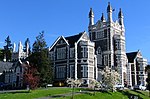
The Latin Rite Roman Catholic Diocese of Dunedin is a suffragan diocese of the Roman Catholic Archdiocese of Wellington. Its cathedral and see city are located in Dunedin, the second-largest city in the South Island of New Zealand. It was formed on 26 November 1869 from a portion of the territory in the Diocese of Wellington, before it was elevated to an archdiocese.

Excerpt from the Wikipedia article Roman Catholic Diocese of Dunedin (License: CC BY-SA 3.0, Authors, Images).

Roman Catholic Diocese of Dunedin
Rattray Street, Dunedin Dunedin Central

Geographical coordinates (GPS) Address Phone number Nearby Places
placeShow on map

Wikipedia: Roman Catholic Diocese of DunedinContinue reading on Wikipedia

Geographical coordinates (GPS)

Latitude Longitude
N -45.87444 ° E 170.497942 °
placeShow on map

Address

St Joseph's Cathedral

Rattray Street 300
9016 Dunedin, Dunedin Central
Otago, New Zealand
mapOpen on Google Maps

Phone number

call+64034776030

StJosephsDunedin
StJosephsDunedin
Share experience

Nearby Places

Arthur Street Cemetery

Arthur Street cemetery was the first cemetery built in Dunedin, New Zealand. It is situated on the City Rise, on the corner of Arthur Street and Rattray Street, on the slopes overlooking the city's centre, which lies 500 metres to the east. The first burial at the site was of surveyor's labourer James Campbell, buried on October 29, 1846, over a year before the settlement of Dunedin was founded in 1848. Coincidentally, the first christening service to be held in Dunedin occurred on the same day; both services were conducted by Rev. Charles Creed.The cemetery served the young settlement until the early 1860s, when the rapid expansion of Dunedin due to the Central Otago Gold Rush made its location inconvenient. The cemetery was closed and the remains relocated in 1865. The location of the cemetery is marked by an obelisk, erected in 1880, which is modelled on London's Cleopatra's Needle. The monument lists the names of the 60 or so known burials at the site. Many of those buried were children, and several were people who died at sea on their way to New Zealand. The site has been used for several purposes since the cemetery closed, notably a military barracks during the 1860s, a meteorological station, and a lunatic asylum. Middle District School, one of the city's first (now Arthur Street School), moved to occupy part of the site in 1877.The site is now partly in the grounds of Otago Boys' High School and partly a public park, Arthur Street Reserve.

City Rise
City Rise

City Rise is an inner suburb of the New Zealand city of Dunedin. One of the city's older suburbs, it is, as its name suggests, centred on the slopes which lie close to the city centre, particularly those closest to the city's original heart of The Exchange (for this reason, places are said to be on the City Rise rather than in City Rise). Extensive views across the central city can be gained from much of City Rise. The name City Rise is generally applied to the area immediately to the west of Princes Street, especially to the approximately triangular area of one square kilometre bounded by Princes Street and the city's Town Belt, with Maitland Street and Stuart Street lying at the edge of the area. Some parts of the lower slopes at one time carried the name Fernhill, a term still occasionally encountered to refer to this area, arising from the name of the residence of an early settler, Captain Bellairs. Other notable streets on the City Rise include High Street, Rattray Street, Stafford Street, Arthur Street, Canongate, and Serpentine Avenue. The name City Rise is sometime used to cover a wider area extending further to the north along the inner edge of the Town Belt from Stuart Street and Moana Pool as far as the stately house Olveston and to the top of Pitt Street. City Rise contains many of the city's earliest grand residences, notably along High Street and streets close to it. Many of these buildings were built on money which flowed into the infant city at the time of the Central Otago Gold Rush of 1861–1862. Notable houses include Threave (designed by Robert Lawson), Moata, and Colquhouns, among many others. The suburb is bounded by the central city to the east and northeast, by Kensington to the south, and Mornington to the west. The small suburb of Belleknowes lies immediately to the north, beyond which is Roslyn. The suburb is mainly residential, though it also has strong links with the city's education. Otago Boys' High School lies close to Stuart Street in the north of City Rise, and the original site of Otago Polytechnic (or, as it was at the time, King Edward Technical College) is also on the city rise side of Stuart Street. Otago Girls' High School is located closer to the city centre at the edge of City Rise. Arthur Street School is also located in the suburb, close to Otago Boys' High School. Next to Arthur Street School's grounds is a monument on what was the site of Dunedin's first cemetery, Arthur Street Cemetery. There is very little industry centred on City Rise, the most notable exception being Speight's Brewery, which is located at the foot of the rise close to the exchange. Immediately above this is St. Joseph's Cathedral, the city's Roman Catholic cathedral. Notable historical industrial connections with the suburb include Choie (Charles) Sew Hoy's importing company and the Kempthorne Prosser chemical manufacturing company, both of which had their main offices on Stafford Street. From the 1880s until the 1950s, City Rise was served by Dunedin's cable tramway, with lines running up from the Exchange to the hill suburbs of Mornington and Roslyn via Stuart Street and Rattray Street. The tramway was notable for being only the second of its type in the world (after the San Francisco cable car system).

Rialto Cinema, Dunedin

The Rialto Cinema is a multiplex cinema located in the New Zealand city of Dunedin. It was opened in 1998. The Rialto's location is a historic building in Moray Place, some 200 metres southwest of the city centre. The building was designed by noted architect Edmund Anscombe, and was first opened in 1916 as the Empire (later Empire DeLuxe) Theatre. With a 2,000 seat capacity, it was for a while New Zealand's second-largest cinema (after Auckland's St. James Theatre. The building was taken over during the 1920s by Thomas O'Brien, and extensively redesigned in a faux Moorish style, with a twinkling starry interior ceiling and minarets. In the late 1930s, the foyer was remodelled in the then popular Art Deco style.The cinema was operated as part of the Kerridge-Odeon chain of cinemas from the end of World War II until 1993. It was renamed as the St. James Theatre in 1952, undergoing major renovations at the same time, though parts of the earlier Moorish and Art Deco stylings were retained. In 1993 the cinema was closed, and was briefly operated as a nightclub and restaurant whilst a major overhaul was undertaken. The complex reopened as a three-screen multiplex (expanded to five then six in the second half of 2004) under its current name in 1998, at which time it became part of the Rialto Cinemas group. The new renovations by Walker Cinema Architects saw the restoration of much of the original interior including the starry ceiling in the main theatre, as well as the uncovering of several of the Moorish styled interior arches and wrought iron work.The building is listed as a Category I historic place in the registry of the New Zealand Historic Places Trust. In the trust's registry it is noted for its elaborate interior features, and as a rare example of a surviving "atmospheric theatre". Several technological features or historic note are also listed. In its notes on its status as an Atmospheric Theatre, the trust indicate its "use of exotic historic architectural design themes to create the illusion of a romantic courtyard or amphitheatre, and... use of special concealed lighting effects to further the illusion... by creating a night sky effect on the ceiling of the auditorium. The illusion of the courtyard/amphitheatre was cleverly done by creating in plaster the design features of a pergola, such as classical or eastern columns with entablatures or architraves, and blind arcades, again in either classical or exotic eastern architectural forms.... [The structure includes] a ceiling of smooth plaster painted electric blue, and curved from behind the side walls without interruption or blemish. Onto this ceiling the illusion of a night sky was projected."