place

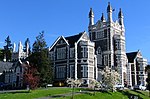
King Edward Technical College

1880s in Dunedin1889 establishments in New ZealandCentral DunedinDefunct universities and colleges in New ZealandEducational institutions established in 1889
Harry Mandeno buildingsHeritage New Zealand Category 1 historic places in OtagoOtago PolytechnicSecondary schools in Dunedin
King Edward Technical College, Dunedin

King Edward Technical College is a former school and technical college in Dunedin, New Zealand. The college was established in 1889 as the Dunedin Technical School when the Caledonian Society instigated night education classes.Through the 1960s and 70s, the school was split up and became Otago Polytechnic and Logan Park High School.

Excerpt from the Wikipedia article King Edward Technical College (License: CC BY-SA 3.0, Authors, Images).

King Edward Technical College
Stuart Street, Dunedin Dunedin Central

Geographical coordinates (GPS) Address Nearby Places
placeShow on map

Wikipedia: King Edward Technical CollegeContinue reading on Wikipedia

Geographical coordinates (GPS)

Latitude Longitude
N -45.8731 ° E 170.4988 °
placeShow on map

Address

Stuart Street 291
9054 Dunedin, Dunedin Central
Otago, New Zealand
mapOpen on Google Maps

King Edward Technical College, Dunedin
Share experience

Nearby Places

Dunedin Town Belt
Dunedin Town Belt

The Town Belt is a green belt which surrounds the centre of the New Zealand city of Dunedin. Covering a total of over 200 hectares (490 acres), it extends around three sides of the city's centre at a distance from it of some 1-3 km (1-2 mi) in a broad 7 km (4 mi) crescent from the Oval at Kensington in the south through the suburbs of Mornington, City Rise, Belleknowes, Roslyn, Maori Hill, Prospect Park, Glenleith, Woodhaugh, The Gardens and Dunedin North and the slopes of Signal Hill. The fourth side of the central city is bounded by the Otago Harbour. One of the world's oldest green belts, the Town Belt was planned in Scotland at the time of the advent of the Otago settlement in 1848. Residential areas outside the belt became separate boroughs, and were not amalgamated with Dunedin until much later. The town belt now forms a break between the city's inner and outer suburbs. The belt was originally a combination of native bush and scrubland, but is now largely replanted forest and open parkland. Many species of plant can be found in the belt, including tree fuchsia, lemonwood, lancewood, manuka, and broadleaf, and the forested area is home to many species of birds, including some uncommon and endangered species such as the kererū, eastern rosella, bellbird, tomtit, tūī, rifleman, morepork, and shining cuckoo, and kōtare. A long, narrow road, Queens Drive, winds along much of the length of the belt and provides easy access to it for Dunedinites. Queens Drive is linked to many of the city's main streets, including Stuart Street and High Street. Numerous walkways lead through the bush and parks, and the belt is a popular recreation area for Dunedinites. The Town Belt includes many open areas and parks, including the Kensington Oval, Dunedin Southern Cemetery, Montecillo Ground, Unity Park, Mornington Ground, Jubilee Park, Belleknowes Golf Course, Robin Hood Park, Littlebourne Ground, Prospect Park, Woodhaugh Gardens, the North Ground, Dunedin Botanic Gardens, Dunedin Northern Cemetery, Logan Park, and the University Oval. Notable buildings and structures in the belt include Moana Pool, Olveston, Otago Boys' High School, and the Beverly-Begg Observatory.

Moana Pool
Moana Pool

Moana Pool is the largest swimming pool in the southern half of New Zealand's South Island. It is located at the corner of Littlebourne Road and Upper Stuart Street close to Otago Boys' High School, on the slopes of Roslyn, overlooking the centre of the city of Dunedin. The pool complex can be seen from much of the city, and commands extensive views over central and coastal Dunedin. The largest of Dunedin's four public pools, Moana Pool was built in the early 1960s on the site of the old Moana Tennis Club, Its name (the Māori word for "sea") is thus coincidentally related to the pool's facilities. It was opened on 14 November 1964. Costing £450,000, the pool was a replacement for the 1914 tepid pools in Lower Moray Place, which were seen as being inadequate for the city's modern needs. Several proposals for new pool facilities were put forward during the 1950s, mainly incorporating a suite of pools and a gymnasium surrounded by a sun terrace. A 1959 proposal, with an indoor main pool and learners' pool and an outdoor diving pool was put forward in 1959, and - with an amendment to place the diving pool under cover - was agreed by the Dunedin City Council. Initial design work by architect Bill Hesson and Ian Ballantyne of the Council's engineering department was completed by mid 1961, and work by Downer & Company began on construction shortly thereafter. The pool complex has undergone several expansions since its opening in 1964, at which time only the main pool and diving pool were complete. The main pool is of Olympic dimensions (50m by 17.5m), and is kept heated to 28.5 degrees Celsius. It can be divided by a moveable bulkhead into two 25m pools; The original diving pool, which is still in use, is 13m by 7.2m with two 1m boards, a 3m board and a high 5m platform. The learners' pool was competed and opened in 1965, and a small restaurant was added to the facilities in the same year. Between 1984 and 1990, two hydroslides were added to the complex, and additions to the learners pool to encourage young families were also made. The restaurant was removed in 1991, replaced by gym facilities, and the sun terrace was revamped, removing two trampolines which had been located there. The gym's facilities were extensively enlarged in 2006.A major expansion to the complex in 2000–01 was undertaken under the supervision of city council architect Robert Tongue. This removed much of the sun terrace, replacing it with a wave pool and leisure complex, revamped and upgraded much of the complex's reception area, and extended the main pool complex with the addition of new, Olympic-standard, diving facilities. The new 25m by 14m dive/lap pool includes three platforms (10, 7.5, and 5 metre) and four springboards (two at 3 metres, two at one metre). When not in use for diving, this pool converts into s six-lane lap pool.Moana Pool has been used for regional and national championships in swimming, diving, and water polo, and is a regular host of the New Zealand Masters' Games, which are held in Dunedin every two years. Two of the pools within the Moana Pool complex were renamed in November 2010 to honour double-Olympic gold medallist Danyon Loader and noted coach Duncan Laing, who spent much of their careers training and working at Moana Pool.

Rialto Cinema, Dunedin

The Rialto Cinema is a multiplex cinema located in the New Zealand city of Dunedin. It was opened in 1998. The Rialto's location is a historic building in Moray Place, some 200 metres southwest of the city centre. The building was designed by noted architect Edmund Anscombe, and was first opened in 1916 as the Empire (later Empire DeLuxe) Theatre. With a 2,000 seat capacity, it was for a while New Zealand's second-largest cinema (after Auckland's St. James Theatre. The building was taken over during the 1920s by Thomas O'Brien, and extensively redesigned in a faux Moorish style, with a twinkling starry interior ceiling and minarets. In the late 1930s, the foyer was remodelled in the then popular Art Deco style.The cinema was operated as part of the Kerridge-Odeon chain of cinemas from the end of World War II until 1993. It was renamed as the St. James Theatre in 1952, undergoing major renovations at the same time, though parts of the earlier Moorish and Art Deco stylings were retained. In 1993 the cinema was closed, and was briefly operated as a nightclub and restaurant whilst a major overhaul was undertaken. The complex reopened as a three-screen multiplex (expanded to five then six in the second half of 2004) under its current name in 1998, at which time it became part of the Rialto Cinemas group. The new renovations by Walker Cinema Architects saw the restoration of much of the original interior including the starry ceiling in the main theatre, as well as the uncovering of several of the Moorish styled interior arches and wrought iron work.The building is listed as a Category I historic place in the registry of the New Zealand Historic Places Trust. In the trust's registry it is noted for its elaborate interior features, and as a rare example of a surviving "atmospheric theatre". Several technological features or historic note are also listed. In its notes on its status as an Atmospheric Theatre, the trust indicate its "use of exotic historic architectural design themes to create the illusion of a romantic courtyard or amphitheatre, and... use of special concealed lighting effects to further the illusion... by creating a night sky effect on the ceiling of the auditorium. The illusion of the courtyard/amphitheatre was cleverly done by creating in plaster the design features of a pergola, such as classical or eastern columns with entablatures or architraves, and blind arcades, again in either classical or exotic eastern architectural forms.... [The structure includes] a ceiling of smooth plaster painted electric blue, and curved from behind the side walls without interruption or blemish. Onto this ceiling the illusion of a night sky was projected."