place

Busan Lotte Town Tower

Buildings and structures in BusanBuildings and structures under construction in South KoreaLotte CorporationSkidmore, Owings & Merrill buildingsSkyscrapers in Busan
South Korean building and structure stubsTourist attractions in BusanTowers in South Korea

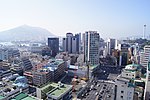
The Busan Lotte Town Tower, also known as Busan Lotte World Tower (Hangul: 부산 롯데 타운 타워) is a 108-floor, 510.1 m (1,674 ft) supertall skyscraper on hold in Busan, South Korea. The tower is planned on a site next to Nampo-dong station on Busan Subway Line 1 .The tower is the centerpiece of the new Busan Lotte Town and construction is being carried out in four phases. The first phase includes a department store, completed in 2009. During the second phase, an addition to the department store was completed in 2010. The third phase will be a market and a cinema, which was completed in 2014, and the last phase will include a luxury hotel, an observation deck, offices, and cultural facilities in a 107-story skyscraper. The design of the skyscraper is intended to resemble a standing ship, in reference to the city's harbour. The tower's underground parking space will be able to house over 2,400 cars. The tower will contain retail outlets (floors 1–11), offices (12-36), residences (41-78), a luxury hotel (82-104), and public access floors (107-110) with an observation deck. In September 2013, the construction work was stopped due to the lack of funding. As of August 2023, construction has resumed, with the facility now being estimated to be complete by 2025.

Excerpt from the Wikipedia article Busan Lotte Town Tower (License: CC BY-SA 3.0, Authors).

Busan Lotte Town Tower
Busandaegyo Bridge, Busan Jungang-dong

Geographical coordinates (GPS) Address Nearby Places
placeShow on map

Wikipedia: Busan Lotte Town TowerContinue reading on Wikipedia

Geographical coordinates (GPS)

Latitude Longitude
N 35.097516666667 ° E 129.03731666667 °
placeShow on map

Address

부산대교

Busandaegyo Bridge
49037 Busan, Jungang-dong
South Korea
mapOpen on Google Maps

Share experience

Nearby Places

Battle of the Pusan Perimeter

The Battle of the Pusan Perimeter (Korean: 부산 교두보 전투), known in Korean as the Battle of the Naktong River Defense Line (Korean: 낙동강 방어선 전투), was a large-scale battle between United Nations Command (UN) and North Korean forces lasting from August 4 to September 18, 1950. It was one of the first major engagements of the Korean War. An army of 140,000 UN troops, having been pushed south to the brink of defeat, were rallied to make a final stand against the invading Korean People's Army (KPA), 98,000 men strong. UN forces, having been repeatedly defeated by the advancing KPA, were forced back to the "Pusan Perimeter", a 140-mile (230 km) defense line around an area on the southeastern tip of South Korea that included the port of Busan. The UN troops, consisting mostly of forces from the Republic of Korea Army (ROKA), United States, and United Kingdom, mounted a last stand around the perimeter, fighting off repeated KPA attacks for six weeks as they were engaged around the cities of Taegu, Masan, and Pohang and the Naktong River. The massive KPA assaults were unsuccessful in forcing the UN troops back farther from the perimeter, despite two major pushes in August and September. North Korean troops, hampered by supply shortages and massive losses, continually staged attacks on UN forces in an attempt to penetrate the perimeter and collapse the line. The UN forces, however, used the port to amass an overwhelming advantage in troops, equipment, and logistics, and its navy and air forces remained unchallenged by the KPA during the fight. After six weeks, the KPA force collapsed and retreated in defeat after the UN force launched a counterattack at Inchon on September 15 and the UN forces in the perimeter broke out from the perimeter the following day. The battle would be the farthest the KPA would advance in the war, as subsequent fighting ground the war into a stalemate.

Great Naktong Offensive

The Great Naktong Offensive was a North Korean military offensive against United Nations Command (UN) forces early in the Korean War, taking place from September 1–15, 1950. It was the North Korean Korean People's Army (KPA)'s unsuccessful final bid to break the Pusan Perimeter established by the UN forces. For the first several months of the war, the KPA successfully defeated and pushed back the UN forces south at each encounter. However, by August the UN troops (which were composed mostly of troops from the United States (US) and Republic of Korea Army (ROK) had been forced into the 140-mile (230 km) Pusan Perimeter on the southeast tip of the Korean peninsula. For the first time, the UN troops formed a continuous line which the KPA could neither flank nor overwhelm with superior numbers. KPA offensives on the perimeter were stalled and by the end of August all momentum was lost. Seeing the danger in a prolonged conflict along the perimeter, the KPA sought a massive offensive for September to collapse the UN line. The KPA subsequently planned a simultaneous offensive for their entire army along five axes of the perimeter; and on September 1 intense fighting erupted around the cities of Masan, Kyongju, Taegu, Yongch'on and the Naktong Bulge. What followed was two weeks of extremely brutal fighting as the two sides vied to control the routes into Pusan. Initially successful in some areas, the KPA were unable to hold their gains against the numerically and technologically superior UN force. The KPA, again stalled at the failure of this offensive, was outflanked by the Inchon landings on 15 September and on 16 September the UN forces began their breakout from the Pusan Perimeter.