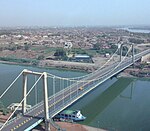
Khartoum or Khartum ( kar-TOOM; Arabic: الخرطوم, romanized: Al-Khurṭūm, pronounced [al.xur.tˤuːm]) is the capital of Sudan. With a population of 6,344,348, Khartoum's metropolitan area is the largest in Sudan.
Khartoum is located at the confluence of the White Nile – flowing north from Lake Victoria – and the Blue Nile, flowing west from Lake Tana in Ethiopia. Divided by these two parts of the Nile, the Khartoum metropolitan area is a tripartite metropolis consisting of Khartoum proper, and linked by bridges to Khartoum North (الخرطوم بحري al-Kharṭūm Baḥrī) and Omdurman (أم درمان Umm Durmān) to the west. The place where the two Niles meet is known as al-Mogran or al-Muqran (المقرن; English: "The Confluence").
Khartoum was founded in 1821, north of the ancient city of Soba. In 1882 the British Empire took control of the Egyptian government, the British left the administration of Sudan in the hands of the Egyptians. At the outbreak of the Mahdist War, the British attempted to evacuate Anglo-Egyptian garrisons from Sudan but the Siege of Khartoum in 1884 resulted in the capture of the city by Mahdist forces and a massacre of the defending Anglo-Egyptian garrison. In 1898 it was reoccupied by British forces, and was the seat of Anglo-Egyptian Sudan's government until 1956.In 1956, the city was designated as the capital of an independent Sudan. Three hostages were killed during the attack on the Saudi Embassy in Khartoum in 1973.
In 2008, the Justice and Equality Movement engaged in combat in the city with the Sudanese Armed Forces as part of the War in Darfur. The Khartoum massacre occurred in 2019 during the Sudanese Revolution. The city saw extensive combat during the 2023 Sudan conflict between the armed forces and the Rapid Support Forces (RSF), affecting Khartoum International Airport and other critical sites.Khartoum is an economic and trade center in North Africa, with rail lines from Port Sudan and El-Obeid. It is served by Khartoum International Airport with the New Khartoum International Airport under construction. Several national and cultural institutions are in Khartoum and its metropolitan area, including the National Museum of Sudan, the Khalifa House Museum, the University of Khartoum, and the Sudan University of Science and Technology.

 Continue reading on Wikipedia