place

Burdwan House

Architecture in BangladeshBangla AcademyBritish colonial architecture in BangladeshBuildings and structures in DhakaHistoric buildings and structures
History of DhakaHouses completed in 1906Museums in DhakaPalaces in BangladeshResidential buildings completed in 1906Tourist attractions in Dhaka
Bangla academy
Bangla academy

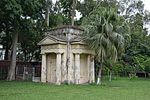
Burdwan House, Bardhaman House or Bordhoman House (Bengali: বর্ধমান হাউস or বর্ধমান হাউজ) is a historic building in Dhaka, Bangladesh. It is currently used as the museum of Bangla Academy. Built in 1906 during the British colonial period, this building, deeply associated with Bangladesh's political, cultural, and language movement history, is a notable example of architecture combining Mughal and European styles. Many prominent figures, including Rabindranath Tagore, Kazi Nazrul Islam, and Sarat Chandra Chattopadhyay, stayed here as guests.

Excerpt from the Wikipedia article Burdwan House (License: CC BY-SA 3.0, Authors, Images).

Burdwan House
Azimpur Road, Dhaka Azimpur

Geographical coordinates (GPS) Address Nearby Places
placeShow on map

Wikipedia: Burdwan HouseContinue reading on Wikipedia

Geographical coordinates (GPS)

Latitude Longitude
N 23.729444444444 ° E 90.397222222222 °
placeShow on map

Address

ঢাকা বিশ্ববিদ্যালয়

Azimpur Road
1211 Dhaka, Azimpur
Dhaka Division, Bangladesh
mapOpen on Google Maps

Bangla academy
Bangla academy
Share experience

Nearby Places

Shaheed Minar, Dhaka

The Shaheed Minar (Bengali: শহীদ মিনার Shohid Minar lit. "Martyr Monument") is a national monument in Dhaka, Bangladesh, established to commemorate those killed during the Bengali Language Movement demonstrations of 1952 in then East Pakistan. On 21 and 22 February 1952, students from Dhaka University and Dhaka Medical College and political activists were killed when the Pakistani police force opened fire on Bengali protesters who were demanding official status for their native tongue, Bengali. The massacre occurred near Dhaka Medical College and Ramna Park in Dhaka. A makeshift monument was erected on 23 February by students of Dhaka medical college and other educational institutions, but soon demolished on 26 February by the Pakistani police force. The Language Movement gained momentum, and after a long struggle, Bengali gained official status in Pakistan (with Urdu) in 1956. To commemorate the dead, the Shaheed Minar was designed and built by Bangladeshi sculptors Hamidur Rahman in collaboration with Novera Ahmed. Construction was delayed by martial law, but the monument was finally completed in 1963, and stood until the Bangladesh Liberation War in 1971, when it was demolished completely during Operation Searchlight. After Bangladesh gained independence later that year, it was rebuilt. It was expanded in 1983. National, mourning, cultural and other activities are held each year on 21 February (Ekushey February) to mark Language Movement Day or Shaheed Dibas (Martyrs' Day), centred on the Shaheed Minar. Since 2000, 21 February is also recognised as International Mother Language Day.