place

Novi Sad railway station canopy collapse

2024 disasters in Serbia21st century in Novi SadBuilding and structure collapses in 2024Building and structure collapses in EuropeNovember 2024 in Serbia
Rail infrastructure in SerbiaTransport disasters in SerbiaTransport in Novi Sad
Novi Sad railway station canopy collapse

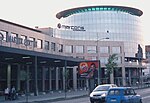
On 1 November 2024, the concrete canopy of the main railway station in Novi Sad, Serbia, collapsed onto the busy pavement below, killing 16 people and severely injuring one more. The station building was constructed in 1964, and was renovated from 2021 to mid-2024 with support from China's Belt and Road Initiative. The cause of the collapse is still under investigation. The collapse spawned a series of mass protests in Novi Sad, which then spread throughout Serbia, fueled by dissatisfaction with other issues including government corruption and media censorship.

Excerpt from the Wikipedia article Novi Sad railway station canopy collapse (License: CC BY-SA 3.0, Authors, Images).

Novi Sad railway station canopy collapse
Bulevar Jase Tomica, Novi Sad МЗ Омалдински покрет

Geographical coordinates (GPS) Address Nearby Places
placeShow on map

Wikipedia: Novi Sad railway station canopy collapseContinue reading on Wikipedia

Geographical coordinates (GPS)

Latitude Longitude
N 45.265555555556 ° E 19.829444444444 °
placeShow on map

Address

Нови Сад

Bulevar Jase Tomica 4
21000 Novi Sad, МЗ Омалдински покрет
Vojvodina, Serbia
mapOpen on Google Maps

Novi Sad railway station canopy collapse
Share experience

Nearby Places

Matica srpska

The Matica srpska (Serbian: Матица српска, Matica srpska, Latin: Matrix Serbica) is the oldest Serbian language independent, non-profit, non-governmental and cultural-scientific Serbian national institution. It was founded on June 1, 1826, in Pest (today a part of Budapest) by the Serbian habsburg legislator Jovan Hadžić and other prominent members of the Serbian Revolution and National Revival. The Matica was moved to Novi Sad in 1864. It is the oldest matica in the world.The main goals are to restore and promote Serbian national and cultural identity in the fields of art, science, spiritual creativity, economy and public life as well as to care for social development of Serbia. The literary and cultural society played a huge role in the flourishing of science and culture of the Serbs of Vojvodina, Serbia. The need for national homogenization, enlightenment, as well as the publication of Serbian books, were the main reasons for the formation of such a Society. The immediate reason for founding Matica Srpska was the need to take over the Serbian Chronicle (later the Chronicle of Matica Srpska), the oldest Serbian literary magazine and then the only Serbian newspaper, which was threatened with extinction. The Matica Srpska Publishing Center has regular publishing activities, including several projects of national importance, such as Ten Centuries of Serbian Literature (Десет векова српске књижевности). Today, in the Palace of Matica srpska in Novi sad more than hundred book presentations, scientific symposia, round table discussions, professional and scientific lectures and concerts of classical music are being organized annually. Matica Srpska is also one of the largest and most important book and magazine publishers in Serbia. Matica Srpska operates on the territory of Croatia, Bosnia and Herzegovina (Republika Srpska) as Association of Members of Matica Srpska in Republika Srpska, as well in Montenegro as Association of members of Matica Srpska in Montenegro. In addition, Matica Srpska operates in Vienna.

Novi Sad Synagogue
Novi Sad Synagogue

Novi Sad Synagogue (Serbian: Новосадска синагога, Novosadska sinagoga) is one of many cultural institutions in Novi Sad, Serbia, in the capital of Serbian the province of Vojvodina. Located on Jevrejska (Jewish) Street, in the city center, the synagogue has been recognized as a historic landmark. It served the local Neolog congregation. The new synagogue, the fifth to be erected at the same location since the 18th century, became a major project for the entire Jewish community of Novi Sad, on which construction began in 1905 and was completed in 1909. Projected by Hungarian architect Baumhorn Lipót, it was part of a bigger complex of buildings that included on both sides of the synagogue two edifices decorated in a similar pattern: One building served as the Jewish school and other as offices of the Jewish community. More than 4,000 Jews lived in Novi Sad before the Second World War, out of a total population of 80,000. Only about 1,000 of them survived the Holocaust that followed the German invasion of Yugoslavia in 1941 and the annexation of Bačka region by Hungary. Many moved to Israel after the war. There are an estimated 400 Jews living in Novi Sad today. Currently, while the synagogue is not used for religious ceremonies, it is used for many cultural concerts and events. In 1991 Novi Sad Synagogue was added to Spatial Cultural-Historical Units of Great Importance list, and it is protected by Republic of Serbia.